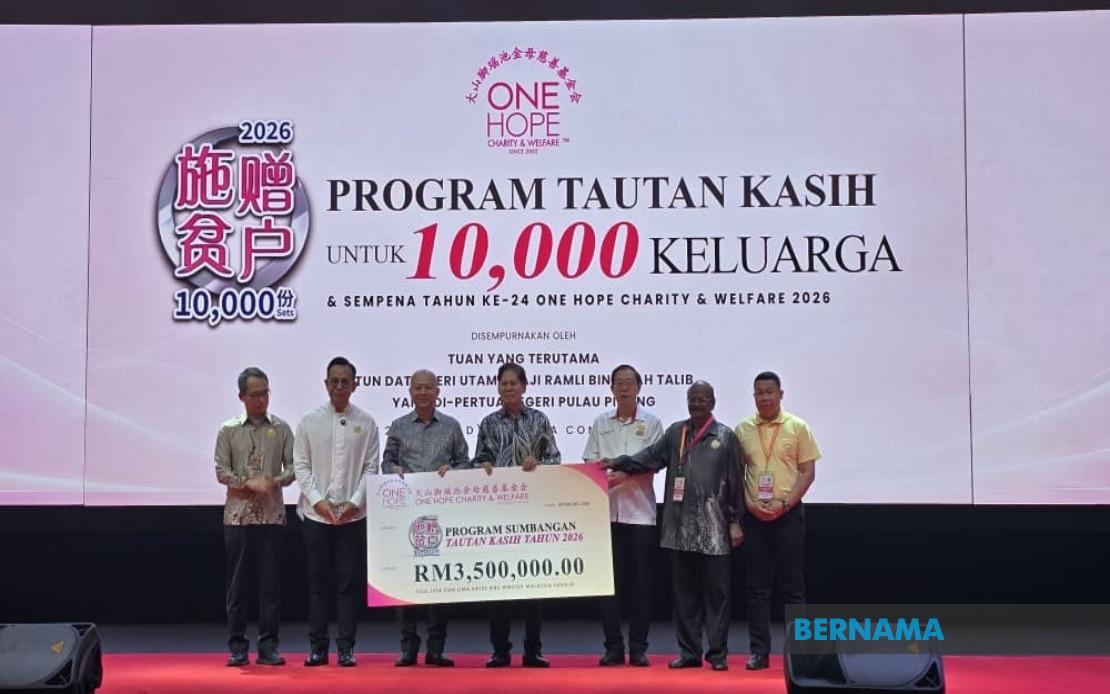
Minister of Entrepreneur Development and Cooperatives Steven Sim Chee Keong has reinforced the government's commitment to strengthening welfare systems across Malaysia, arguing that comprehensive social safety nets are essential to protect citizens navigating economic hardship and personal crises. Speaking at an event in Butterworth, Sim underscored that state advancement cannot be measured solely through economic growth metrics, but must equally encompass genuine improvements in living standards for those most vulnerable to poverty and deprivation.
Sim's remarks underscore a broader philosophical framework within Malaysian policymaking: that prosperity and stability are intertwined with social cohesion and collective responsibility. His observation that life presents unpredictable challenges requiring institutional safeguards reflects recognition that many Malaysians face circumstances beyond their control—joblessness, illness, family breakdown, or unexpected financial shocks. The minister positioned welfare policy not as a temporary relief measure but as a foundational component of a functioning state apparatus capable of maintaining social equilibrium.
The minister highlighted the critical role that civil society organisations play in complementing government efforts. One Hope Charity emerged as a case study demonstrating how private philanthropy and business networks, when properly coordinated, can achieve substantial scale in social assistance. The organisation's trajectory from a modest initiative in Bukit Mertajam to one of Penang and Malaysia's most significant welfare bodies illustrates the potential for non-governmental actors to fill service gaps and reach beneficiaries with tailored support.
Since its inception, One Hope Charity has channelled more than RM100 million across the five-year period from 2021 to 2025, concentrating efforts on medical assistance, hospital support, procurement of medical equipment, and diverse welfare programmes spanning the Penang region and beyond. This substantial financial commitment reflects not only donor confidence but also underlying demand for welfare services, suggesting that government provisions alone may be insufficient to address the full scope of community need.
Founder and chairman Datuk Chua Sui Hau detailed the mechanics of recent assistance distribution, revealing that over 10,000 families benefited from support packages combining essential goods with discretionary cash transfers. The dual-component approach—providing both specified necessities and RM200 in unrestricted cash per family—demonstrates recognition that vulnerable households possess diverse priorities and that centralised decisions about resource allocation may miss individualised circumstances. Each family received approximately RM320 in total assistance, a modest sum underscoring the challenge of scaling welfare reach without proportionally increasing costs.
The approaching 25th anniversary of One Hope Charity has prompted planning for expanded initiatives worth approximately RM30 million, with particular emphasis on broadening the Medical Assistance Programme. This expansion signals anticipated growth in demand for healthcare-related welfare, reflecting both ageing demographics and rising medical costs within lower-income segments of Malaysian society. Healthcare accessibility remains a persistent vulnerability point for disadvantaged populations despite government provision of subsidised services, suggesting market failures in the existing system.
Sim's emphasis on welfare's role in building compassionate society and strengthening cross-communal unity carries particular resonance for Malaysia's multi-ethnic context. By framing welfare initiatives as mechanisms for bridging racial and religious divides, the minister positioned social assistance beyond mere poverty alleviation toward nation-building. One Hope Charity's explicit commitment to serving beneficiaries regardless of ethnic background, religious identity, or political affiliation exemplifies this integrative approach, though such neutral positioning remains uncommon in Malaysian social services where communal-based organisations historically dominate welfare provision.
The presence of Penang Governor Tun Ramli Ngah Talib and his wife at the event underscored official state-level endorsement of welfare initiatives, signalling alignment between state administration and private philanthropy. Such high-level participation reflects growing recognition that welfare challenges require coordinated responses spanning government, business, civil society, and community sectors. The governor's presence also indicates that Penang state government views organisations like One Hope Charity as partners in achieving social objectives rather than competitors or supplementary actors.
For Malaysian policymakers, the scale of One Hope Charity's operations raises questions about whether existing welfare infrastructure adequately addresses community needs. The organisation's annual distribution of at least RM20 million, while impressive, must be contextualised against Malaysia's total population of approximately 34 million and estimated poverty rates that, while declining, still affect millions. The emergence of large-scale private welfare organisations may indicate either successful civil society mobilisation or inadequate government provision—likely both factors operate simultaneously across different geographic regions and demographic groups.
The minister's call for ongoing welfare policy strengthening arrives amid broader Southeast Asian discussions about social safety nets in developing economies. Malaysia, positioning itself as an upper-middle income nation, faces pressure to maintain welfare commitments while managing fiscal constraints and competing development priorities. Countries throughout the region grapple with similar tensions between economic growth imperatives and social protection expansion, making Malaysia's welfare approach relevant for regional policy learning.
Looking forward, the strategic emphasis on medical assistance expansion reflects rational prioritisation given that healthcare costs constitute a primary driver of household financial distress across Southeast Asia. By concentrating resources on medical welfare provision, organisations like One Hope Charity address root causes of poverty rather than merely treating symptoms. This targeted approach, when combined with government initiatives, theoretically offers more efficient welfare delivery than universal but thinly-spread programmes.
Sim's remarks also implicitly acknowledge that Malaysia's economic growth has not automatically resolved vulnerability for substantial population segments. The continued need for welfare programmes at the scale demonstrated by One Hope Charity suggests that labour market participation, wage levels, and social mobility remain insufficient buffers against hardship for many households. This reality contradicts assumptions that development automatically eliminates poverty, instead suggesting that deliberate policy interventions remain necessary regardless of aggregate economic performance.
As Malaysia contemplates its welfare architecture for coming years, experiences of organisations like One Hope Charity and government initiatives offer valuable data points for policy refinement. The combination of emergency assistance, medical support, and regular income transfers appears to address multiple vulnerability dimensions, though evidence-based evaluation of programme effectiveness and beneficiary outcomes remains limited in Malaysian public discourse. Strengthening welfare systems will require not only increased resource allocation but also improved data collection and rigorous impact assessment to ensure interventions effectively improve vulnerable communities' circumstances.

