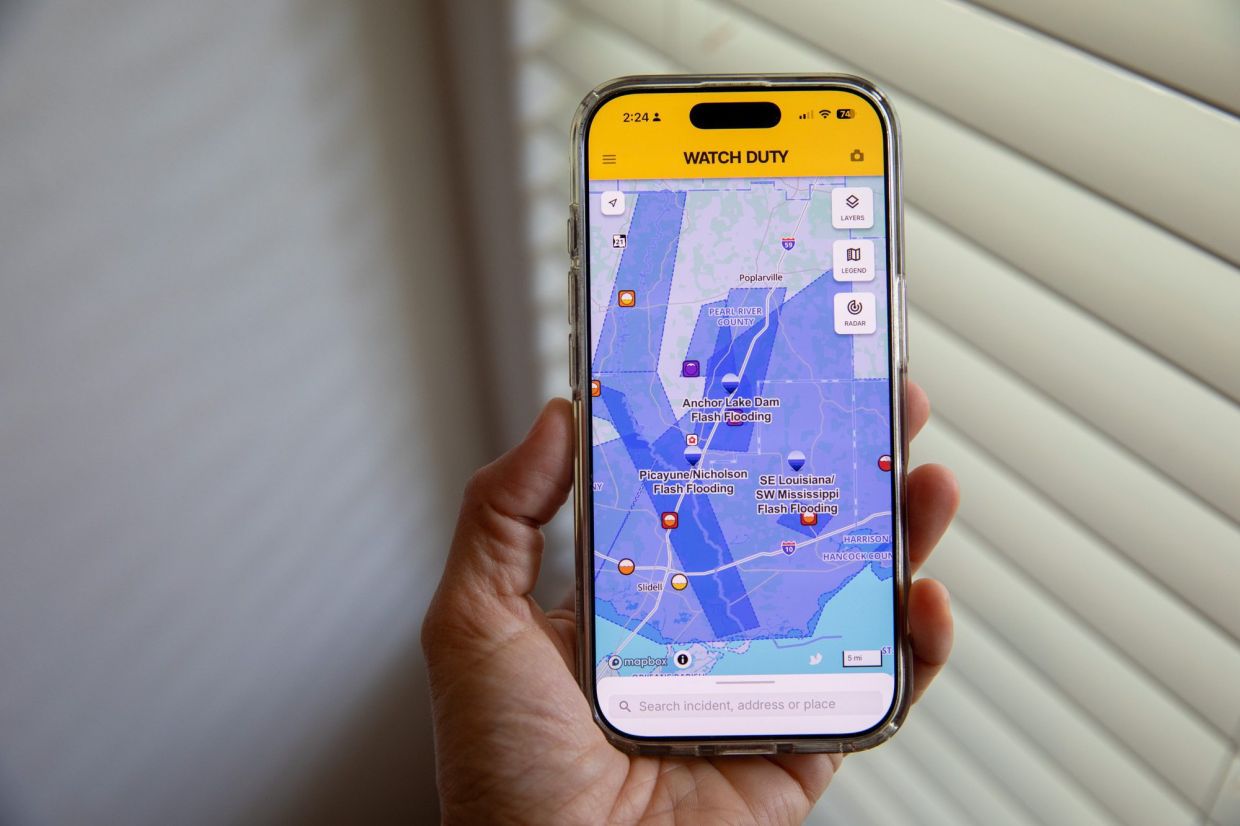
When the Eaton Fire approached his Altadena home on the evening of January 7, 2025, Matt Blea faced an agonising choice: stay put or flee. A rescue worker friend suggested downloading Watch Duty, a free application that displays fire perimeters, evacuation orders and emergency response updates in real time. The information Blea accessed proved decisive—he left with his family before their home was destroyed by the advancing flames. His experience reflects a growing reliance on technological intermediaries to navigate increasingly catastrophic natural disasters, a trend that has profound implications for emergency management across North America and beyond.
Watch Duty became a lifeline for more than 2.5 million people tracking the destructive fires that ravaged Los Angeles County in early 2025. The operation running behind this massive user base was surprisingly modest: approximately twenty staff members working alongside over one hundred volunteers who synthesised information from emergency radio broadcasts, aircraft communications and official agency reports. Among those who depended on the service was David Hertz, captain of a Malibu fire brigade, who viewed the app as instrumental to public safety during the Eaton and Palisades fires, which killed thirty-one people. The fires underscored a critical vulnerability: official warning systems sometimes failed to reach residents in time, leaving communities dangerously uninformed about imminent threats.
The gap between disaster arrival and public notification has become a recurring pattern in American emergency management. In June 2025, Watch Duty began channeling this model toward another catastrophic hazard: flooding. The expansion reflects mounting urgency, particularly as peak flash flood season approaches annually and communities grapple with rainfall patterns that increasingly defy historical precedent. This diversification comes nearly a year after devastating Texas floods killed more than one hundred thirty people, sparking substantial criticism of communication failures that left Hill Country residents and visitors unprepared for rapidly escalating water dangers.
John Mills, the nonprofit's chief executive and co-founder, framed the expansion as a response to systemic breakdown. "This is painful that this keeps happening," Mills stated, emphasising that current information dissemination mechanisms cannot reach people through sufficient channels or with adequate speed. Mills established Watch Duty in 2021 after discovering that official alerts and evacuation instructions failed to reach his own Northern California neighbourhood when wildfire threatened. His observation identified a structural problem: while the United States maintains multiple alert systems encompassing text messages, radio broadcasts and digital platforms, the process of issuing specific warnings often becomes ensnared in bureaucratic procedures that depend on human decision-making under extreme pressure.
The fundamental challenge, Mills argued, is not primarily information scarcity but rather accessibility and utility. Critical data often exists within government systems and agencies, yet remains difficult for ordinary citizens to locate and interpret during emergencies. Recognising this gap, Mills assembled volunteer radio monitors and software engineers to construct a solution, deliberately structuring Watch Duty as a nonprofit to foster public confidence. The approach has attracted substantial support: the organisation received nearly six million US dollars in grants and donations during 2025, enabling expansion across its user base exceeding twenty million people.
Watch Duty's operational structure relies upon approximately three hundred volunteer reporters who aggregate and verify information sourced from radio scanners, satellite imagery, stationary cameras, crowdsourced observations and official announcements. The platform presents data in five languages through interactive maps, text feeds and push notifications calibrated to penetrate even silenced mobile devices. Pete Curran, Watch Duty's meteorologist and retired firefighter, highlighted the operational advantage: users access unified, plainly written information rather than consulting multiple government agencies separately. "You're not going to have to go to multiple other entities, to the weather service, emergency management website, county website," Curran explained. The concentrated focus enables Watch Duty reporters to sometimes disseminate information faster than official agencies, principally because their sole function involves monitoring and communication rather than incident command and operational response.
The flood-tracking expansion deliberately leverages established data infrastructure while acknowledging climate-driven shifts in hydrological patterns. The application integrates weather modelling and forecasting data from the National Weather Service, the National Oceanic and Atmospheric Administration and the US Geologic Survey. Users access National Weather Service flood warnings and watches alongside real-time river gauge measurements and notifications regarding potential dam or levee failures. Critically, Watch Duty enables individuals to understand their baseline risk before disasters strike, permitting residents to identify whether they occupy Federal Emergency Management Agency-designated flood zones and to establish customised alerts keyed to specific river gauge thresholds. Dr Lori Moore-Merrell, the former US Fire Administrator who serves on Watch Duty's board, emphasised that unprecedented rainfall patterns now threaten regions with no historical experience of such events, necessitating heightened public awareness.
Yet technological solutions, however innovative, cannot fully resolve the multifaceted challenges inherent in public emergency communication. Chad Berginnis, executive director of the Association of State Floodplain Managers, articulated a crucial limitation: warnings prove ineffective without corresponding knowledge and capability to respond. The Texas floods demonstrated that possessing information differs fundamentally from understanding what actions to undertake. Berginnis emphasised that residents must know evacuation routes and practice emergency procedures, not merely maintain theoretical plans. Additionally, the national infrastructure supporting weather monitoring and public alerts faces significant budgetary vulnerability stemming from past and proposed federal funding reductions. The reality that effective emergency communication demands sustained investment contradicts the premise that technological innovation alone can substitute for institutional capacity.
Mills deliberately positioned Watch Duty as complementary to, rather than replacive of, official government systems. He stressed that the National Weather Service, professional fire services and established emergency infrastructure remain essential, and he encouraged users to enrol in local alerting systems administered by official agencies. This humble framing acknowledges that proprietary applications possess inherent limitations. A smartphone application benefits only those who download the software and possess cellular coverage during emergencies—preconditions that exclude vulnerable populations lacking smartphone access or residing in areas with inadequate infrastructure. Berginnis similarly cautioned against overreliance on technological solutions, recommending instead that households maintain inexpensive NOAA weather radios as backup systems when digital networks fail. "Sometimes we get so focused on tech, we forget the easy stuff," he observed, highlighting how contemporary disaster management can paradoxically overlook simpler, more reliable alternatives.
The emergence and rapid scaling of Watch Duty reflects genuine anxieties about the adequacy of American emergency management systems facing intensifying climate-related hazards. The application's expansion to flood monitoring signals recognition that extreme weather events will continue accelerating, requiring communication mechanisms that transcend traditional bureaucratic constraints. Yet the app's limitations—dependence on digital literacy, smartphone access and cellular networks—underscore that technological interventions cannot fully substitute for robust public institutional capacity, equitable resource distribution and community-level emergency preparedness. For Malaysian and Southeast Asian observers, Watch Duty exemplifies how private-sector innovation sometimes fills gaps created by stretched government systems, raising questions about whether disaster management should depend substantially upon nonprofit applications or whether governments should prioritise strengthening official alerting infrastructure and funding adequate emergency communications capacity.

