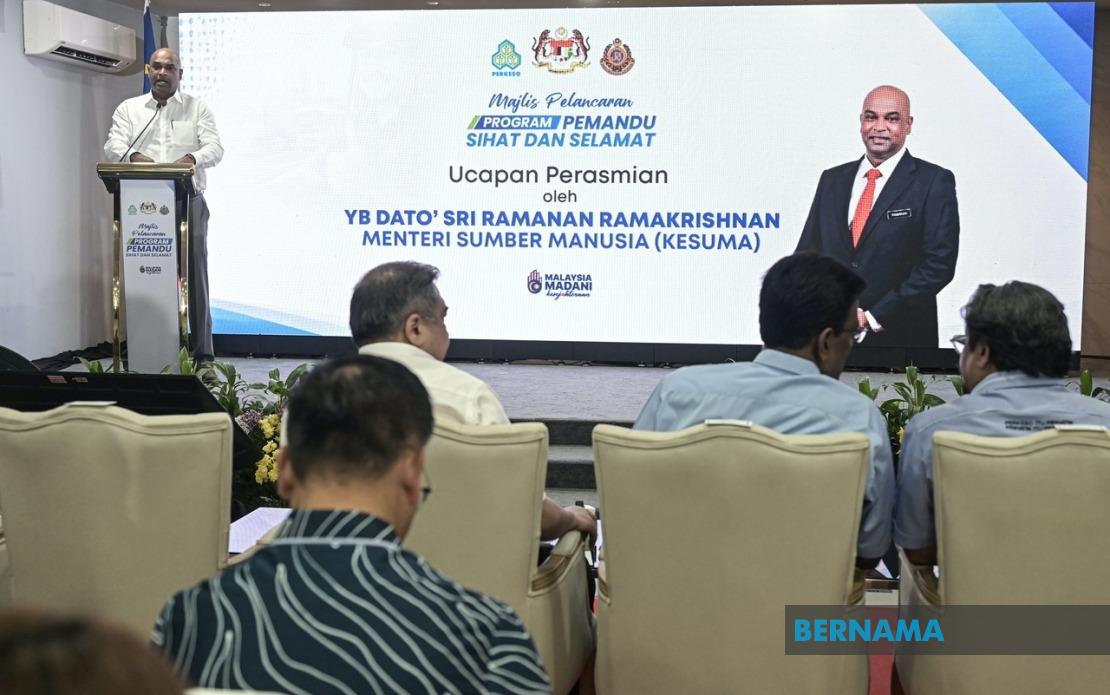
Vocational drivers across Malaysia must now complete a comprehensive health screening to renew their professional licences, marking a significant shift in the country's approach to road safety. The Healthy and Safe Driver Programme, launched by Human Resources Minister Datuk Seri R. Ramanan, represents a collaborative effort between the Ministry of Human Resources and the Ministry of Transport to reduce fatalities among professional road users. The initiative targets an immediate expansion from 500 participating clinics to 3,000 nationwide, reflecting government ambitions to make health assessments accessible to the estimated hundreds of thousands of vocational drivers operating across the country.
The screening protocol encompasses a broad spectrum of health evaluations designed to identify conditions that could impair driving ability. Physical examinations form the foundation, but the programme goes further to assess vision and hearing acuity, critical sensory functions directly linked to accident prevention. Of particular significance is the screening for obstructive sleep apnea and other sleep disorders, conditions that have gained increasing recognition in road safety circles as leading contributors to driver fatigue and microsleep incidents. The assessment also evaluates key organ systems including cardiovascular, respiratory, and neurological function, recognising that underlying heart disease, chronic lung conditions, or neurological disorders pose genuine risks to drivers and other road users. For drivers with indicators of metabolic disease, glycated haemoglobin testing screens for diabetes management, a condition requiring careful monitoring among those who spend extended hours behind the wheel.
The financial structure of the programme demonstrates government commitment to affordability and accessibility. Drivers pay only RM30 for the complete screening, with the Social Security Organisation subsidising the remaining RM55 through MADANI Government resources. This heavily subsidised arrangement removes a potential barrier to compliance, though it also raises questions about the sustainability and scalability of funding as the initiative expands. The cost-sharing model reflects broader government policy on preventative health and worker welfare, framing road safety as a public health investment rather than purely a regulatory matter.
The initiative emerges against a backdrop of worsening road fatalities among workers. Statistics presented during the programme launch reveal a troubling trajectory: 115 workers died in road accidents during 2025, a 22 percent increase from 94 deaths in 2024. These figures encompass diverse occupational categories dependent on road transport—lorry drivers, bus operators, van drivers, car drivers, and motorcyclists—but the data exposes a particular vulnerability among heavy vehicle operators. Lorry drivers accounted for 62 of the total deaths, representing 21 percent of all worker fatalities on Malaysian roads. This concentration among commercial truck drivers suggests that vehicle size, load management, fatigue from long-distance travel, and pressure to meet delivery schedules may be compounding factors requiring targeted intervention.
The mandatory screening requirement represents a meaningful policy intervention, yet implementation success depends on several practical factors. The rollout to 500 clinics provides reasonable geographic coverage in urban and semi-urban areas, but rural and remote regions where drivers operate long-distance routes may face accessibility challenges. Government communication about the requirement, the process for obtaining screening, clinic locations, and licence renewal procedures will prove crucial to ensuring compliance without creating bureaucratic friction. The timeline for full implementation and whether there are grace periods for initial renewals remains important detail for affected drivers and transport operators.
From a regional perspective, Malaysia's approach reflects growing Southeast Asian recognition that driver health directly impacts public safety and occupational welfare. Thailand, Indonesia, and the Philippines have grappled with similar road fatality challenges, often attributed to driver fatigue, untreated medical conditions, and inadequate occupational health standards. Malaysia's systematic approach to health screening offers a potential model, though regional adoption would require adaptation to local healthcare infrastructure and regulatory frameworks. The programme also addresses the International Labour Organisation's emphasis on occupational safety and health standards, particularly relevant for the transport sector where workers face elevated risks.
The programme's success will likely hinge on whether health screening translates into genuine behaviour change and early medical intervention. Identifying sleep apnea, for instance, only yields benefits if drivers subsequently seek treatment and modify driving patterns. Similarly, discovering hypertension or uncontrolled diabetes must prompt clinical follow-up and lifestyle adjustments. The screening essentially represents a checkpoint in a broader occupational health continuum. Government collaboration with occupational health specialists, transport operators, and worker associations will be essential to ensure screening results trigger appropriate medical care and that drivers understand the connection between their health status and safe driving capability.
The economic implications for Malaysia's transport sector warrant consideration. Approximately 62 lorry drivers died in 2024, translating to disruption in logistics, supply chain vulnerabilities, and significant costs to operators and families. Reducing road fatalities among professional drivers could yield substantial economic benefits through reduced insurance claims, lower vehicle damage costs, fewer work disruptions, and crucially, preserved human life and family stability. For transport operators already contending with fuel costs, maintenance expenses, and wage pressures, government-subsidised health screening represents a preventative investment that could reduce their overall operating costs and insurance premiums over time.
The expansion target to 3,000 clinics suggests government recognition that 500 clinics will prove insufficient once the programme becomes fully operational. However, scaling requires careful coordination with the healthcare system, training for screening staff, and establishment of quality assurance mechanisms. The Social Security Organisation's involvement provides institutional capacity and expertise, though ensuring consistent screening standards across diverse private and public clinics demands robust oversight. Government monitoring of screening quality, outcome tracking, and epidemiological analysis will determine whether the programme genuinely reduces fatalities or merely creates administrative checkbox compliance.
Looking forward, this initiative positions Malaysia as a country taking seriously the occupational health dimensions of road safety. The voluntary participation in screening could eventually evolve into stricter standards, potentially requiring periodic health reviews for licence maintenance rather than solely at renewal. Integration with telemedicine or occupational health services could provide drivers in remote areas with access to specialist consultations following initial screening. The programme also creates opportunities for data collection on occupational health trends, information that could inform future targeted interventions for high-risk driver populations.
Ultimately, the Healthy and Safe Driver Programme reflects a pragmatic recognition that road fatalities, particularly among vocational drivers, are not inevitable consequences of transport but rather preventable outcomes when health risks are identified and managed systematically. The programme's emphasis on early detection and intervention positions health screening as a fundamental component of professional driving standards, alongside mechanical vehicle safety and traffic rules. As Malaysia moves toward larger-scale implementation, the focus must remain on translating health assessments into genuine medical care, behaviour change, and ultimately, lives saved on the country's roads.

