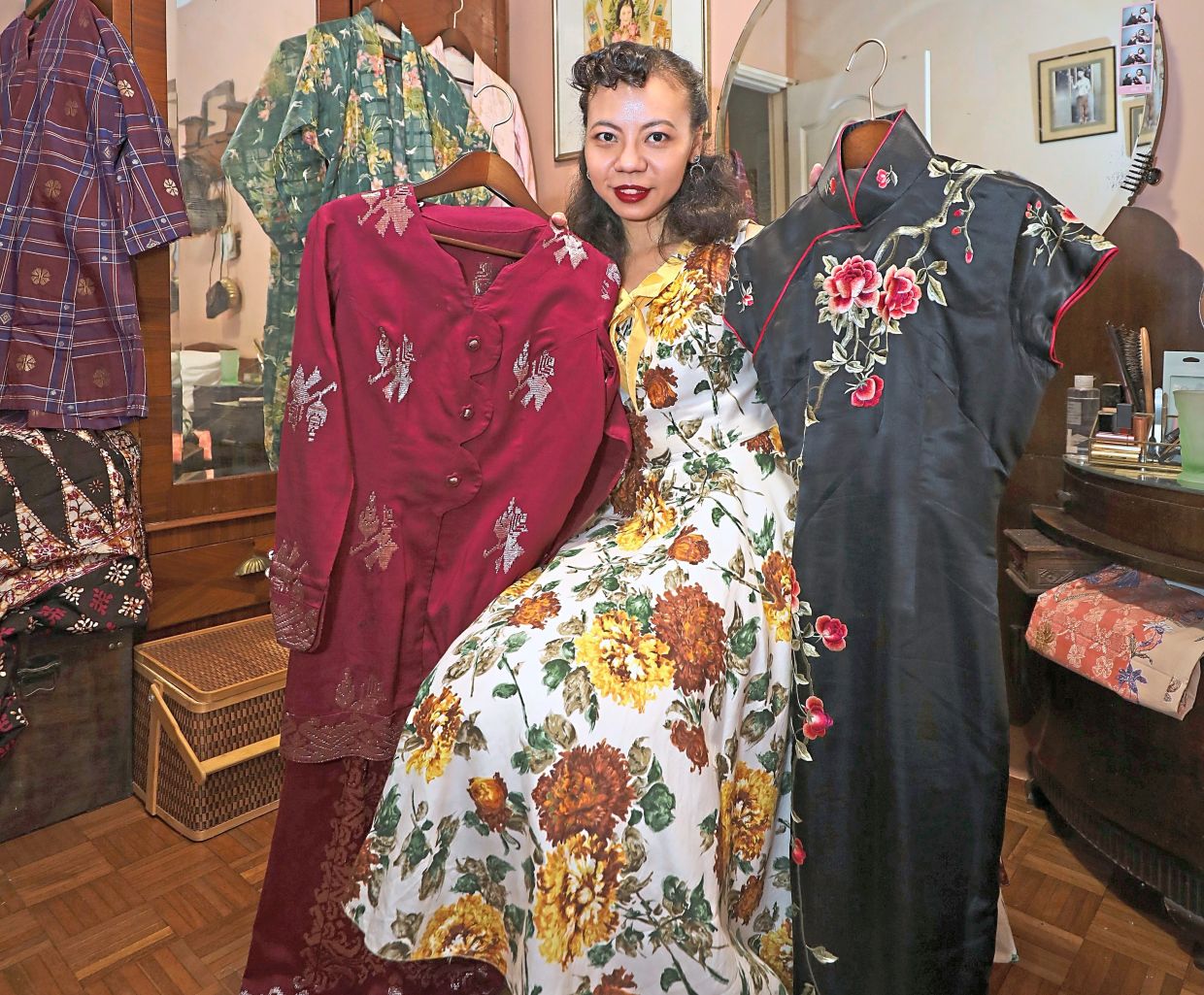
A sepia-toned photograph of Suzanne Lim's grandparents dancing in a 1950s dance hall sparked a lifelong passion that would eventually reshape how she engages with her country's material culture. The 33-year-old graphic designer traces her fascination with vintage clothing directly to that image of her family members, dressed impeccably and lost in the joy of an era that felt distinctly their own. Their enthusiasm for fashion and movement became the foundation for her own trajectory: dancing from childhood, competing in ballroom and Latin competitions, and ultimately developing an eye for the garments that once adorned Malaysian bodies across generations.
Lim's secondary school years deepened this connection when she joined her school's cultural club, where performing traditional dances required donning elaborate costumes complete with accessories that made the historical significance tangible. That exposure to traditional Malay dress—the intricate kebaya, the patterned batik, the luxurious songket—transformed from mere costume into genuine historical artifact. The moment she acquired her first vintage piece, what had been an academic interest crystallized into an obsession she could no longer ignore. Today, her social media presence documents her wearing these garments against heritage backdrops, offering viewers a visual language for understanding how Malaysians dressed and presented themselves across different eras.
For Lim, vintage clothing functions as a historical text that extends far beyond aesthetics. The garments themselves become windows into the economic conditions, social hierarchies, and daily realities of their time. A worn hem, a particular fabric choice, or a specific construction technique reveals information about accessibility, trade patterns, and cultural priorities that traditional history books often omit. By studying and wearing these pieces, she engages in a form of material history that demands attention to detail and historical context. This approach carries particular weight in Malaysia, where rapid modernization has sometimes relegated traditional dress to ceremonial occasions or tourism performances, stripping away the ordinary, everyday contexts in which these garments once lived.
Mohamad Alif Daniel Mohammad Nor, a 25-year-old recent graduate, approaches historical clothing through a different but equally compelling pathway. His interest originated from his late grandmother's stories, narratives that gradually expanded to encompass music, historical cinema, and eventually military uniforms and official dress. Beginning his collection in his mid-teens with Japanese occupation-era currency notes, he progressed to more comprehensive historical material. His involvement with Persatuan Reka Ulang Sejarah (PRUS) provided structured access to historical re-enactment, allowing him to move beyond passive collection into active embodiment of the past. This hands-on engagement with historical dress taught him lessons about culture, identity formation, and historical consciousness that conventional educational systems rarely provide with the same emotional resonance.
The distinction between Lim's approach and Mohamad Alif Daniel's re-enactment work remains significant, yet both recognize clothing as evidence of lived experience. For Lim, vintage pieces serve as bridges across the gap between contemporary digital culture and embodied historical knowledge. She observes that many Malaysians have become disconnected from museums and reliable historical sources, a phenomenon she attributes partly to information overload and changing leisure habits. By wearing and photographing vintage pieces on platforms where young people actually spend their attention, she democratizes access to cultural history. Rather than requiring visitors to navigate museum spaces or parse academic texts, she brings historical Malaysian fashion directly into the social media feeds of potential audiences.
Accuracy presents a constant negotiation in Lim's practice. She readily acknowledges that not every outfit she curates maintains strict period authenticity, particularly when she applies contemporary styling to vintage pieces. However, when she possesses access to genuine historical textiles and construction techniques, she prioritizes fidelity to the original. This calibrated approach reflects a deeper philosophy: even simply demonstrating that certain local textiles and garment forms existed can make cultural heritage feel more concrete and present for viewers who might otherwise encounter it only as abstraction. The visibility itself becomes an act of preservation in a culture increasingly mediated by digital representation.
Lim has detected a growing trend among younger Malaysians deliberately collecting vintage clothing and objects, a phenomenon she partially attributes to the inherent tension within contemporary life. The digital saturation and virtual nature of modern existence creates a counterbalancing yearning for tactile, material experience and nostalgic connection. Vintage clothing offers precisely this: objects with patina, history embedded in fabric, and a resistance to the disposability of fast fashion. Yet this nostalgia need not mean historical replication. She argues persuasively that young people can extract inspiration from the past while exercising creative autonomy through modern styling choices, a balance that appeals to a generation seeking both connection to heritage and room for individual expression.
This creative freedom, however, requires boundaries to prevent cultural dilution. Lim emphasizes that while reinterpretation remains valid, the fundamental integrity of traditional garments must be preserved to prevent misrepresentation that could undermine Malaysia's cultural identity. The distinction matters: adapting a kebaya with contemporary jewelry and styling respects the garment's essence, whereas fundamentally altering its construction or mixing elements inappropriately risks transforming heritage into costume. This responsibility toward cultural stewardship reflects a maturity of perspective among younger Malaysians, suggesting that engagement with heritage need not be either rigid fundamentalism or casual appropriation.
Mohamad Alif Daniel has observed a cascade effect from his own social media documentation of traditional attire: his posts demonstrating pride in historical dress have encouraged others to do the same, particularly individuals who previously felt ashamed wearing such garments in public spaces. This social validation represents a crucial dimension of heritage reclamation often overlooked in discussions of historical preservation. In societies where Western dress has long dominated public spheres and traditional clothing has been relegated to ethnic or ceremonial contexts, publicly normalizing historical Malaysian fashion becomes a political and social act. Young people wearing kebaya or songket to ordinary events, photographed and shared online, subtly reshape what feels acceptable and desirable in contemporary Malaysian life.
The movement toward vintage clothing collection and wearing reflects broader questions about cultural continuity amid rapid change. Malaysia's transition from colonial administration through independence to contemporary global integration has created ruptures in everyday transmission of cultural knowledge. Grandparents' stories, once shared naturally across generations, now require deliberate excavation. Traditional garments, once worn without self-consciousness, now require conscious choice and research. In this context, young Malaysians turning to vintage pieces, exploring historical re-enactment, and documenting their findings on social media represent an active reclamation of narratives their country's rapid modernization might otherwise obscure. These practices assert that Malaysian cultural history possesses value worthy of sustained attention and that contemporary identity can remain rooted in historical consciousness without freezing in place.
The implications extend beyond individual enthusiasm. As digital platforms increasingly mediate how young Malaysians encounter their own heritage, creators like Lim and Mohamad Alif Daniel perform essential cultural work. They demonstrate that history remains relevant, that material objects contain stories worth decoding, and that pride in cultural specificity strengthens rather than limits personal identity. Their work suggests that heritage preservation need not mean static museum exhibits or ceremonial performances. Instead, it can be dynamic, creative, and integrated into contemporary life through platforms young people actually inhabit. In this way, a photograph from the 1950s, a collection of vintage textiles, or a carefully researched historical outfit becomes more than nostalgia—it becomes an ongoing conversation between past and present that reshapes how an entire generation understands itself.

