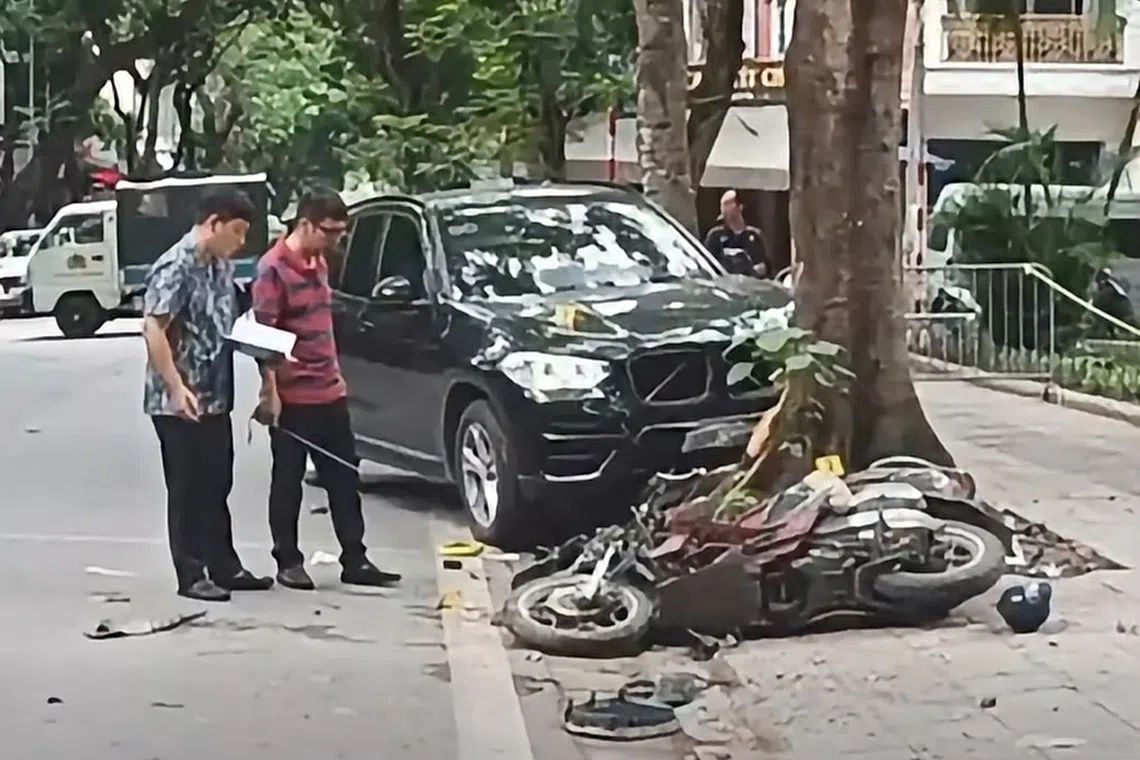
Vietnam's state broadcaster aired an unusual segment this week, dedicating six minutes of airtime to a fatal road accident that occurred more than a year earlier—an extraordinary gesture in a nation where traffic deaths routinely exceed 10,000 annually without drawing comparable media scrutiny. The incident in question, however, involved a former senior government figure, and its renewed prominence reflects an intensifying campaign by young Vietnamese citizens who have weaponised social media to demand accountability in a political environment where public questioning of official actions remains uncommon.
The tragic collision occurred on May 30, 2025, when former Vietnamese National Assembly deputy Nguyen Sy Cuong, driving a luxury vehicle, veered into oncoming traffic at high speed and struck a motorbike carrying a father and his 18-year-old daughter, Do Ngoc Phuong Thuy. The impact severed the teenager's right leg, and despite emergency hospitalisation, she succumbed to her injuries ten days later, days before her scheduled high school graduation examinations. Following the accident, official media coverage ceased almost immediately after May 31, leaving the case effectively buried from public view as police investigations proceeded behind closed doors.
The sustained silence persisted for over a year until a coordinated online movement emerged more than a week ago, flooding Vietnamese social media platforms, particularly Threads, with millions of posts bearing hashtags such as #NguyenSyCuong and #BMW. Predominantly composed of Gen Z users and young adults in their late teens and twenties, the campaign demanded transparency regarding the investigation's conclusions and held authorities accountable for what many perceived as preferential treatment shielding a politically connected figure. The movement demonstrated remarkable sophistication, with users employing technical workarounds to circumvent attempted content restrictions, redistributing messages across Facebook, Instagram, and X to reach wider audiences.
Symbolic demonstrations accompanied the digital activism, with masked youth placing flowers at the accident site, which became known as the Justice Tree and even gained coordinates on Google Maps. When authorities swiftly removed these physical tributes, activists created a parallel virtual memorial that accumulated hundreds of thousands of digital tributes, illustrating how younger Vietnamese have adapted protest methods to digital spaces where governmental control remains incomplete. The movement raises significant questions about generational attitudes toward institutional authority and the mechanisms through which information now circulates in authoritarian contexts where traditional media operates under state oversight.
Social activist Nguyen Hoang Vi, who documents educational and social issues through her blog and raises Generation Z children, identified multiple factors driving the campaign's unexpected traction. The victim's age and proximity to the activists' own lives fostered profound empathy, she explained, while the year-long information vacuum ultimately exhausted public patience with official silence. Young Vietnamese increasingly reject passive acceptance of governmental assurances about justice, instead demanding visible, tangible evidence that accountability mechanisms function transparently and apply equally regardless of social status.
Attorney Tran Dai Lam from Hanoi's ANVI law firm articulated a critical observation about the case's legal dimensions: incidents do not simply disappear from public consciousness merely because mainstream media cease coverage. He noted that such matters can resurface rapidly with minimal additional information, suggesting that the campaign's emergence reflected accumulated frustration rather than any sudden revelation. Notably, his assessment suggested that official explanations, however comprehensive, might fail to satisfy the generation's heightened expectations regarding procedural transparency and detailed justification for legal determinations.
The state broadcaster's report cited police and prosecution sources stating that Nguyen Sy Cuong had "sincerely confessed and actively and fully remedied the consequences of his actions," leading the victim's family to forego criminal charges, resulting in his exemption from criminal liability. Significantly, Do Ngoc Phuong Thuy's father, Do Viet Hung, appeared in the broadcast to express gratitude toward internet users while appealing for privacy to permit his family's grieving process and reconstruction. This strategic positioning attempted to undercut activist narratives by suggesting family satisfaction with investigative outcomes, though the continued placement of flowers at the memorial tree indicated widespread scepticism regarding the official narrative.
Lawyer Tran Dai Lam's subsequent assessment proved prescient: while the televised report addressed some legal queries raised by social media users, it fundamentally failed to resolve the underlying credibility gap. He observed that Gen Z citizens demonstrate little satisfaction with vague assurances that authorities acted "in accordance with the law," instead demanding specificity regarding which statutes applied, what particular decisions were rendered, and the substantive reasoning behind those determinations. This generational insistence on detailed justification represents a significant departure from previous Vietnamese social attitudes and complicates traditional governmental approaches to information management.
Authorities simultaneously endeavoured to reframe the campaign through security rhetoric, with senior police officials warning of "highly dangerous plots and intentions by hostile forces, reactionaries and bad actors" exploiting the incident to incite disorder. State media and pro-government influencers drew parallels to colour revolutions and regional unrest, particularly referencing Bangladesh, to discourage further participation. This defensive response revealed governmental anxiety regarding youth mobilisation capacities and social media's role in circumventing traditional state information monopolies, though the persistence of commemorative activities following the broadcast suggested such warnings held limited persuasive power.
The episode represents a watershed moment in Vietnamese civil society dynamics. This constitutes the first instance where a social media campaign initiated and sustained by Gen Z successfully mobilised sufficient public pressure to compel official governmental response addressing issues reflecting youthful priorities. Activist Nguyen Hoang Vi acknowledged that recent developments substantially altered her previous assumptions about younger Vietnamese, whom she had previously characterised as self-indulgent and detached from societal concerns. She now recognises that disengagement represents merely a surface appearance, with Generation Z demonstrating sustained commitment to justice issues through engagement modalities fundamentally divergent from previous generational approaches.
The implications for Southeast Asian governance structures deserve careful examination. Vietnam's experience illustrates how digital connectivity and social media literacy enable younger citizens to circumvent traditional gatekeeping mechanisms controlling public discourse, even within contexts of significant state censorship capabilities. The campaign's persistence despite official efforts to suppress content and reframe narratives suggests that generational cohorts increasingly possess both technological sophistication and collective determination to demand accountability from institutional structures. This phenomenon extends beyond Vietnam, potentially signalling broader regional transformations in how younger citizens conceptualise their relationship with state authority and institutional transparency, posing substantial challenges for governance approaches premised upon information monopolies and deference to hierarchical decision-making processes.

