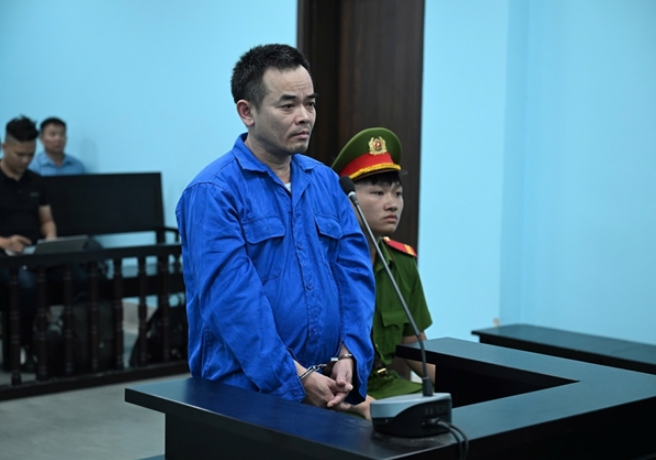
A Vietnamese court has handed down a lengthy 20-year prison sentence to a concrete mixer truck driver for the deliberate killing of a teenage girl in what prosecutors described as a calculated act driven by financial self-interest. The Hanoi People's Court delivered its verdict on Tuesday, June 30, against 52-year-old Dinh Van Long from Phu Tho province, finding him guilty of murder in the September 2024 death of Nguyen Dao Ha A., a young resident of Phu Xuyen Commune who was born in 2010.
The sequence of events that unfolded on the morning of September 13, 2024, began as what might have been classified as a tragic accident but transformed into something far more sinister through the defendant's subsequent actions. Long was operating a concrete mixer truck loaded with approximately 14 tonnes of ready-mix concrete as he approached National Highway 1A near the Van Diem underpass in Phu Xuyen Commune. The circumstances of the initial collision involved multiple vehicles in close proximity, with another truck travelling in the same direction alongside Long's vehicle while the victim attempted to overtake on an electric motorbike from the right side.
According to court records, the teenager lost control of her electric motorbike and fell directly into the path of Long's truck. The vehicle's front right wheel ran over her abdomen with significant force. Long indicated to investigators that he felt a substantial impact and experienced the steering wheel shake violently beneath his hands. He applied the brakes, bringing the heavy truck to a halt several metres further along the road. At this critical juncture, Long checked his mirrors but could not locate the victim in his field of vision.
What transpired next revealed the psychological calculation at the heart of this case. Rather than immediately checking beneath his vehicle or summoning assistance, Long made a deliberate decision to continue driving forward. Prosecutors contend that Long's reasoning was coldly pragmatic: he feared that if the girl survived the initial impact, he would face substantial financial compensation claims that could bankrupt him, whereas her death would result only in criminal responsibility, which he apparently judged as a more manageable consequence. This mental framework, the court found, demonstrated a conscious choice to end the victim's life through inaction transformed into action.
As Long drove the truck forward for another 10 metres, he reported feeling unusual resistance beneath the vehicle and hearing the tyres grinding against an object. Despite these sensations that should have alerted any reasonable driver to the presence of a human body beneath the truck, he continued propelling the multi-tonne vehicle across the road. He only ceased driving when bystanders rushed toward the truck, shouting warnings and pointing to the space beneath the vehicle where the girl had become trapped and was being dragged along the asphalt.
When Long finally reversed the truck by approximately three metres, the victim was still breathing, though she had sustained catastrophic abdominal injuries from being crushed and dragged beneath the heavy vehicle. She was extracted from beneath the truck and rushed to Bach Mai Hospital, one of Vietnam's leading medical facilities, but the extent of her internal injuries proved unsurvivable. She died during transport. Long abandoned the scene immediately following the incident and did not surrender to police until later that evening, suggesting an attempt to distance himself from the immediate aftermath.
The case took on additional dimensions regarding victim compensation and family suffering. Long's daughter voluntarily contributed 80 million Vietnamese dong (approximately US$3,000) toward compensation payments, while his employer, a local construction materials company that had hired him in January 2024, added a further 100 million dong ($3,800) to support the victim's family. The bereaved family pursued additional claims encompassing emergency medical treatment costs, funeral expenses, and compensation for emotional trauma and loss.
The trial panel's characterisation of Long's conduct as "particularly dangerous" reflected widespread revulsion at his actions. The court determined that Long's decision to continue driving constituted direct intent to cause death, driven not by momentary panic but by a calculated assessment of personal financial liability versus criminal consequence. The judges emphasised that his behaviour demonstrated a "violent nature" that extended beyond the mechanics of the accident itself, incorporating a deliberate choice to let a trapped victim die rather than stop and seek help. This reasoning resonated with public sentiment across Vietnam, where the case generated significant outrage at what many perceived as callous prioritisation of financial self-protection over human life.
Beyond the 20-year custodial sentence, the court imposed an additional 182 million dong in compensation payments that Long must remit to the victim's family, a financial obligation that will extend well into his incarceration period and beyond. The judgment reflects Vietnam's legal system's willingness to characterise such calculated indifference to human life as murder rather than treating the extended driving as a mere continuation of an accidental incident. For Malaysian and Southeast Asian observers, the case underscores both the vulnerability of vulnerable road users like electric motorbike riders and the severe legal consequences that can follow when drivers respond to accidents with premeditated choices rather than immediate assistance, establishing important precedent regarding culpability in complex traffic fatality cases.

