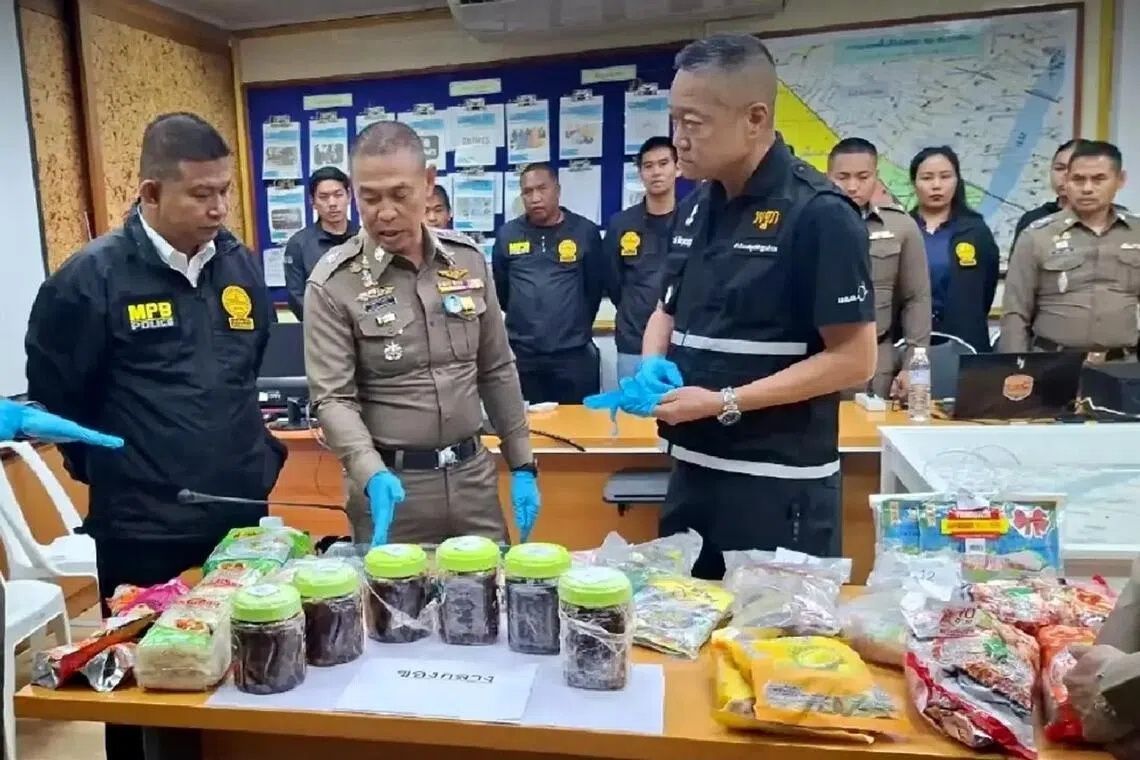
Thai police have uncovered an international methamphetamine trafficking scheme orchestrated by a Vietnamese criminal network that leveraged Thailand's geographic position and porous borders to move illegal drugs to Japan. The elaborate operation came to light when a courier contracted to deliver what he believed were innocent food products grew suspicious of unexpectedly heavy jars of tamarind paste bound for Tokyo, prompting him to report his concerns to authorities on July 13. Metropolitan Police Bureau commissioner police lieutenant-general Siam Boonsom, alongside police major general Chaiya Phetpanya, commander of Metropolitan Police Division 7, detailed the investigation findings on July 17, revealing a multi-layered smuggling network designed to insulate masterminds from direct contact with contraband.
When investigators examined the tamarind containers, they discovered six foil-wrapped packages hidden within the jars, laboratory tests confirming the presence of more than 2kg of crystal methamphetamine, commonly referred to as ice on illicit markets. This discovery emerged from routine questioning of Thai suspect Sompong, whose financial involvement with the operation became evident as investigators traced banking transactions and supply chains. The case exemplifies a troubling trend across Southeast Asia in which drug syndicates exploit unsuspecting couriers and legitimate commercial logistics to move narcotics across international borders, banking on the difficulty customs authorities face in thoroughly inspecting every shipment destined for export.
The investigation pieced together a hierarchical organizational structure that deliberately fragmented responsibility and communication to prevent law enforcement from establishing direct links between the operation's architects and the physical contraband. At the apex, a senior operative allegedly stationed in Hanoi directed the entire enterprise, communicating through anonymous Facebook accounts to hire local delivery riders in Thailand. These intermediaries, apparently unaware of the illicit nature of their work or deliberately kept in ignorance, collected packages from residences occupied by Vietnamese nationals scattered throughout Thailand. The parcels were then transferred to separate Thai couriers tasked with the actual international transportation, creating multiple sequential handoffs that effectively obscured the supply chain.
This compartmentalization strategy reflects sophisticated understanding of law enforcement investigative techniques and represents a significant evolution in drug smuggling methodology. Rather than attempting to move contraband through a single direct pathway, the network intentionally introduced unnecessary intermediaries and redundant layers, recognizing that even if one link in the chain was compromised, investigators would struggle to identify those controlling the operation. The use of food products as concealment adds another dimension to the sophistication, as tamarind paste is a legitimate export commodity from Southeast Asia to Japanese markets, making shipments less likely to trigger heightened scrutiny at border checkpoints.
Financial analysis provided crucial evidence connecting various elements of the conspiracy. Authorities identified that payments and operational expenses flowed through a bank account registered to Sompong, who appears to have functioned as the Thailand-based financial hub despite his limited understanding of the network's full scope. Vietnamese nationals allegedly operating the money laundering component would periodically withdraw cash in amounts ranging from 20,000 to 50,000 baht, typically leaving Thailand shortly after accessing these funds. This pattern of frequent small withdrawals and immediate departure suggests a deliberate effort to avoid triggering financial investigation thresholds while making it difficult for authorities to establish patterns of suspicious activity through banking records alone.
The operational methodology also reveals how transnational drug organizations exploit visa and border regulations to their advantage. By rotating personnel who withdrew funds and maintained local logistics, the network minimized the risk that any single individual would remain in Thailand long enough to establish patterns authorities could exploit. This rotation also reduced the likelihood of any person in the chain accumulating sufficient direct evidence of involvement that would justify prosecution on charges carrying severe penalties. The strategy reflects a pragmatic assessment that temporary detention for minor offences is an acceptable cost of doing business, provided that key decision-makers and larger quantities of contraband remain insulated from direct seizure.
Police have determined that at least four additional individuals participated in the conspiracy beyond those already apprehended. Arrest warrants have been issued for Sompong and three Vietnamese nationals believed responsible for various operational components, including withdrawing funds, managing anonymous social media accounts, and directing specific aspects of the smuggling pipeline. Notably, Sompong has consistently denied allegations against him, a position often maintained by mid-level operatives who genuinely lack comprehensive knowledge of the broader conspiracy. Investigators have also identified Sompong's girlfriend as a person of interest, believing she possessed knowledge of the operation, though formal charges have not yet been filed against her pending further examination of her specific role.
The case carries significant implications for Southeast Asia's broader struggle against transnational drug trafficking, illustrating how modern smuggling operations have adapted to contemporary policing methods through organizational innovation rather than sophisticated chemistry or sophisticated concealment techniques alone. Thailand's critical position along major drug trafficking corridors makes it both a key transit point and a focus for law enforcement, yet the sheer volume of international commerce passing through the country daily means that determined smugglers can exploit inspection capacity limitations. The reliance on courier networks dependent on legitimate shipping infrastructure and food commerce integration suggests that future disruptions will require greater coordination between customs agencies, financial regulators, and law enforcement across the region.
For Malaysia and other Southeast Asian nations, this investigation underscores vulnerabilities in border security and financial oversight that mirror challenges documented across the region. The use of anonymous social media to recruit operational personnel demonstrates how digital platforms facilitate criminal coordination in ways that traditional law enforcement surveillance struggles to monitor effectively. The case also highlights the risks facing ordinary citizens who may unknowingly agree to transport packages for modest compensation, potentially exposing themselves to serious criminal charges despite lacking genuine knowledge of shipment contents. Regional coordination through mechanisms like ASEAN law enforcement cooperation channels remains essential to degrading these networks and disrupting the financial flows that sustain international drug operations.

