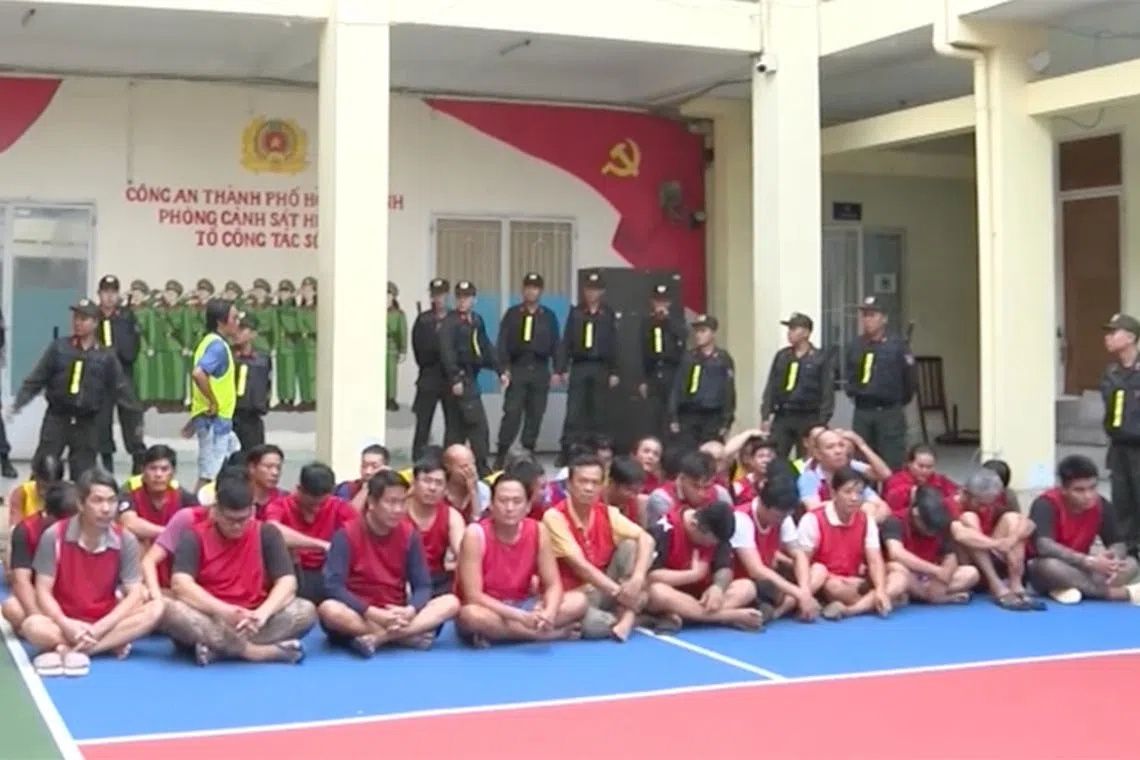
Vietnamese law enforcement has delivered a significant blow to organised illegal gambling, arresting 85 individuals connected to two expansive betting syndicates with combined transaction values reaching US$133 million, authorities revealed on Tuesday. The police operations, conducted in late June, targeted what officials described as exceptionally sophisticated networks characterised by strict hierarchical structures and carefully orchestrated control mechanisms across multiple jurisdictions. The timing of the enforcement action coincides with intensified government efforts to stamp out unlicensed gambling activities capitalising on the heightened public interest surrounding the 2026 FIFA World Cup.
The two dismantled syndicates had processed an estimated US$133 million through illegal channels since October 2025, according to Ho Chi Mihn City police statements. These figures underscore the substantial financial dimensions of underground gambling operations in Vietnam, where the formal prohibition of online wagering has created a lucrative black market. The networks operated with remarkable sophistication, employing layered structures designed to insulate leadership from direct exposure to law enforcement while maximising operational resilience. Such organisational complexity reflects broader patterns observed across Southeast Asian transnational crime networks, where compartmentalisation and specialised roles enable sustained criminal enterprise despite periodic intervention.
Investigators uncovered a particularly revealing operational methodology: ring leaders obtained "master-level betting accounts" sourced from Cambodia before systematically subdividing these accounts into secondary tier agent and member accounts distributed to individual gamblers. This arrangement allowed operators to maintain distance from direct transactions whilst preserving financial control and profit extraction. The Cambodia connection highlights the regional dimension of illegal gambling infrastructure in Southeast Asia, where porous jurisdictions and loose regulatory oversight facilitate cross-border criminal coordination. Such syndicate structures have become standard throughout the region, enabling operators to exploit regulatory gaps between nations.
The government's gambling crackdown extends well beyond these two major networks. Vietnam's public security ministry reported that police had dismantled 73 separate gambling operations nationwide during the initial 20 days of World Cup competition, resulting in 346 arrests targeting individuals involved in both general illegal gambling and unauthorised football wagering. Colonel Bui Tuan Anh of the public security ministry characterised the aggregate financial scale of these enforcement operations in dramatic terms, noting that transaction volumes across all cases totalled thousands of billions of dong, equivalent to hundreds of millions of dollars. This broader suppression campaign demonstrates systematic government commitment to controlling unlicensed gambling during major international sporting events.
The timing of these enforcement drives during World Cup periods reflects established Vietnamese security doctrine. International sporting events, particularly football tournaments, historically generate exponential increases in betting activity as communities become mobilised around matches. Authorities view these windows as critical intervention points where heightened public engagement with gambling creates opportunities for organised syndicates to expand operations and recruit new participants. By concentrating enforcement resources during such periods, government agencies aim to disrupt organisational capacity and deter participation through visible consequences. This prevention-through-demonstration strategy has become standard across Vietnamese law enforcement agencies managing organised crime.
Online gambling operates within Vietnam's restrictive legal framework as a categorically prohibited activity, reflecting the communist government's historical approach to regulating commercial vices. Unlike certain Southeast Asian nations that have licensed online gambling platforms or permitted limited forms of wagering, Vietnam maintains comprehensive prohibition across all forms of remote betting. This policy stance creates structural conditions favouring underground operations by eliminating legitimate channels through which consumer demand might be satisfied. The resulting black market has become increasingly sophisticated, utilising encryption, digital payment systems, and cross-border account structures to evade detection. Authorities consistently face challenges in disrupting these evolving technical architectures.
The 2026 FIFA World Cup, scheduled to be hosted jointly by Canada, Mexico, and the United States with the championship final slated for July 19, represents a particularly significant enforcement moment for Vietnamese authorities. The tournament's expanded format, featuring 48 participating nations and dramatically increased match quantities compared to previous competitions, will intensify both public interest and illicit betting demand. Vietnamese security agencies have evidently begun preparation well in advance, establishing enforcement frameworks and intelligence capabilities targeting syndicates likely to capitalise on the expanded tournament structure. The scale of the operations now being dismantled suggests authorities anticipate substantial criminal gambling activity throughout the competition period.
The Cambodia sourcing element carries particular significance for regional security analysts. That ring operators were obtaining master accounts from individuals operating in Cambodia indicates systematic cross-border criminal coordination spanning the Mekong region. Such partnerships suggest mature criminal networks with established relationships, secure communication channels, and proven operational capacity. The fact that investigators could identify and disrupt these relationships suggests improving law enforcement intelligence sharing and operational coordination across Southeast Asian borders, though the continuing operations demonstrate that criminal adaptation remains faster than institutional security responses in many jurisdictions.
For Malaysian readers, the Vietnam situation illustrates patterns directly relevant to domestic illegal gambling challenges. Both nations confront substantial underground betting markets generated by prohibition policies in contexts where consumer demand for gambling remains strong. The cross-border account sourcing mechanisms identified in Vietnamese cases mirror techniques observed operating within Malaysia's own illegal betting infrastructure, where operators frequently utilise foreign jurisdictional bases to facilitate transactions. Understanding Vietnamese enforcement approaches and their apparent limitations provides instructive lessons regarding the structural challenges inherent in combating technologically sophisticated, internationally networked gambling organisations. The scale of Vietnamese operations also underscores the genuine profitability driving such enterprise, suggesting that enforcement alone faces fundamental constraints absent complementary demand-reduction strategies.

