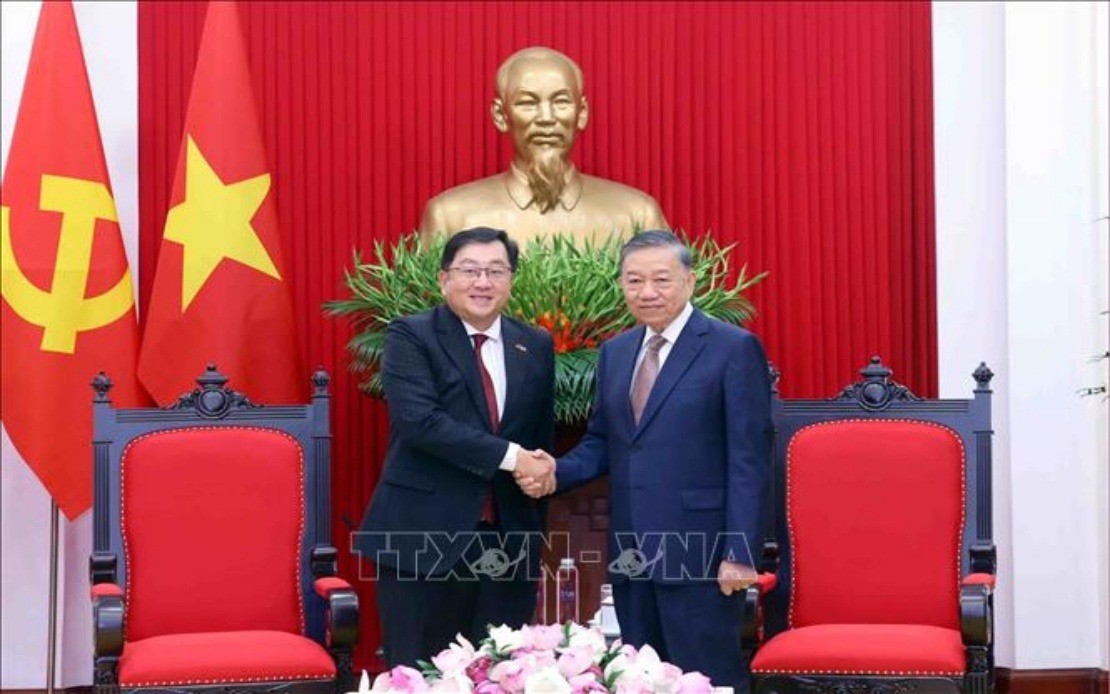
Vietnamese President To Lam has described the bilateral relationship with Malaysia as increasingly dynamic and robust, underscored by deepening political trust and accelerating economic linkages. The remarks came during a farewell meeting with outgoing Malaysian Ambassador to Vietnam Datuk Tan Yang Thai, reflecting both countries' commitment to elevating their Comprehensive Strategic Partnership at a critical juncture for Southeast Asian geopolitics.
During the Wednesday audience, President Lam conveyed warm regards to His Majesty Sultan Ibrahim, King of Malaysia, and Prime Minister Datuk Seri Anwar Ibrahim, extending formal invitations for high-level visits to Hanoi. The gesture underscores Vietnam's diplomatic priority in engaging Malaysia's political leadership and reflects the protocol that characterises mature bilateral relations within ASEAN. Such top-tier exchanges have become increasingly frequent, signalling institutional confidence and sustained political will on both sides to maintain momentum across multiple cooperation channels.
The Vietnamese President commended Ambassador Tan for his effective stewardship of diplomatic relations during his posting, acknowledging his role in advancing Malaysian interests while simultaneously strengthening the bilateral connection. Lam expressed confidence that Tan would continue to champion Vietnam-Malaysia ties through his subsequent diplomatic assignments, recognising the ambassador's personal commitment to the relationship. This acknowledgment reflects a diplomatic tradition of maintaining continuity and personal relationships that often transcend formal institutional structures in Southeast Asian statecraft.
Economic performance has emerged as a significant pillar of the partnership, with bilateral trade reaching US$10.8 billion during the first half of 2026, representing robust 40 per cent year-on-year growth. This expansion demonstrates the underlying complementarities between the two economies and the effectiveness of existing trade frameworks. Malaysia's position as Vietnam's third-largest investor among ASEAN nations and its ranking as the tenth-largest source of foreign direct investment among 154 countries and territories underscore the scale and significance of Malaysian capital commitments to Vietnam's industrial and services sectors.
Beyond traditional commerce, both nations have identified emerging economic frontiers as collaborative priorities. Digital economy development, green economic transition, and renewable energy represent strategic alignments reflecting broader Southeast Asian responses to climate change and technological disruption. These shared interests position Vietnam and Malaysia to coordinate within regional mechanisms, potentially amplifying their influence in shaping ASEAN's collective approach to sustainable development and digital governance standards. The emphasis on these sectors suggests both countries recognise the necessity of structural economic transformation to maintain competitiveness.
Political relations have undergone qualitative strengthening characterised by expanded high-level exchanges across party, state, government, and parliamentary channels. Regular visits and institutionalised dialogue mechanisms create redundancy in communication pathways, reducing misunderstandings and building confidence through personal relationships between political leaders. The establishment of effective bilateral cooperation frameworks demonstrates mature institutionalisation of the relationship, moving beyond episodic interactions to systematic engagement across multiple governance levels.
President Lam articulated a forward-looking agenda emphasising deepened political trust through intensified exchanges and implementation of existing high-level agreements. He specifically highlighted cooperation in defence, security, and maritime affairs—domains traditionally sensitive in bilateral relations yet increasingly recognised as requiring collaborative frameworks given shared interests in regional stability and freedom of navigation. Enhanced maritime cooperation carries particular resonance given overlapping maritime interests in the South China Sea and the importance of predictable mechanisms for managing potential friction points.
The Vietnamese leader also advocated for facilitation of balanced trade and investment flows, suggesting awareness that trade imbalances or perceived asymmetries can generate political friction. Emphasis on facilitation—rather than expansion alone—implies attention to removing non-tariff barriers and administrative obstacles that may constrain existing commercial relationships. This pragmatic approach recognises that economic interdependence requires functional institutions and transparent regulatory environments.
Ambassador Tan reciprocated with affirmations of Malaysia's commitment to strengthening bilateral ties, expressing particular enthusiasm regarding digital economy collaboration, green economy initiatives, and renewable energy partnerships. His remarks acknowledged Vietnam's substantial recent development achievements while positioning Vietnam and Malaysia as coordinated contributors to broader ASEAN unity and resilience. The ambassador's emphasis on drawing upon professional experience and personal affection for Vietnam suggests the relationship operates at both institutional and human levels, with individual diplomatic figures serving as vectors for sustained engagement.
The mutual invitation exchange—with Malaysia's King extending an invitation to President Lam and Vietnam similarly inviting Malaysian leadership—establishes reciprocal diplomatic momentum that typically precedes substantive bilateral initiatives. Such invitations serve ceremonial functions while creating opportunities for detailed policy discussions and personal rapport building among senior leadership. The timing of these exchanges, coupled with explicit reference to ASEAN cohesion, suggests both nations view their bilateral relationship as contributing to broader regional architecture resilience during a period of significant geopolitical flux.
For Malaysian readers, this deepening partnership carries implications across multiple dimensions. As Vietnam accelerates development and regional integration accelerates, Malaysia's significant investment presence and trading relationship position Malaysian firms advantageously in Vietnamese markets while securing access to Vietnamese resources and labour markets. The emphasis on maritime cooperation and defence partnership reflects evolving security architectures in Southeast Asia, where bilateral defence relationships increasingly complement multilateral frameworks. Malaysia's role as a bridge between Vietnam and broader ASEAN cooperation mechanisms enhances its diplomatic relevance and potential influence in regional norm-setting processes around digital governance, climate action, and maritime security.
The relationship trajectory evident in these remarks—characterised by simultaneous expansion across economic, security, and political domains—reflects both nations' recognition that bilateral partnerships must provide mutual benefit across multiple sectors to sustain political support and bureaucratic momentum. The 40 per cent trade growth and investment diversification into technology and green sectors suggest the relationship has moved beyond commodity dependence toward more sophisticated economic integration. This structural deepening creates stronger mutual dependencies that typically translate into political resilience, making the relationship less vulnerable to short-term diplomatic friction or changing political circumstances.

