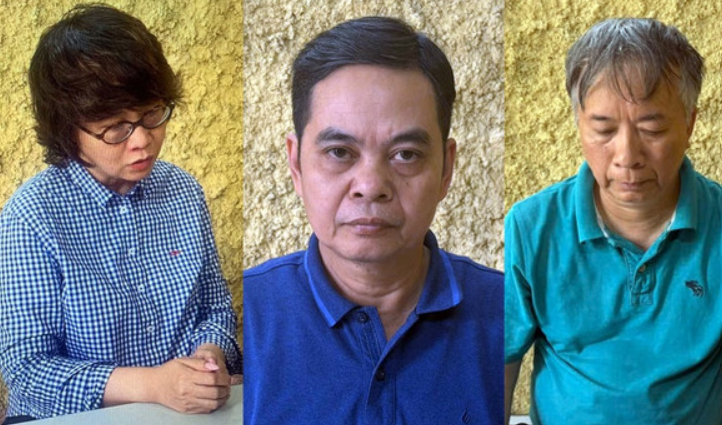
Vietnam's security apparatus has moved decisively against those involved in publishing and promoting a biography of Ho Chi Minh, the revered Communist Party founder, in what amounts to the most significant literary suppression case in recent years. Police announced the arrest of three senior officials from the Vietnam Writers' Association Publishing House on Wednesday, July 15, joining the author and a social media influencer previously detained on state security charges. The coordinated enforcement action signals the Vietnamese government's determination to control the narrative surrounding its founding figure and protect what it considers orthodox interpretations of revolutionary history.
The book in question, titled "Stories with Thanh -- A New Account of Light", was authored by Nguyen Thanh Nam, a former telecommunications executive whose background in business rather than academia apparently raised red flags with authorities. Released in May by the publishing house, the work examines Ho Chi Minh's formative years spent abroad as he developed political philosophy and strategies to achieve national independence. The author's arrest came in early July on charges of producing materials opposed to the Socialist Republic of Vietnam, a broad provision that gives authorities considerable latitude in prosecuting cases involving political content deemed problematic by the regime.
The three arrested publishing officials—the director, editor-in-chief, and head of the editorial board—face identical charges to Nam under Vietnam's strict information control laws. According to police statements, all three individuals participated in editing, revising, and promoting the manuscript throughout its production cycle. Authorities allege that the book fundamentally misrepresents Vietnam's revolutionary history and contradicts established Communist Party positions on its founder and policies. The publishing house itself has already withdrawn the book from circulation under official pressure, effectively preventing further distribution within Vietnam's tightly regulated print market.
What distinguishes this case is the scope of the government's response beyond the original publisher. The Ministry of Culture announced on the same day that it had sanctioned twenty-three news outlets that had published favorable reviews or coverage of the biography. This expansion of punishment into the media sector reveals how seriously the regime takes potential challenges to its historical orthodoxy. The outlets collectively paid nearly US$2,500 in fines, a relatively modest sum that serves more as a symbolic penalty and warning than a genuine financial deterrent. More significantly, over a dozen journalists and editorial staff members involved in covering the book faced reassignments, suspensions, or dismissal from their positions.
The ministry's characterization of the news outlets' errors provides insight into the government's concerns. Officials stated that the media agencies had failed to verify source material adequately and had subsequently acknowledged their mistakes while gaining "profound understanding of the lessons of source verification." This language, common in Vietnamese official pronouncements, typically indicates that outlets have been instructed on approved editorial guidelines and promised stricter adherence to state-approved narratives going forward. The phrasing suggests these organizations were pressured to adopt more cautious editorial policies regarding sensitive historical subjects.
Nguyen Thanh Nam himself appeared on state television to recant his work, a typical feature of Vietnam's approach to political cases. In his televised statement, the author acknowledged "factual errors and false assertions" that he claimed contradicted party and state guidelines while damaging Ho Chi Minh's reputation and causing public confusion. Such confessions, whether freely given or coerced, serve multiple purposes within Vietnam's political system: they reinforce state authority, discourage similar future projects, and provide propaganda material demonstrating the regime's control over narrative and public figures. Nam's role in telecommunications and his apparent lack of prior political activism suggest that authorities may have viewed his venture into historical writing as particularly threatening precisely because it came from outside traditional academic circles.
This crackdown illuminates the Vietnamese Communist Party's deep sensitivity regarding historical interpretation, particularly surrounding Ho Chi Minh, whose image remains central to the regime's political legitimacy. Unlike some communist successor states that have permitted more nuanced historical reassessment, Vietnam maintains strict controls over how the revolutionary past is presented to its citizens. The government appears concerned that even sympathetic biographical accounts introducing new details or perspectives could undermine its monopoly over historical meaning-making, a process essential to maintaining ideological orthodoxy and justifying single-party rule.
The timing and coordination of the arrests and sanctions suggest careful planning by state security and cultural authorities working in tandem. The decision to target not only the author and publisher but also the influencer who promoted the book on social media demonstrates awareness of how information spreads through digital channels beyond traditional print media. Vietnamese officials have shown increasing sophistication in managing narratives across multiple platforms, particularly recognizing that social media commentary can reach audiences that might never purchase a physical book. By addressing the influencer dimension simultaneously, authorities attempted to block multiple dissemination pathways.
For regional observers and international analysts, the case underscores Vietnam's continued commitment to state control over public discourse despite economic liberalization and technological change. While Vietnam has permitted greater entrepreneurial freedom in recent decades, political and cultural expression remains subject to strict party oversight. The prosecution of a former private sector executive for publishing a history book indicates that the regime draws firm boundaries between permissible commercial activity and content that touches on politically sensitive domains. This distinction becomes increasingly difficult to maintain as digital platforms enable rapid information sharing and as citizens gain access to diverse perspectives from outside Vietnam's borders.
Human Rights Watch has documented that Vietnam currently imprisons more than 160 political prisoners and critics of the government, making it one of Southeast Asia's least tolerant environments for free expression. The Ho Chi Minh biography case fits within a broader pattern of restrictions affecting journalists, bloggers, activists, and now authors and publishers who venture into restricted intellectual territory. The government's multi-faceted response—simultaneous criminal prosecution, media sanctions, and public recantation—reflects strategies refined over decades of managing dissent while projecting an image of national unity and ideological coherence.
For Malaysian readers and others in Southeast Asia observing Vietnam's trajectory, this episode raises questions about the sustainability of Vietnam's current model of controlled liberalization. As education levels rise, internet penetration increases, and access to international information expands, maintaining such tight restrictions on historical discourse becomes administratively burdensome and philosophically questionable. The arrest of publishing professionals and punishment of news organizations over a sympathetic biography suggests a regime feeling somewhat threatened by challenges to its narrative authority, even from sources broadly sympathetic to its founding principles. Whether Vietnam will continue intensifying such controls or gradually permit more open historical discourse remains uncertain, but recent events indicate the regime has chosen the path of tighter enforcement rather than accommodation.

