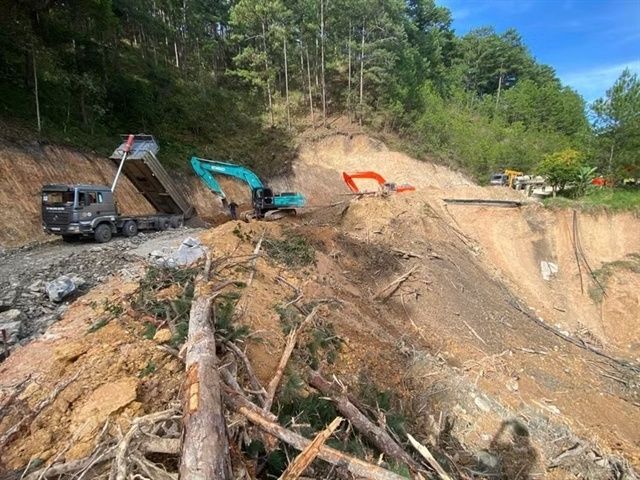
Vietnam's Ministry of Construction has formally declared a state of natural disaster emergency affecting Ho Chi Minh Road in Tuyen Quang Province, following a month-long period of intense rainfall that inflicted substantial damage to critical transport infrastructure. The emergency designation, which underscores the severity of the situation, applies specifically to the Km115+000 section where Ho Chi Minh Road intersects with National Highway 2C, an area falling under the operational authority of Road Management Zone I.
The declaration was necessitated by successive waves of heavy precipitation that occurred throughout June, creating dangerous road conditions and structural deformation that posed risks to both motorists and pedestrians. Data compiled by the Tuyen Quang Provincial Hydrometeorological Station and the National Centre for Hydrometeorological Forecasting documented multiple extreme rainfall events spanning the entire month of June, establishing the meteorological foundation for the emergency response.
The Vietnamese road authority structure has been mobilized to address the crisis with clear lines of accountability and responsibility. The Department for Roads of Việt Nam and Road Management Zone I have assumed primary responsibility for conducting comprehensive damage assessments, formulating repair strategies, and issuing an Emergency Construction Order to restore functionality to the affected infrastructure. This institutional response reflects Vietnam's systematic approach to managing transport disruptions caused by severe weather.
The scale of infrastructure deformation reported at Km115+000 necessitates urgent remedial action to restore safe passage for the high volume of traffic that typically utilizes Ho Chi Minh Road, a major artery connecting northern and southern Vietnam. The decision to invoke emergency protocols represents recognition that standard maintenance procedures would prove inadequate to address the magnitude of damage sustained during the June rainfall episodes.
Separate from the primary crisis zone, authorities have also identified a secondary flooding concern along a 3.4-kilometre stretch between Km124+600 and Km128, where Ho Chi Minh Road overlaps with National Highway 2. Traffic congestion management and flow optimization at this location have become secondary priorities for officials, requiring concurrent intervention to prevent cascading disruptions across the broader transport network. The proximity of these two problem areas suggests that regional weather patterns and topographical factors may have contributed similarly to both locations.
Directive authority for the emergency response has been distributed among senior transportation officials, with the Director General of the Department for Roads of Vietnam and the Director of Road Management Zone I bearing direct accountability to the Minister of Construction for their handling of the situation. This hierarchical responsibility structure ensures that decisions regarding emergency repair methodologies and timelines remain subject to ministerial oversight, maintaining standards of public accountability throughout the response.
The emergency construction framework allows rapid mobilization of resources and expedited procurement procedures that would normally be constrained by standard bureaucratic timelines. By invoking this mechanism, Vietnamese authorities acknowledge that conventional construction schedules cannot accommodate the safety imperatives created by the current road conditions. Once repair work has been substantially completed, the Department for Roads of Vietnam is obligated to submit a comprehensive report to the Ministry of Construction, which will then evaluate whether conditions warrant termination of the emergency declaration.
For regional observers and transport analysts, the Ho Chi Minh Road emergency illustrates the vulnerability of Southeast Asian infrastructure to increasingly intense rainfall events. Vietnam's major transport corridors, which facilitate crucial trade flows connecting the region, face periodic disruption from extreme weather. The Tuyen Quang incident provides a practical case study in how governments mobilize administrative and technical resources to maintain connectivity during climate-related crises.
The Transport and Road Safety Division of the Ministry of Construction has been designated as the coordinating body responsible for directing and monitoring implementation of emergency measures across all involved agencies. This centralized coordination function aims to prevent gaps in communication and ensure that repair timelines remain synchronized across multiple operational units. The division's mandate extends beyond technical oversight to encompassing broader traffic management strategies that minimize economic disruption to commerce dependent on reliable road access.
The declaration carries implications extending beyond Tuyen Quang Province, signaling to logistics operators and travellers that alternate routing may prove necessary during the repair phase. Supply chains dependent on Ho Chi Minh Road connectivity may require temporary reconfiguration, while passenger transport services must prepare contingency plans. Vietnamese authorities' transparent communication of the emergency status enables stakeholders throughout the country's transport sector to adjust operations accordingly.
Climate resilience has become an increasingly pressing concern for Vietnam's infrastructure planners. The June rainfall intensity in Tuyen Quang reflects broader patterns of extreme weather events that meteorologists attribute to evolving climate conditions. As these events grow more frequent and severe, infrastructure design standards and maintenance protocols may require reassessment to ensure that major transport arteries can withstand projected rainfall intensities in coming years.
The emergency response process outlined by the Ministry of Construction demonstrates Vietnam's established protocols for managing transport crises, involving rapid damage assessment, systematic repair planning, and hierarchical accountability mechanisms. Whether this particular infrastructure challenge can be resolved within weeks or requires extended remediation will likely depend on the structural extent of damage revealed during detailed engineering surveys. Authorities have set in motion a comprehensive institutional response designed to restore safe and reliable passage along this critical national transport corridor.

