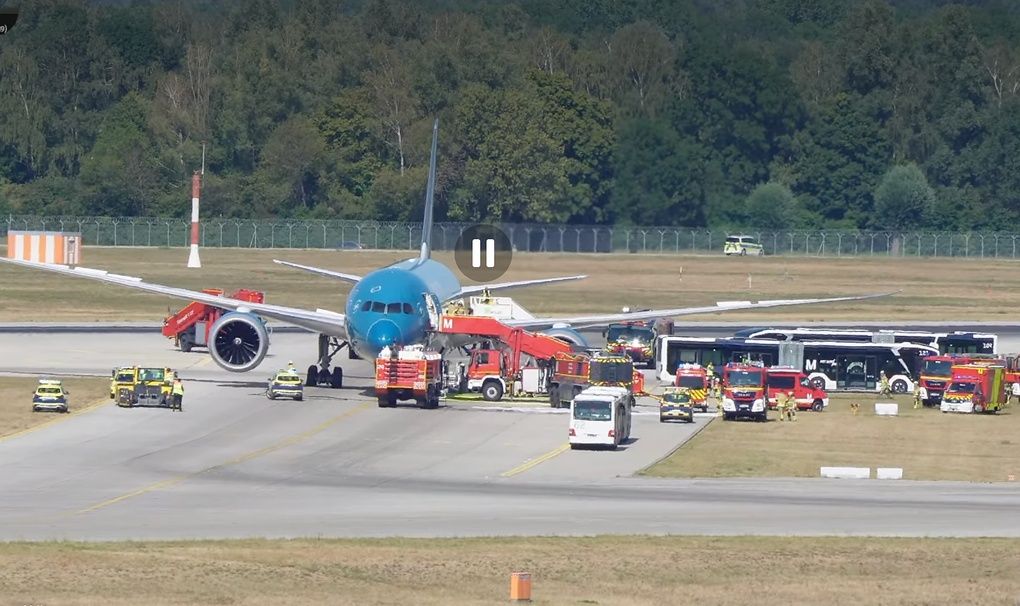
A Vietnam Airlines Boeing 787-9 bound for Hanoi from Munich Airport encountered a technical malfunction on August 15, forcing the crew to abort the flight and return to the German airport shortly after departure. The incident, which occurred during the critical takeoff phase, highlighted both the precision of modern aviation safety protocols and the unpredictability of mechanical failures at crucial moments in flight operations. Vietnam Airlines confirmed that all passengers and crew members remained safe throughout the ordeal, though the aircraft sustained damage requiring further investigation and repairs.
According to aviation safety analysts monitoring the incident, the Boeing 787 experienced what specialists term a "late rotation" during takeoff, meaning the aircraft's nose lifted more slowly than anticipated as it accelerated along the runway. This delay in rotation forced the tail section of the fuselage to make contact with the runway surface—a phenomenon known as a tailstrike—before the wheels fully left the tarmac. The impact was forceful enough to trigger a runway overrun situation, where the aircraft consumed more runway distance than designed for a normal takeoff sequence. Video footage captured near Munich Airport shows the wide-body jet accelerating down the runway and rotating extremely close to its end, with visible dust clouds rising as the aircraft struggled into the air.
The damage sustained during this aborted takeoff extended to the aircraft's landing gear. The tire contact with the runway during the tailstrike incident and subsequent rotation inflicted damage significant enough to require immediate attention. As the aircraft climbed to approximately 9,000 feet after becoming airborne, the flight crew initiated a holding pattern—a standard procedure where aircraft circle in designated airspace while awaiting clearance or allowing operational teams on the ground to prepare for the emergency. This holding period served a dual purpose: it allowed fuel to be burned off, reducing the aircraft's weight and stress on the damaged components during landing, and it gave ground crews at Munich Airport time to fully assess the severity of the situation and position emergency response vehicles.
The decision to return to Munich rather than continue to Hanoi reflected the crew's assessment that landing the aircraft as soon as possible at an airport equipped with specialized maintenance facilities and emergency services was the safest course of action. Approximately two hours after the initial takeoff, the Boeing 787 made its descent back to Munich Airport. Emergency services had been placed on standby throughout the holding period, and they were prepared to respond immediately upon landing. When the aircraft touched down, the already-damaged tires produced smoke as they made contact with the runway, visible evidence of the structural stress the landing gear had endured during the earlier takeoff incident.
Vietnam Airlines moved quickly to address the immediate needs of the affected passengers and crew members. All individuals aboard were safely escorted from the aircraft into the terminal building once it had come to a complete stop. The airline initiated comprehensive support measures, including accommodation, meals, and ground transportation for stranded travelers. Given that the aircraft had been scheduled to complete a transpacific service back to Southeast Asia, the disruption affected a substantial number of international passengers, many of whom were connecting through either Hanoi or Ho Chi Minh City to other destinations throughout the region.
The carrier launched immediate arrangements to provide alternative travel options for passengers whose journeys had been interrupted. This process involved coordinating with other airlines for rebooking, arranging standby flights on subsequent services, and in some cases organizing ground transportation to nearby airports operated by partner airlines. Vietnam Airlines emphasized that affected passengers would receive updates regarding their new travel arrangements once the airline had completed its internal coordination and finalized operational contingencies.
Parallel to passenger assistance efforts, Vietnam Airlines initiated a formal investigation into the root causes of the takeoff failure. The airline stated it was collaborating with German aviation authorities, technical teams from Boeing, and other relevant parties to determine precisely what triggered the late rotation and subsequent tailstrike. Such investigations typically examine multiple factors including weather conditions at the time, crew actions and decisions, aircraft maintenance records, weight and balance calculations, and any potential mechanical or sensor anomalies that may have contributed to the incident. The aircraft itself would undergo comprehensive inspection and maintenance before returning to service.
For regional aviation observers, this incident underscores the inherent risks present during takeoff and landing phases, which remain statistically the most dangerous portions of any flight. The fact that this malfunction occurred with a modern Boeing 787-9—one of the aviation industry's most technologically advanced aircraft—demonstrates that even the newest generation of commercial jets can experience unexpected failures. However, the successful handling of the emergency by the flight crew and the absence of injuries also reflects the robustness of modern aviation safety systems and crew training protocols.
Vietnam Airlines operates an extensive network of long-haul services connecting Southeast Asia with Europe, utilizing its fleet of wide-body aircraft including the Boeing 787 Dreamliner and the Airbus A350 XWB. The Munich route represents one of the carrier's key European gateways, with regular direct services departing from both Hanoi and Ho Chi Minh City. The airline typically operates these intercontinental routes with premium aircraft capable of handling the 12-plus hour flight duration and carrying several hundred passengers across multiple cabin classes. The Munich Airport incident, while serious, has not resulted in any reported plans to suspend or modify these European services pending completion of the investigation and necessary repairs to the aircraft involved.

