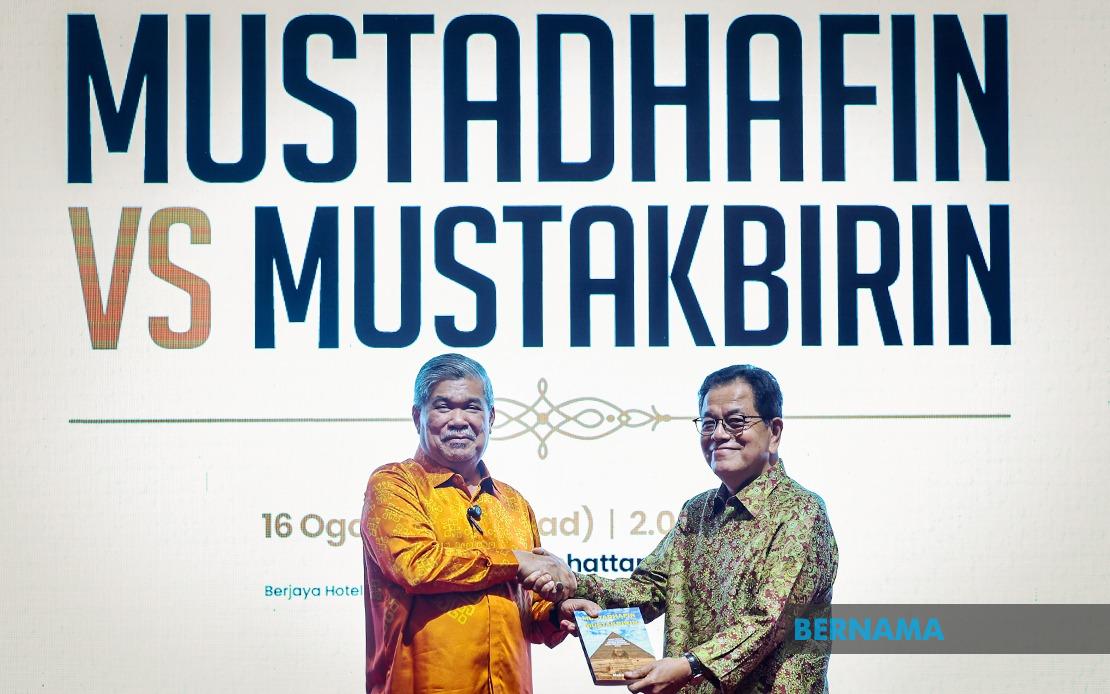
Datuk Seri Mohamad Sabu has issued a stark warning about the dangers of accepting unverified political allegations, arguing that uncritical belief in accusations threatens the integrity of Malaysia's democratic discourse. Speaking at the launch of his memoir in Kuala Lumpur, the Amanah president and Agriculture and Food Security Minister stressed that citizens must develop the intellectual discipline to scrutinise claims before adopting them as truth, a practice he believes has become increasingly rare in an age of rapid information dissemination.
At the heart of Mohamad Sabu's concern lies the concept of 'asabiyyah'—a term rooted in Islamic scholarship describing the tendency of groups to defend their own members regardless of fault while systematically denigrating the actions and motivations of rivals. In the Malaysian political context, this phenomenon has become particularly pronounced as polarisation deepens and tribal allegiances intensify. The Amanah leader argues that when voters and citizens uncritically absorb allegations against political opponents, they inadvertently reinforce this tribal dynamic, creating echo chambers where falsehood flourishes and nuance withers.
The minister specifically addressed recurring claims that the Democratic Action Party represents a communist threat and that any coalition partner working with DAP effectively endorses communist ideology. Rather than dismissing such assertions outright, Mohamad Sabu framed the issue as a test case for critical thinking, questioning whether these allegations withstand factual scrutiny. His intervention reflects a broader frustration within multiethnic coalition partners about the persistence of Cold War-era accusations that, while emotionally resonant among certain voter segments, lack substantive foundation in contemporary Malaysian politics.
Modern information ecosystems, Mohamad Sabu observed, create perverse incentives that reward sensationalism over accuracy. Accusations and suspicions spread with remarkable velocity through social media platforms, requiring minimal effort and yielding immediate engagement. Conversely, factual information and nuanced analysis demand considerably more cognitive investment from audiences and circulate far more slowly through deliberate channels. This asymmetry means that those deploying unverified claims gain strategic advantage, while those committed to evidence-based discourse operate at a structural disadvantage in capturing public attention and shaping political narratives.
The Amanah president's personal approach to information consumption, as detailed in his newly launched memoir, reflects a lifelong commitment to independent verification rather than passive reception. From his youth, Mohamad Sabu developed a practice of investigating matters personally rather than accepting received wisdom or propaganda narratives circulating within his communities. This methodology, he suggests, has equipped him to navigate Malaysia's complex political landscape with greater clarity than those who rely primarily on secondhand accounts and ideologically filtered information sources.
His memoir, launched by National Journalism Laureate Tan Sri Johan Jaaffar, documents the evolution of this analytical approach through decades of political engagement and international exposure. The book chronicles Mohamad Sabu's encounters with diverse political actors and his efforts to understand issues through direct observation and firsthand experience rather than partisan interpretation. By documenting these experiences, the minister aims to provide readers with a model for how political actors might approach contentious issues with greater intellectual honesty and empirical grounding.
Beyond Malaysian domestic politics, Mohamad Sabu's memoir extends to global geopolitical dynamics, incorporating his observations on colonialism, Islamic movements, the Palestinian conflict, and shifting power balances in international relations. These broader considerations underscore his fundamental argument that understanding any political phenomenon requires moving beyond surface-level accusations to engage with underlying historical, cultural, and structural factors. The same epistemological principle that applies to assessing DAP's political credentials applies equally to comprehending international affairs: lazy thinking produces misleading conclusions.
The timing of Mohamad Sabu's intervention carries particular significance in Malaysia's contemporary political moment. Coalition governments depend substantially on voter confidence that partners possess legitimate intentions and that cooperation serves genuine national interests rather than masking hidden agendas. Recurring accusations that undermine this confidence without rigorous factual foundation threaten coalition stability and policy effectiveness. By urging citizens toward greater critical engagement, the Amanah leader implicitly argues that Malaysian democracy functions more effectively when political competition occurs over substantive policy differences rather than unsubstantiated character assassination.
For Malaysian media consumers navigating an increasingly fragmented information landscape, Mohamad Sabu's appeal carries practical relevance. The proliferation of communication channels has democratised information distribution but simultaneously eroded quality control mechanisms that traditionally filtered unreliable content. Individual citizens now bear greater responsibility for evaluating source credibility, cross-referencing claims, and distinguishing between evidence-based analysis and speculation masquerading as fact. This places a premium on precisely the kind of intellectual discipline Mohamad Sabu advocates.
The minister's comments also reflect awareness that Southeast Asian democracies face particular vulnerability to misinformation campaigns that exploit existing communal tensions and historical grievances. Malaysia's diverse religious and ethnic composition means that allegations framed around identity politics, ideological affiliation, or religious intent can mobilise constituencies with remarkable efficiency. Countering this requires not only institutional fact-checking mechanisms but also cultivation of individual habits of critical thinking that make voters less susceptible to manipulation through unverified claims.
Moreover, Mohamad Sabu's emphasis on personal verification resonates with emerging scholarship on epistemic resilience—the capacity of individuals and communities to maintain accurate understanding despite exposure to deliberate disinformation. Building such resilience requires conscious effort, access to reliable information sources, and willingness to challenge one's own assumptions. These prerequisites remain unevenly distributed across Malaysian society, suggesting that appeals for greater critical engagement must accompany substantive improvements in information accessibility and media literacy infrastructure.
The Amanah president's message ultimately transcends partisan politics to address fundamental questions about how citizens should approach contested claims in democratic societies. While specifically addressing Malaysian political debates, his argument applies universally: democratic governance deteriorates when voters make decisions based on unverified allegations rather than substantive policy analysis. By urging Malaysians toward more rigorous standards of evidence and more resistant attitudes toward tribal political loyalties, Mohamad Sabu advocates for a democratic culture that privileges truth-seeking over score-settling and collective understanding over fractious division.

