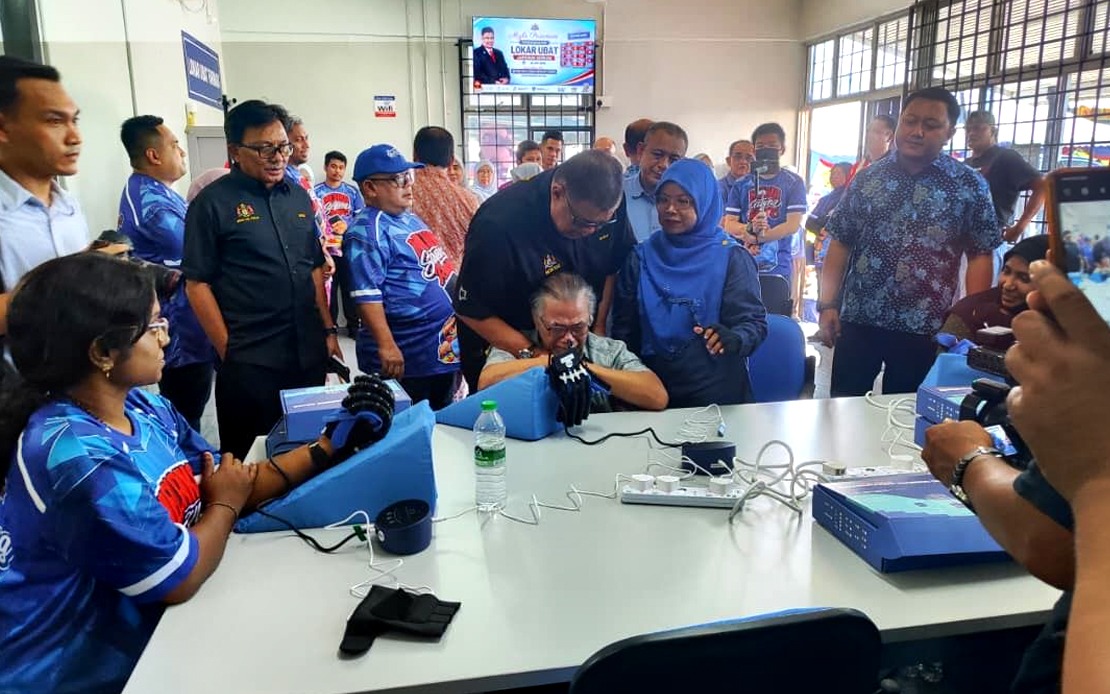
A new rehabilitation centre operated by Universiti Teknikal Malaysia Melaka (UTeM) has begun operations in Serkam, Jasin, bringing laboratory-developed technologies directly into clinical practice for patients recovering from stroke, injury, and mobility disorders. The MADANI Community Rehabilitation Centre and Gymnasium represents an effort to bridge the gap between academic research and community health needs, utilising innovations created within the university's engineering and biomedical laboratories. Chief Minister Datuk Seri Ab Rauf Yusoh officially launched the facility as part of the broader Public University Community Empowerment Programme.
The centre's technological arsenal includes three major innovations developed by UTeM's research teams. The Roboglove system assists patients in regaining hand function and strength through guided rehabilitation exercises, addressing one of the most challenging aspects of post-stroke recovery. Complementing this is the Assistive Lower Limb Chair (ALLC), which automates lower limb training to help patients rebuild leg strength and mobility without excessive burden on caregivers or physiotherapists. An exoskeleton system rounds out the offering, amplifying the effectiveness of movement training by providing mechanical support and resistance during exercise routines. Together, these devices represent a departure from conventional manual physiotherapy, potentially accelerating recovery timelines while reducing strain on healthcare personnel.
Funding for the facility came through the Finance Ministry's UniMADANI 2024 Grant programme, which channels resources into university-led community initiatives. The initiative reflects a strategic pivot toward making publicly-funded research outcomes accessible to ordinary Malaysians rather than remaining confined to academic settings. By establishing the centre in Serkam rather than within the university campus itself, UTeM has positioned the facility to serve the broader Melaka population, including rural areas where access to specialist rehabilitation services remains limited.
UTeM vice-chancellor Prof Datuk Dr Massila Kamalrudin emphasised that the centre serves as a proof-of-concept for scaling technology-based rehabilitation across Malaysia. She highlighted how the model demonstrates the university's commitment to translating research into tangible community benefits, a challenge that many Malaysian institutions have struggled to address effectively. The vice-chancellor also signalled openness to replicating the model in other locations, suggesting that if the Serkam centre demonstrates measurable improvements in patient outcomes, expansion could follow.
The project involved substantial coordination across multiple stakeholders, reflecting the collaborative governance increasingly common in Malaysian public health initiatives. UTeM partnered with the Serkam State Constituency Development and Coordination Committee (Japerun), village-level development bodies, the Social Welfare Department, and PERKESO, Malaysia's social security organisation. This multi-layered partnership structure meant that local representatives, community leaders, and social safety net administrators all had input into the facility's design and operations, potentially improving its relevance to local patient populations.
The launch addresses a genuine gap in Malaysia's rehabilitation infrastructure. Stroke remains a leading cause of disability in the country, and access to quality physiotherapy services varies dramatically between urban centres and rural areas. Many patients cannot afford private rehabilitation clinics, while public-sector facilities often face staffing shortages and equipment limitations. A technology-enhanced centre offers potential relief to this pressure, though questions remain about sustainability, maintenance of sophisticated equipment, and the training required to operate these systems effectively.
Associate Professor Dr Mariam Md Ghazaly, who led the project, represents the growing cohort of Malaysian researchers focused on translational research that directly addresses social needs. Her work exemplifies a shift within technical universities toward engineering solutions for healthcare challenges, a natural extension of UTeM's engineering-focused mission. The centre's establishment validates her research direction and creates institutional support for further iterations of the technology.
From a regional perspective, Malaysia's movement toward locally-developed rehabilitation technology carries implications for Southeast Asia more broadly. Many neighbouring countries face similar challenges of unequal healthcare access and limited specialist services. If UTeM's approach proves cost-effective and produces measurable patient outcomes, it could serve as a template for other universities in the region, particularly in countries with strong engineering research capacity. This potential for knowledge transfer and technology adaptation represents an underexplored avenue for Malaysia's technical universities to assert regional leadership.
The facility's success will depend heavily on factors beyond the technology itself. Patient uptake will require awareness campaigns reaching potential beneficiaries across Melaka. Healthcare practitioners using the equipment will need sustained training and support. Maintenance contracts must be established to prevent equipment breakdown, a common challenge with sophisticated medical technology in under-resourced settings. Cost-recovery mechanisms must be designed carefully to ensure accessibility without creating financial barriers that exclude lower-income patients.
UTeM's broader institutional strategy appears to involve positioning itself as a community-engaged research entity rather than purely an academic centre. This shift reflects international trends in university rankings that increasingly value research impact and community benefit, not merely publication metrics. By establishing visible, accessible centres that demonstrate research utility, UTeM builds both institutional reputation and evidence for future grant applications.
Looking forward, the centre's performance metrics will prove crucial. Data on patient recovery rates, length of stay, functional outcomes, and cost per treatment compared to conventional rehabilitation will determine whether the model is truly superior or primarily represents a well-intentioned but marginally more efficient approach. Malaysian policymakers are watching such pilots closely, as health system pressures mount and rehabilitation demands increase with an ageing population.
The MADANI centre ultimately represents a modest but meaningful step toward democratising access to advanced rehabilitation technology in Malaysia. Whether this single facility catalyses broader systemic change or remains an isolated success story will depend on factors including government commitment to scaling successful models, university capacity to maintain and further develop the technology, and most importantly, demonstrated improvements in patient outcomes that justify the additional investment.

