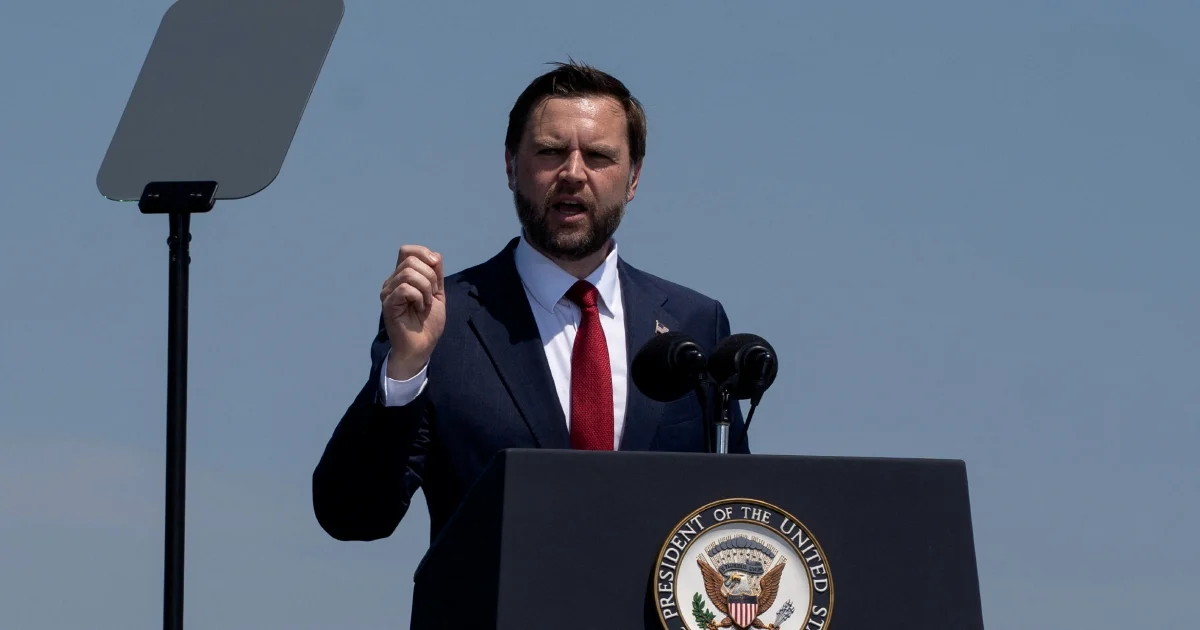
US Vice President JD Vance has trained fresh scrutiny on Britain's political establishment, delivering a pointed critique of the country's leadership trajectory while simultaneously signalling American readiness to engage with whoever assumes control at 10 Downing Street. Speaking during a visit to London, Vance articulated a blunt assessment of Britain's institutional performance, contending that the nation has endured prolonged governance failures across multiple administrations.
The Vice President's comments arrive amid Britain's complicated political moment. The country has cycled through six prime ministers since 2016, each confronting inherited crises ranging from the Brexit aftermath to economic instability and public service strain. This carousel of leadership has left voters frustrated and institutions strained, creating palpable demand for substantive change rather than incremental adjustments. Vance's remarks implicitly acknowledged this widespread dissatisfaction while positioning the United States as attentive to Britain's recovery prospects.
Vance emphasized that he harboured genuine hopes for the incoming British prime minister to catalyse the transformational agenda that the British electorate has been signalling through successive electoral cycles. His language suggested recognition that cosmetic reforms and marginal policy tweaks have proven insufficient to address the depth of public discontent. The structural challenges facing Britain—from declining competitiveness to social fragmentation to institutional trust deficits—demand the kind of comprehensive reimagining that only determined leadership can undertake.
The Vice President's intervention carries particular weight given the centrality of the US-UK relationship to both nations' strategic calculations. Washington's assessment of British leadership capacity directly influences how American policymakers calibrate their engagement with London across trade, security, and technology partnerships. By publicly expressing hope for meaningful change, Vance was signalling that the Biden-Harris administration remains invested in British renewal even as it acknowledges the severity of recent institutional dysfunction.
Britain's extended period of political instability has created downstream consequences for regional dynamics across Europe and the Atlantic. Leadership vacuums and policy inconsistency undermine Britain's ability to maintain its historical role as a stabilising actor within Western alliances. For Malaysia and Southeast Asian observers, Britain's institutional challenges carry indirect relevance—they diminish London's diplomatic bandwidth for engagement in Indo-Pacific affairs and constrain its capacity to balance rising geopolitical tensions in that region.
The structural reforms Vance referenced likely encompass multiple dimensions of British governance and economic management. Economic productivity, workforce skills development, regional inequality, and constitutional relations between Westminster and devolved administrations all feature prominently in contemporary British political discourse. A prime minister capable of coordinating coherent action across these domains would indeed represent a departure from recent practice, where administrations have lurched between competing priorities and failed to execute comprehensive strategies.
Vance's comments also reflect broader American observations about democratic governance challenges across the Western alliance. Britain's struggles mirror certain patterns visible in other mature democracies—institutional sclerosis, declining social cohesion, and difficulty building durable coalitions for reform. The Vice President's remarks implicitly encouraged British leadership to learn from comparative experience and demonstrate that democratic systems retain the adaptive capacity to address fundamental challenges.
The timing of Vance's intervention—made during direct engagement with British counterparts—suggests Washington intends to maintain close consultation with the incoming administration on both bilateral relationship calibration and broader multilateral cooperation. American administrations typically use such visits to signal priorities and establish frameworks for engagement with successor governments, thereby reducing transition friction between transitions. Vance's emphasis on structural change served as implicit guidance regarding the areas where Washington would most welcome substantive British action.
For Southeast Asian policymakers monitoring great power alignments, Britain's internal renewal matters because it affects London's capacity to maintain credible commitment to regional security arrangements and economic partnerships. Britain maintains historical relationships and contemporary defence arrangements across Southeast Asia, from Singapore's status as a major hub for British naval operations to broader Five Power Defence Arrangements. A Britain weakened by institutional dysfunction becomes less reliable as a security partner and less influential in regional balancing efforts.
The incoming British government will face immediate pressure to demonstrate competence across multiple fronts simultaneously—stabilising public finances, addressing cost-of-living pressures, revitalising stagnant growth, and rebuilding trust in institutions. Vance's encouragement for systemic reform rather than narrow partisan advantage suggested American awareness that British voters have transcended traditional party loyalties in demanding actual substantive improvement rather than mere electoral rotation.
The Vice President's remarks ultimately positioned American interests as aligned with successful British renewal. Washington requires a functionally effective British government capable of sustained partnership across security, economic, and technology domains. By articulating this preference publicly, Vance was making the case that Britain's recovery serves broader Western interests while simultaneously conveying that the United States retains confidence in the British system's capacity for adaptation despite recent turmoil.
The broader context of Vance's comments reflects enduring American investment in the transatlantic relationship despite periodic strains and occasional scepticism toward European institutional effectiveness. Even as the US administration recalibrates priorities to emphasise competition with China and Russia, maintaining robust alliances with established democratic partners remains foundational to American strategic doctrine. Britain's institutional renewal thus carries significance extending well beyond bilateral relations into the architecture of Western cooperation.

