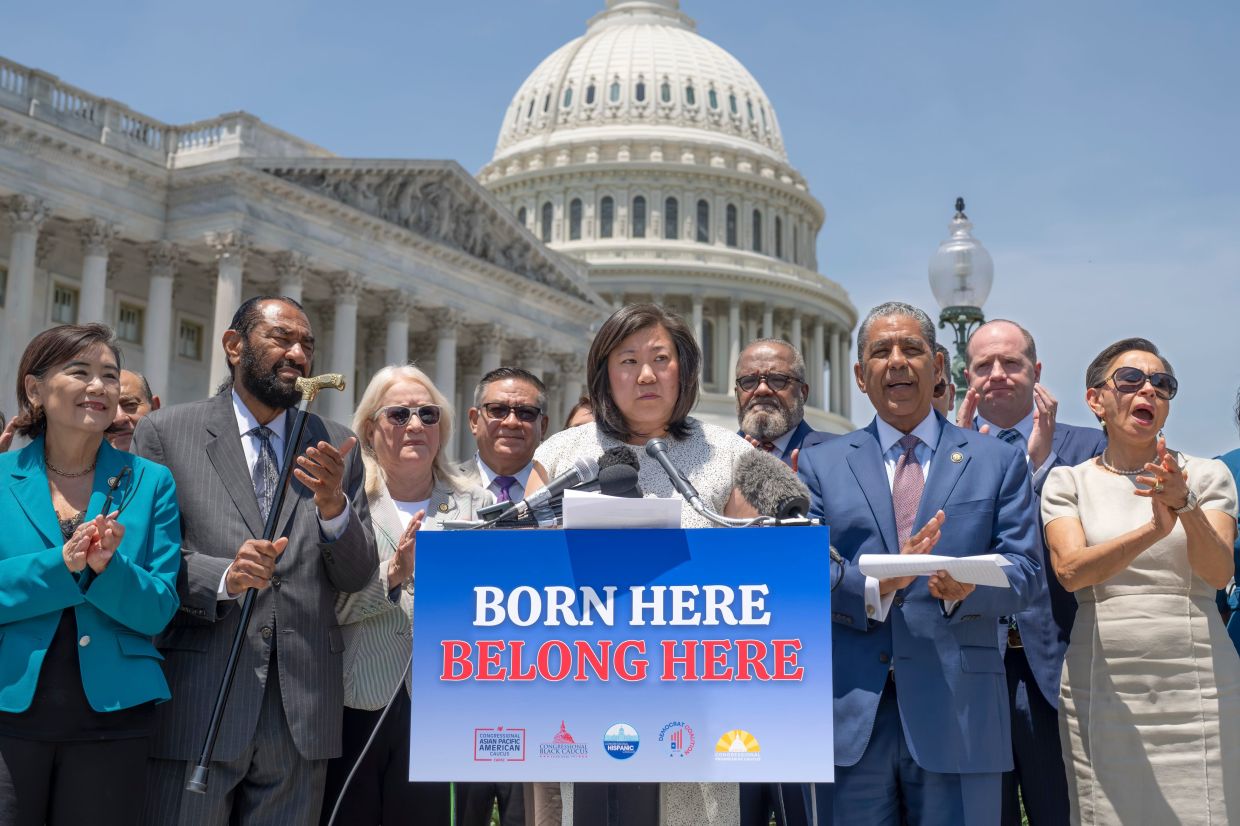
The United States Supreme Court has delivered a decisive blow to one of the Trump administration's signature immigration policies, ruling 6-3 in Trump vs Barbara that children born on American soil to undocumented parents or those on temporary visas retain their constitutional right to citizenship. The decision represents a major setback for the president's second-term agenda, which had positioned restricting birthright citizenship as a cornerstone policy objective. Trump signed an executive order in early 2025 designed to terminate citizenship eligibility for children of undocumented immigrants and temporary visa holders, though the Supreme Court intervened before the policy could take full effect.
The ruling has drawn sharp reactions from the White House. Trump took to social media to express his displeasure, calling the decision "too bad" for the nation while attempting to reframe defeat as merely a temporary setback. Rather than accepting the court's constitutional interpretation, Trump suggested Congress could achieve the same outcome through legislation, claiming that "no long and unwieldy Constitutional Amendment is necessary." He urged lawmakers to begin work immediately on ending what he characterised as an "expensive and unfair" policy, promising his "Complete and Total Support" for congressional action. The president also took aim at China in a separate post, congratulating President Xi and the country on a "massive Birthright Citizenship WIN," a reference to the administration's previous focus on birth tourism allegations.
What often goes unmentioned in public debates over birthright citizenship is that Trump's order actually targeted individuals with lawful immigration status rather than purely unauthorised entrants. The executive order would have stripped citizenship rights from children born to holders of highly skilled work visas including H-1B and L-1 categories, as well as those on dependent visas, student visas, temporary labour visas, and achievement visas—all categories classified as "lawful but temporary" by the US Citizenship and Immigration Services. The policy would have carved out an exception only for cases where at least one parent held US citizenship. This broader reach exposed a fundamental inconsistency in the administration's messaging, which had long emphasised unauthorised immigration as the primary concern while the actual policy swept in far more categories of people legally present in the country.
The Supreme Court's decision hinged on a close examination of the 14th Amendment's Citizenship Clause, a constitutional provision passed in 1866 and ratified in 1868 specifically to protect the rights of formerly enslaved people and other marginalised communities following the Civil War. Chief Justice John Roberts, writing for the majority, articulated a powerful vision of citizenship's foundational purpose: "Citizenship, then and now, was the right to have rights – to freely participate in our political community. The Framers of the Fourteenth Amendment extended that promise to 'every free-born person in this land'. We keep that promise today." The language echoed arguments made by civil rights advocates who contended that dismantling birthright citizenship would represent a regression to a darker chapter in American constitutional history.
The historical foundation for the court's position extends back more than a century. The 1898 Supreme Court decision in United States v Wong Kim Ark established the principle that nearly all persons born on American soil acquire citizenship regardless of their parents' nationality or immigration status. Wong, a Chinese-American born in San Francisco, had been denied re-entry to the United States after travelling to China when officials claimed the Chinese Exclusion Act prevented him from being considered a citizen based on his parents' immigration status. The landmark ruling struck down this discriminatory interpretation and established birthright citizenship as a nearly universal right. More than 125 years later, Wong's descendants publicly reflected on the decision's enduring significance, with Norman Wong, described as Wong Kim Ark's great-grandson, noting that "he was one man, only a cook, and yet he stood up for what was right, and I believe that it has made a difference."
The ruling carries particular significance for Asian-American communities, as advocacy organisations were quick to emphasise. Stop AAPI Hate released a statement noting that birthright citizenship has been instrumental in allowing Asian-American and other communities of colour to expand in size and political power, and identified the Trump administration's attempt to curtail it as a direct threat to these communities' continued growth and political influence. Krish O'Mara Vignarajah, president of Global Refuge, a non-profit focused on refugee advocacy, described the outcome as a victory for fundamental rights, suggesting that without birthright citizenship protections, "the maternity ward" would have essentially "become a customs checkpoint." The framing underscored concerns that the policy would have created unprecedented state intrusion into medical settings and family formation.
Birth tourism emerged as a secondary justification for the Trump administration's position, distinct from the primary focus on undocumented immigration that has traditionally dominated birthright citizenship debates. During Supreme Court oral arguments in April, Trump's top litigator, Solicitor General D. John Sauer, argued that birthright citizenship "has spawned a sprawling industry of birth tourism," claiming that "uncounted thousands of foreigners from potentially hostile nations have flocked to give birth in the" United States. The administration had previously highlighted a 2024 criminal case involving Michael Wei Yueh Liu and Jing Dong, a husband-and-wife team sentenced to 41 months in prison each for operating a birth tourism scheme that charged Chinese clients tens of thousands of dollars to facilitate births in America. The focus on China as the primary source of birth tourism reflected broader Trump administration concerns about Chinese nationals, though the extent and actual scale of the practice remained subject to significant dispute among policy analysts.
Following the Supreme Court's decision, the Department of Justice moved to shift focus toward prosecuting birth tourism schemes. In a memo released on Tuesday afternoon, DOJ officials directed federal prosecutors to prioritise investigations into such arrangements. Colin McDonald, a senior Justice Department official, wrote that "The Department of Justice will zealously protect the sanctity of United States citizenship by investigating and prosecuting those who fraudulently exploit our immigration system." The directive represented the administration's pivot from attempting to change the constitutional rule through executive order to pursuing prosecutions under existing legal frameworks. However, legal experts questioned whether aggressive prosecution alone could substantially reduce birth tourism or whether the practice would require international cooperation and visa policy changes to address meaningfully.
For Southeast Asian observers and Malaysian policymakers, the Supreme Court decision offers several instructive lessons about constitutional limits on executive power and the enduring influence of historical civil rights precedents on modern immigration policy. The case demonstrates how courts in established democracies can constrain executive action on immigration matters and how historical injustices—in this instance, the Chinese Exclusion Act and Jim Crow era discrimination—continue to shape contemporary constitutional interpretation. Additionally, the controversy over birth tourism highlights how immigration governance intersects with international relations, particularly regarding perceptions of Chinese nationals engaging in what some characterise as gaming immigration systems. For Malaysia and the region, which have experienced their own waves of immigration and increasingly grapple with questions about citizenship and belonging in diverse societies, the American case serves as a reminder that citizenship policies carry profound implications for political participation, social cohesion, and the fundamental rights of communities already present within national borders.

