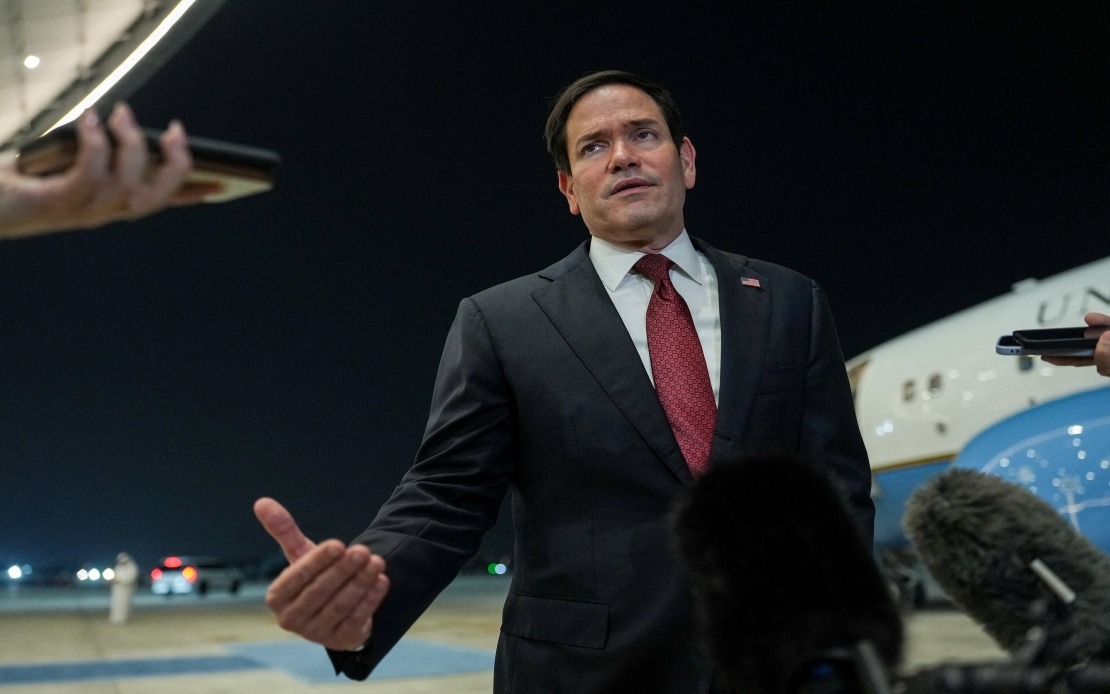
The United States will not provide financial support toward an Iran reconstruction fund, according to Secretary of State Marco Rubio, who sought to dispel speculation about American involvement in such an initiative. Speaking to journalists on Tuesday, Rubio characterised any such contribution as premature to discuss and emphasised that Washington's money would not feature in whatever arrangement might eventually materialise. His remarks came as regional players, particularly Gulf Arab states, reportedly weigh their own investment participation in potential economic programmes benefiting Iran.
Rubio's clarification addresses lingering uncertainty following President Donald Trump's earlier dismissal of reports regarding a purported $300 billion reconstruction fund. The Secretary of State indicated that while Iran might create economic opportunities through such a mechanism, the pathway forward hinges upon progress across several unresolved security dimensions. This conditionality underscores the Trump administration's broader negotiating stance, which ties economic cooperation to achievements in other contested areas between Washington and Tehran.
The context for these discussions emerges from recent diplomatic engagement between the two nations. Iran and the United States convened in Burgenstock, Switzerland, on Sunday, with Qatar and Pakistan facilitating the negotiations. The American delegation was headed by J.D. Vance, while Iran's parliamentary speaker Mohammad Bagher Ghalibaf led the Iranian contingent. Both sides subsequently announced that substantive progress had been achieved during these talks.
Moreover, the two countries recently signed a remotely executed memorandum last week designed to terminate the military conflict that commenced on 28 February. This agreement establishes specific timelines for critical actions: the United States is to remove its naval blockade affecting Iran, while Iran commits to reopening shipping lanes through the Strait of Hormuz. The memorandum thus addresses immediate security concerns that have defined the recent escalatory cycle between Washington and Tehran.
For Malaysia and other Southeast Asian nations closely monitoring developments in the Middle East, these negotiations carry substantial implications. The stability of the Strait of Hormuz directly impacts regional commerce, given that significant maritime trade corridors essential to Asian economies traverse these waters. A de-escalation reducing military tensions along this vital chokepoint would provide benefits extending well beyond Iran and the United States, stabilising shipping routes upon which Malaysian commerce depends. Conversely, should negotiations falter, the risk of renewed disruption could elevate already volatile energy and logistics costs across the region.
The nuclear dimension remains equally consequential for regional strategists. Iran has committed not to pursue weapons-grade nuclear capabilities under the memorandum, with detailed negotiations on its broader nuclear programme scheduled to commence within the next sixty days. This separate negotiation track will prove instrumental in determining whether the preliminary military de-escalation can translate into durable diplomatic normalisation. The resolution of Iran's nuclear status affects not only Middle Eastern security calculations but also global non-proliferation frameworks that influence international stability.
Rubio's emphasis that reconstruction fund decisions remain distant suggests the Trump administration prefers sequencing: resolving immediate security matters and nuclear concerns before contemplating economic reconstruction support. This approach reflects a preference for leveraging economic incentives as part of a comprehensive settlement rather than advancing them prematurely. Gulf Arab states, however, may pursue independent economic engagement with Iran irrespective of American participation, particularly if regional security improves sufficiently to justify such investments.
The role of Qatar and Pakistan as mediators deserves particular note for Malaysian observers. Both nations carry substantial diplomatic capital in Middle Eastern affairs and have demonstrated capacity to broker dialogue between adversaries. Their involvement suggests serious international effort underpinning these negotiations and indicates that regional actors view de-escalation as preferable to continued confrontation. For Southeast Asian countries including Malaysia, such successful mediation by regional powers exemplifies diplomatic approaches that can be adapted to local dispute resolution mechanisms.
Looking forward, the success of these negotiations will likely determine whether the reconstruction fund concept ever materialises meaningfully. Should the parties achieve breakthrough agreements on security and nuclear matters within the projected timeline, economic reconstruction could follow as a tangible manifestation of normalised relations. Conversely, if negotiations stall or revert to confrontation, the reconstruction fund will remain theoretical. Rubio's careful language avoiding American financial involvement while leaving room for Gulf participation suggests Washington intends to support regional actors taking economic risks, thereby distributing responsibility for outcome success while maintaining strategic flexibility.