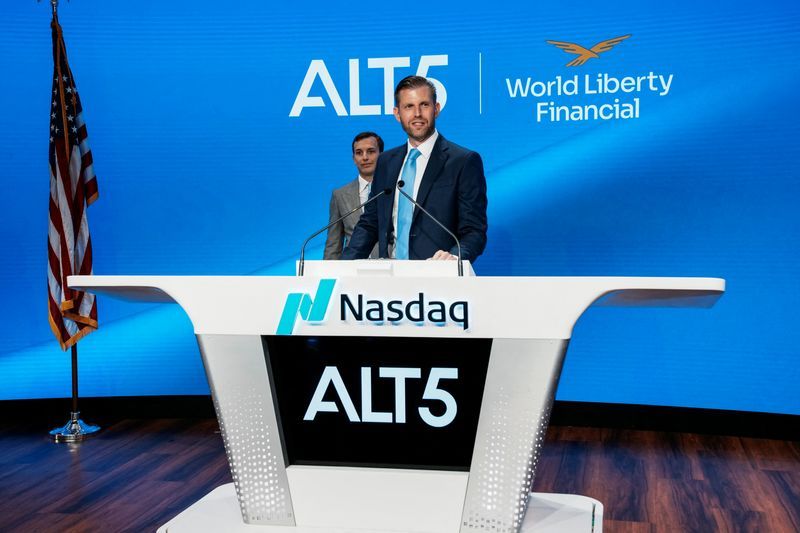
In a significant development for the cryptocurrency sector, the United States Office of the Comptroller of the Currency granted conditional preliminary approval on Friday to World Liberty Trust Company's application for a national trust charter, marking a major milestone for the Trump-family-backed digital assets venture. The decision effectively clears regulatory hurdles that had blocked the company's path toward operating as a federally chartered financial institution capable of managing cryptocurrency assets and issuing stablecoins under direct government supervision.
World Liberty Financial, co-founded in late 2024 by President Trump and his three sons alongside the Witkoff family—longstanding Trump allies—has emerged as one of the administration's most prominent cryptocurrency initiatives. The approval letter from the OCC, published on its website, outlined conditions that the company must meet before receiving final authorisation to operate its trust bank subsidiary, a structural arrangement that would fundamentally expand the reach and credibility of its operations across American markets.
The grant of this charter represents a watershed moment in how regulatory authorities now approach digital assets companies, particularly those with prominent political backing. Unlike traditional bank charters that permit deposit-taking and lending, a trust bank charter allows cryptocurrency firms to hold and manage client assets nationwide under a single federal regulatory framework, settle transactions with greater speed, and provide custodial services for reserve assets backing stablecoins. For World Liberty Financial specifically, the charter would enable the company to directly issue and manage its USD1 stablecoin, responsibilities currently delegated to cryptocurrency custody provider BitGo, substantially consolidating operational control within the organisation.
The conditional approval came with several mandatory requirements. World Liberty Financial must maintain at least $20 million in capital reserves, notify the OCC of any significant alterations to business strategy, and employ a qualified internal audit manager subject to regulatory standards. These provisions reflect standard practice in banking regulation but underscore the OCC's determination to establish rigorous oversight mechanisms even as it accommodates cryptocurrency sector expansion under the current administration's favourable policy environment.
The regulatory decision arrives amid intensifying industry momentum toward securing similar federal trust bank charters. Comptroller Jonathan Gould, appointed by Trump last year, has expedited approvals for multiple cryptocurrency firms, including Ripple and Circle, signalling a deliberate shift toward accommodating digital assets companies within the traditional regulatory framework. This approach contrasts sharply with the hesitation that characterised previous administrations and reflects the Trump administration's explicit commitment to fostering domestic cryptocurrency development as a competitive economic advantage.
Contention surrounding the approval centred on the participation of foreign investors in World Liberty Financial's ownership structure. The OCC disclosed that it had raised concerns about non-United States shareholders and subsequently obtained passivity agreements from several international investors, including those affiliated with the United Arab Emirates, pledging non-interference in operational decisions. Notably, Eric Trump, the president's son, signed one such agreement in his capacity as president of a Trump-family investment vehicle, a detail that prompted further scrutiny about potential conflicts of interest and the separation of family financial interests from public regulatory responsibility.
Democratic opposition to the charter materialised through multiple channels, with two Senate Banking Committee members requesting examination of national security implications following reports of a $500 million stake acquisition linked to the UAE's national security adviser announced in February. Critics argued that the charter approval represented an extraordinary conflict of interest, with Trump's appointed Comptroller potentially favouring ventures in which the president and his family held substantial financial interests. During congressional testimony, Democrats pressed Comptroller Gould to disclose complete unredacted application materials, contending that the publicly released version omitted crucial information about capital structure and business operations.
The OCC's response to such criticism maintained that Comptroller Gould and his staff had conducted the review consistently with statutory obligations and ethical guidelines, with career civil service examiners conducting substantive analysis and future supervision. However, the structural reality remains that the OCC, unlike most other financial regulators, operates without a bipartisan governance board, concentrating decision-making authority within a single political appointee's hands during a period of heightened partisan divide over regulatory philosophy.
World Liberty Financial's rapid expansion demonstrates the commercial momentum behind its core USD1 stablecoin, which achieved fourth-largest status by market capitalisation within months of its March 2025 launch, commanding approximately $4 billion in circulating supply. Reuters reporting indicates the Trump family generated roughly $50 million in earnings from USD1 operations through June 2026, with overall World Liberty Financial distributions to the president and his family exceeding $1.6 billion as of April. These figures underscore the financial significance of the venture and help explain the administration's regulatory enthusiasm for its advancement.
World Liberty Financial's stated mission emphasises democratising access to financial services by enabling users to circumvent what the Trump family characterises as an unnecessarily restrictive traditional banking infrastructure. This rhetorical framing—positioning cryptocurrency and blockchain technologies as liberatory alternatives to conventional finance—has resonated throughout the digital assets industry and provided ideological justification for regulatory accommodation. The company's USD1 stablecoin represents its flagship product, marketed as a stable, dollar-backed asset designed to facilitate blockchain-based financial transactions and asset management for retail and institutional clients alike.
For Southeast Asian investors and businesses, this development carries notable implications. The regulatory accommodation of cryptocurrency ventures within the United States framework may influence approaches adopted by regional financial authorities, many of whom have historically approached digital assets with considerable caution. Malaysia, Singapore, and other ASEAN economies monitoring international regulatory trends may face increased pressure to clarify their own cryptocurrency policies, particularly regarding stablecoin issuance and custody arrangements. The charter approval potentially establishes a competitive dynamic wherein countries offering streamlined cryptocurrency frameworks attract significant financial flows and entrepreneurial activity, prompting regional policymakers to reassess their regulatory positioning within the global cryptocurrency ecosystem.
Zach Witkoff, president and chairman of World Liberty Trust and son of Trump's special diplomatic envoy Steve Witkoff, welcomed the conditional approval as a watershed institutional moment. His statement emphasised that housing stablecoin issuance, custody, and reserve management within a federally supervised trust bank would subject World Liberty Financial to banking regulatory standards developed across generations, implicitly positioning the arrangement as conferring legitimacy and stability upon cryptocurrency operations. The Witkoff family's central role in World Liberty Financial—with Steve Witkoff serving as special diplomatic envoy while his brother Robert Witkoff will serve as a director, and nephew Zach Witkoff holding CEO responsibilities—exemplifies how Trump family business interests remain deeply intertwined with government administration, a structural reality that continues generating political controversy despite regulatory assurances of institutional independence.

