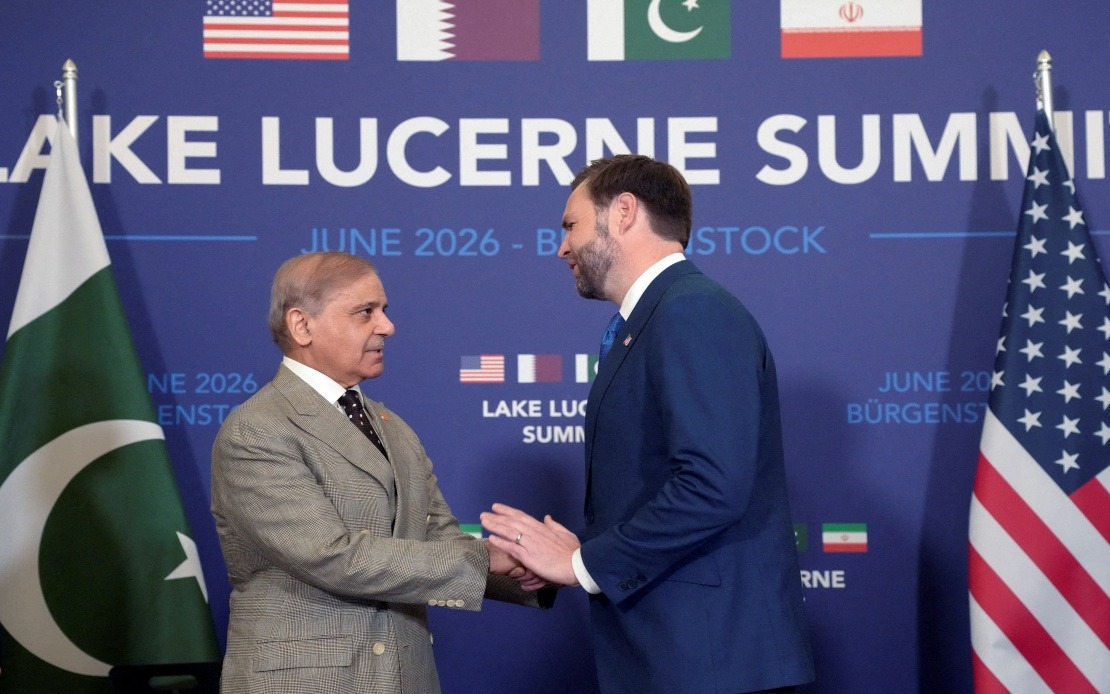
A delegation of senior American officials gathered with Pakistan's top civilian and military leadership at the Burgenstock resort in Switzerland on Sunday to discuss bilateral relations and regional security matters. The meeting brought together Vice President JD Vance, special envoys Steve Witkoff and Jared Kushner with Pakistan's Prime Minister Shehbaz Sharif and Pakistan Army Chief Field Marshal Asim Munir, marking a significant diplomatic engagement between the two countries at a crucial moment in global affairs.
The timing of this encounter holds particular significance as it unfolded alongside broader international negotiations aimed at resolving decades-long tensions between the United States and Iran. Technical-level discussions involving delegations from Iran, the US, Pakistan, and Qatar commenced at the same venue, with these talks deliberately conducted behind closed doors to allow for candid exchanges without public scrutiny. The parallel nature of these discussions suggests coordinated diplomatic efforts to address interconnected regional security challenges.
Days earlier, Iran and the United States had reached a substantial breakthrough by electronically signing a memorandum in the early hours of June 18. This agreement represents a watershed moment in bilateral relations, establishing a framework to conclude the military confrontation that escalated dramatically on February 28. The accord goes beyond merely ceasing hostilities, incorporating detailed provisions that address the mechanics of de-escalation between two nations whose adversarial relationship has shaped Middle Eastern geopolitics for generations.
Central to the memorandum are specific timelines governing how both nations will unwind their militarised postures. The United States has committed to lifting its naval blockade, a measure that has constrained Iranian economic activity and regional trade flows. In reciprocal fashion, Iran has agreed to restore its shipping operations through the Strait of Hormuz, one of the world's most critical maritime chokepoints through which a substantial proportion of global energy supplies transit daily. The restoration of these shipping lanes carries implications extending far beyond Iran and the US, affecting global energy prices and supply chain stability that matter directly to Southeast Asian economies dependent on reliable petroleum imports.
The nuclear dimension remains perhaps the most contentious aspect of the accord. Iran has formally undertaken not to pursue the development of nuclear weapons, a commitment that addresses the central concern driving decades of international pressure and sanctions. However, the parties recognised that resolving the specifics of Iran's nuclear programme requires a separate, dedicated agreement. Rather than attempting to resolve this extraordinarily complex technical and political issue within the initial memorandum, negotiators established a 60-day window for reaching a comprehensive understanding on how Iran's nuclear activities will be monitored, limited, and verified going forward.
For Iran, the tangible benefit materialising from these negotiations would be the removal of international sanctions that have severely constrained its economy. These restrictions have touched nearly every sector of Iranian commerce, from energy exports to banking relationships, effectively isolating the country from global financial systems. The lifting of sanctions represents Tehran's primary objective, making the successful conclusion of the nuclear negotiations essential to justifying domestic political costs associated with the military stand-down and strategic concessions embedded in the current agreement.
Pakistan's presence at these negotiations warrants careful consideration regarding its regional role and strategic positioning. As a neighbour to Iran and a long-standing security ally of the United States, Pakistan occupies a delicate diplomatic space. The country has significant interests in Middle Eastern stability given its substantial expatriate population working in Gulf countries, the influence of regional conflicts on its own sectarian dynamics, and its broader foreign policy objectives. Pakistan's participation as a mediator alongside Qatar suggests both nations see themselves as honest brokers capable of facilitating dialogue between regional and international powers.
The involvement of special envoys Witkoff and Kushner indicates the White House's prioritisation of this diplomatic initiative at the highest levels. These individuals carry direct authority to negotiate on behalf of the administration, signalling that decisions reached in these discussions can be rapidly operationalised without lengthy bureaucratic consultation. The presence of Vice President Vance underscores the administration's personal investment in achieving outcomes that demonstrate successful foreign policy achievement.
For Southeast Asian nations including Malaysia, the implications of these developments extend across several domains. Regional stability in the Middle East and the Persian Gulf directly affects the availability and pricing of oil imports upon which many Southeast Asian economies depend. Reduced tensions and restored shipping capabilities should theoretically benefit energy markets and reduce geopolitical premiums currently embedded in crude oil pricing. Additionally, any framework that successfully manages great power competition through negotiation rather than military escalation provides a template potentially applicable to other regional tensions, including those affecting Southeast Asia.
The diplomatic architecture being constructed at Burgenstock represents a significant experiment in managed great power relations. Whether the technical discussions currently underway can translate into a durable comprehensive nuclear agreement within the prescribed 60-day timeframe remains uncertain. However, the willingness of all parties to engage in sustained dialogue, the involvement of respected mediators, and the establishment of concrete deadlines suggest genuine commitment to resolving longstanding disputes through negotiation rather than confrontation.
The coming weeks will prove critical in determining whether this diplomatic opening can deliver concrete results. The technical complexities of nuclear verification, the political sensitivities within both Iran and the United States regarding any agreement, and the regional implications all present formidable obstacles. Nevertheless, the gathering at Burgenstock demonstrates that even relationships fractured by decades of hostility can be repaired through sustained engagement and creative diplomacy. For observers across Southeast Asia watching these developments, the fundamental lesson concerns the persistent possibility of negotiated solutions to even the most intractable international disputes.

