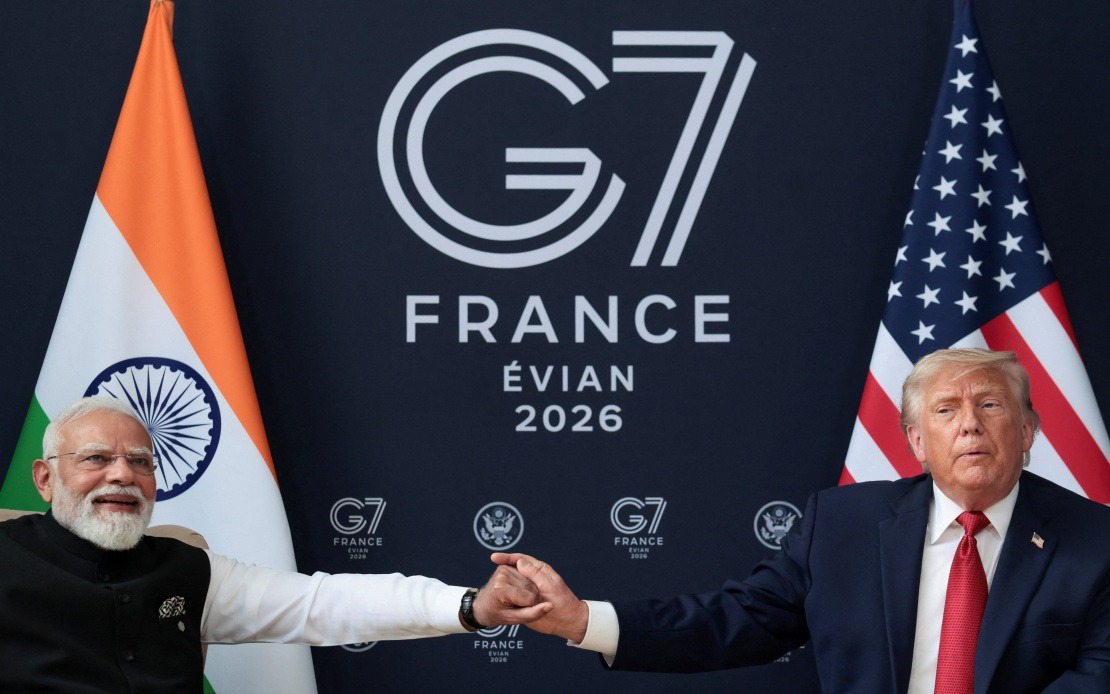
India has declared that meaningful momentum is building in long-running trade negotiations with the United States, marking a potential breakthrough in discussions that have dragged on for months. The announcement came after Prime Minister Narendra Modi and US President Donald Trump held bilateral talks on the sidelines of the Group of Seven summit held in Evian, France, on Wednesday. Both leaders instructed their respective negotiating teams to accelerate work on what officials describe as an interim agreement that would be balanced and commercially viable for both sides.
The Indian External Affairs Ministry formalised the progress in an official statement, noting that both governments are committed to finalising an accord that serves mutual commercial interests. The diplomatic language underscores the complexity of these negotiations, which have involved contentious tariff disputes and geopolitical considerations. Crucially, the statement indicated that US Trade Representative Jamieson Greer would travel to India the following week to maintain momentum on the negotiations, suggesting that high-level engagement will intensify over coming days.
Trump's characterisation of Modi as one of the world's toughest negotiators reveals something of the dynamic at play in these discussions. The American president, during remarks at the G7 summit, said Modi was "as tough as a killer" despite his gentle appearance, suggesting that India has been firm in protecting its economic interests throughout the negotiation process. This candid assessment reflects the reality that both nations have significant leverage and competing priorities, making compromise difficult but not impossible.
The context for these negotiations is shaped by severe trade tensions that erupted in 2025. Trump imposed 25 per cent tariffs on Indian goods and added a further 25 per cent penalty specifically targeting Indian purchases of Russian oil. These punitive measures struck at the heart of India's strategic autonomy and energy security, as New Delhi has long relied on affordable Russian crude to fuel its growing economy. The tariffs were part of a broader Trump administration strategy to reshape global trade relationships and penalise countries deemed to be acting against American interests.
In February 2025, the two countries managed to reach an interim accord that represented some de-escalation of tensions. Under that agreement, the United States reduced its tariff rate to 18 per cent, a significant retreat from the original 25 per cent level. However, the additional tariff on Russian oil purchases remained in place, highlighting the contentious nature of India's energy partnerships and the difficulty of finding common ground on geopolitical matters intertwined with commercial relationships.
For Southeast Asian nations including Malaysia, this trajectory matters considerably. A deeper US-India trade relationship could reshape regional commerce and investment flows, potentially drawing capital and supply chains towards the Indo-Pacific region in ways that benefit some economies while challenging others. Malaysia's own trade relationships with both Washington and New Delhi mean that a comprehensive bilateral deal could create new opportunities for regional commerce or alternatively shift competitive dynamics in ways that require careful adaptation.
The interim agreement framework suggests that both countries are exploring sectoral approaches to trade liberalisation rather than a single sweeping pact. This modular approach allows negotiators to make progress on less contentious items while quarantining disagreements on sensitive sectors. Agriculture, pharmaceuticals, technology, and services likely represent areas where both nations see mutual benefit, though intellectual property protection and market access for Indian workers remain perennial flashpoints in US-India trade discussions.
India's position in these negotiations reflects its desire to maintain strategic space while deepening economic ties with the United States. As a nation that values non-alignment and partnerships with multiple powers, India cannot afford to appear to be capitulating to American pressure on matters like Russian energy purchases. Simultaneously, India recognises that deeper integration with the US economy could accelerate its development and technological advancement. This tension between strategic autonomy and economic pragmatism has defined India's negotiating posture throughout.
The timeline suggested by the official announcements indicates that both sides view completion of negotiations as urgent. By dispatching Trade Representative Greer to India immediately following the G7 summit, the Trump administration is signalling seriousness about reaching a deal relatively quickly. However, urgency does not necessarily translate into rapid agreement, particularly when significant economic and strategic interests remain contested. Previous attempts to conclude US-India trade agreements have repeatedly stalled over disagreements on tariff reduction schedules, rules of origin requirements, and protection for sensitive domestic industries.
For Malaysian businesses and policymakers, developments in US-India trade relations warrant close monitoring. A successful agreement could reshape regional supply chains, particularly in technology, automotive components, and pharmaceuticals where both countries possess significant capabilities. Conversely, if negotiations fail or produce only modest results, it could signal broader difficulties in the Trump administration's trade agenda and suggest that bilateral tensions may persist, creating unpredictability for regional economies dependent on stable trade patterns.
The statements emerging from the G7 summit suggest that both Washington and New Delhi recognise the political value of demonstrating progress, regardless of the substantive breakthroughs achieved. However, the dispatch of senior officials for follow-up negotiations indicates that this momentum must translate into concrete outcomes if credibility is to be maintained with domestic audiences and trading partners. The coming weeks will determine whether the "significant progress" announced represents genuine movement towards resolution or merely diplomatic theatre masking continued fundamental disagreements.

