The Upper Rajang Development Agency (URDA) is embarking on a strategic pivot to reshape the region's economic foundations by forging closer ties with educational institutions, state development bodies, and grassroots communities. The initiative aims to transition the rural economy from a commodity-dependent model toward a knowledge-intensive framework centred on innovation, technological adoption, and premium-grade products. This reorientation represents a significant departure from traditional approaches that have historically anchored the region's prosperity to resource extraction and primary production.
Datuk Seri Alexander Nanta Linggi, who chairs URDA and serves as Member of Parliament for Kapit and Minister of Works, articulated the rationale behind this structural reform during a recent engagement at Universiti Sains Malaysia's facilities in Kelantan. He emphasised that sustainable rural prosperity can no longer rest on supplying basic raw materials to external markets. Instead, communities must be equipped to construct integrated value chains—networks of interconnected economic activities that allow local producers to capture greater margins and exert meaningful influence over market positioning and pricing dynamics.
The agency's confidence in this approach stems partly from demonstrable outcomes of its High Impact Community Projects (HICP) initiative. Participating households have recorded income improvements averaging more than 25 per cent, a performance metric that Nanta cited as evidence that strategic investments in research capability, cutting-edge methods, and systematic knowledge dissemination can translate into material welfare gains. These results suggest that the formula of combining institutional expertise with community engagement holds genuine transformative potential for regions historically marginalised from modern economic activity.
Nanta's conception of the university's role extends beyond its traditional association with theoretical research and scholarly publication. He positioned higher education institutions as instrumental economic development partners whose research agendas, when deliberately calibrated to address community requirements and resourced by both public authorities and implementation agencies, yield outcomes transcending laboratory experimentation. The resulting innovations, he argued, generate authentic economic openings capable of reshaping household incomes and living standards across affected populations.
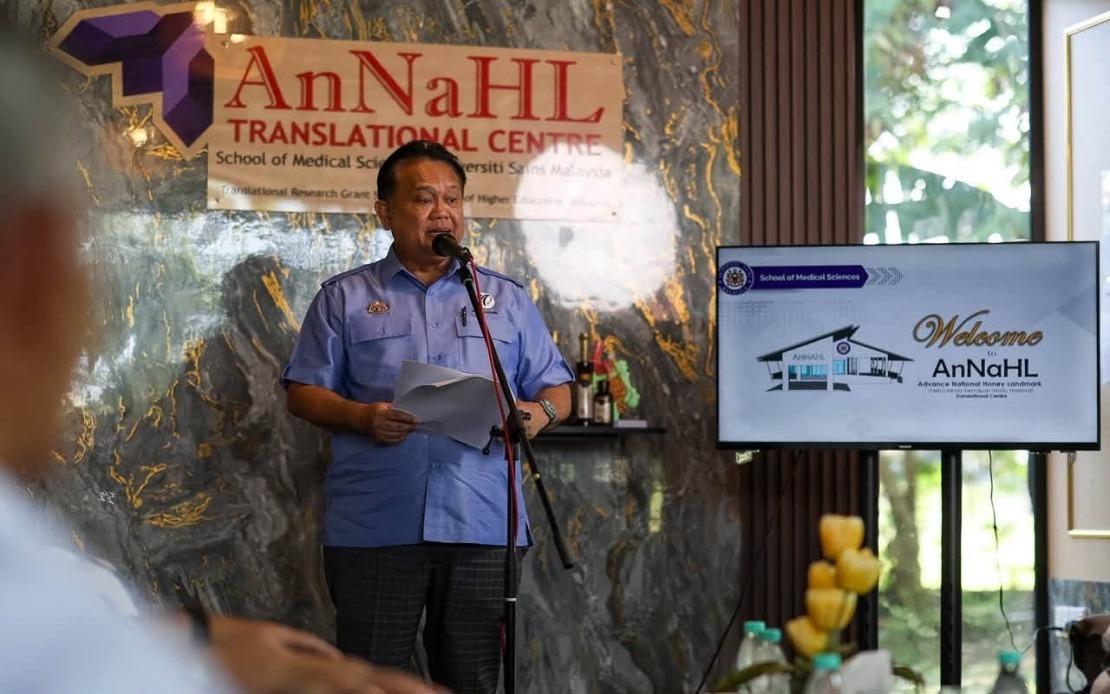
The strategic framework gained concrete expression through a joint field visit by delegations from URDA and the Regional Corridor Development Authority (RECODA) to the Advanced National Honey Landmark Translational Centre situated at USM's Health Campus in Kubang Kerian. This facility exemplifies the type of institutional infrastructure that can bridge academic research with commercial application and community benefit. The centre's mandate spans production processes, market positioning, skills development, and sectoral advancement—functions that position it as a potential model for how universities can serve as active drivers of rural economic transformation rather than passive knowledge repositories.
Within the Kapit parliamentary constituency specifically, URDA has designated multiple locations as priority zones for intensive community economic projects. The stingless bee sector emerged as a focal area, reflecting broader regional potential in high-value agricultural specialties that command premium pricing in both domestic and export markets. Such commodities offer rural households pathways to substantially elevated income without requiring large-scale capital investment or technological infrastructure beyond their acquisition capacity. The selection process itself indicates a strategic approach that maps local ecological endowments and cultural competencies onto market opportunities.
The stingless bee sector exemplifies the economic logic underlying URDA's reorientation. Indigenous to tropical Southeast Asia, these species generate honey, propolis, and other bee products commanding prices significantly exceeding conventional honey on international markets, particularly among consumers valuing traditional and organic certification. For small-scale rural producers, this value differential proves transformative. However, realising these gains requires capacity in processing, quality assurance, regulatory compliance, and market navigation—precisely the functions that institutional partnerships with universities and development agencies are designed to provide.
The translational centre serves multiple functions within this ecosystem. It functions as a technical resource for producers navigating the transition from subsistence-level activity to commercial operation. It offers facilities for value-addition processing, where raw products undergo transformation into finished goods commanding higher market prices. It provides training in production methodology, safety protocols, and quality standards demanded by domestic and international buyers. Equally, it furnishes market intelligence and connection pathways that enable rural suppliers to reach institutional purchasers, wholesale distributors, and export networks otherwise inaccessible from remote locations.
For Malaysian policymakers and regional development practitioners, URDA's approach holds broader significance. Southeast Asia's rural populations comprise hundreds of millions of people whose livelihoods remain vulnerable to commodity price fluctuations and competition from lower-cost producers in other nations. Transitioning these populations toward higher-value, innovation-intensive economic activities represents a central challenge for regional development. URDA's framework—emphasising university partnerships, knowledge transfer, community capacity building, and technology adoption within value chains—offers a replicable template that other agencies and jurisdictions might adapt to local circumstances.
The emphasis on sustainability through indigenous knowledge integration adds another dimension. Rather than imposing external development models, URDA's approach recognises and builds upon existing community competencies in stingless bee management and other traditional practices. This culturally-grounded methodology increases the likelihood of genuine community ownership and participation, factors historically critical to development initiative success. When communities perceive innovations as enhancements to existing capacities rather than replacements for traditional knowledge, adoption rates and commitment levels typically improve substantially.
The partnership framework also addresses a critical gap in conventional development programming. Many rural communities possess substantial entrepreneurial energy and latent productive capacity but lack institutional connections and technical guidance necessary to access broader markets. Universities and development agencies can function as intermediaries, translating research into applicable forms and connecting dispersed producers to collective marketing platforms and commercial intelligence networks. This intermediation function—connecting supply with demand at scales and quality standards exceeding what individual household operations can achieve independently—proves essential for actualising economic opportunity.
Looking ahead, the success of URDA's initiatives will hinge upon consistent institutional commitment, adequate resourcing of university partnerships, and genuine integration of community voices into planning and implementation processes. The 25 per cent income gains documented in HICP projects suggest substantial potential. However, scaling these outcomes across larger populations and geographies will demand sustained policy attention and investment commitment beyond typical project cycles. For rural Sarawak and comparable regions across Southeast Asia, whether URDA's innovation-centred approach achieves transformative impact at scale remains a test case with implications extending far beyond the Upper Rajang region.

