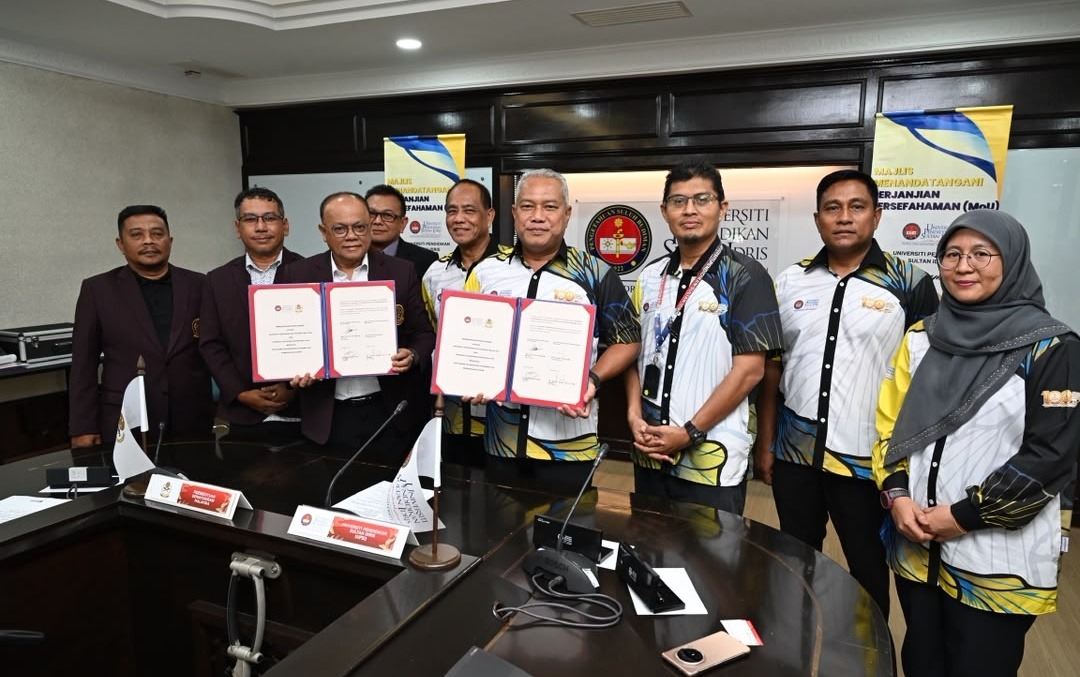
Universiti Pendidikan Sultan Idris (UPSI) and the Malaysian Sepaktakraw Federation (PSM) have formally established a strategic partnership aimed at strengthening the nation's sepak takraw ecosystem through integrated education and athletic development. The Memorandum of Understanding, signed at the Chancellery Building on Sultan Abdul Jalil Shah Campus in Tanjong Malim, represents a significant institutional commitment to bridging the traditional divide between competitive sport and academic pursuits.
The agreement addresses a longstanding challenge in Malaysian sports: enabling high-performing athletes to advance their education without compromising their athletic careers. UPSI Vice-Chancellor Prof Datuk Dr Md Amin Md Taff emphasised that the partnership transcends symbolic gestures, committing the university to concrete implementation through tailored academic pathways. The institution pledges to accommodate qualified sepak takraw athletes at all levels of study, with flexible scheduling designed to accommodate training regimens and tournament participation without sacrificing educational rigour.
This collaborative framework carries particular relevance for Malaysian sports policy. Sepak takraw, a Southeast Asian sport with deep cultural roots in the region, has historically struggled to maintain competitive pathways that also prioritise athlete welfare and post-sport employment prospects. By formalising education access through a university partnership, UPSI and PSM establish mechanisms that could reduce the precarity many athletes face when their playing careers conclude. The three-year initial tenure, renewable by mutual agreement, allows both parties to evaluate impact and refine approaches based on practical experience.
Beyond educational access, the MoU commits UPSI to leveraging its substantial technical capabilities for sepak takraw advancement. The university will share expertise spanning coaching methodology, sports science applications, officiating standards, and emerging sports technology. These contributions address a critical infrastructure gap in Malaysian sepak takraw, where access to world-class analytical and training resources remains unevenly distributed. UPSI's involvement signals that elite sports development requires institutional infrastructure typically concentrated in universities rather than federation resources alone.
Talent identification and development emerge as central pillars of the collaboration. The agreement establishes pathways for athletes from Malaysian Sports Schools and State Sports Schools to transition into university-level competition while pursuing formal qualifications. This creates a developmental pipeline addressing a chronic gap in Malaysian sports structures: the transition between school-level programmes and national team selection. Athletes can now develop within supported environments where academic progression parallels athletic advancement, mitigating the boom-bust cycles that characterise many Southeast Asian sports systems.
The partnership also contemplates establishing a dedicated national training centre for sepak takraw, though implementation details remain subject to future Memoranda of Agreement. Such a facility would consolidate currently dispersed training activities and provide standardised conditions for athlete preparation. For a sport competing for resources against more financially lucrative codes, institutional backing from a major university substantially increases prospects for sustained investment in facilities and personnel.
PSM Vice-President Tengku Zaihan Che Ku Abdul Rahman framed the collaboration as combining PSM's technical expertise with UPSI's sports science capabilities. This articulation reveals the complementary nature of the partnership: federations typically excel in sport-specific technical knowledge and competition management, while universities command infrastructure, research capacity, and educational delivery systems. The synergy creates potential advantages that neither institution could independently replicate.
The agreement carries broader implications for Malaysian higher education's engagement with national sports development. Universities have historically maintained arms-length relationships with competitive sport, treating athletics as extracurricular rather than integral to institutional missions. UPSI's formal partnership signals a reorientation toward universities as anchors in national sports systems. This positioning aligns with international practice, where institutions like University of Sport Science in Bangkok or University of Physical Education in Thailand drive national athletic competitiveness through integrated programmes.
For Southeast Asian context, the UPSI-PSM model offers a replicable framework for other sports federations and higher education institutions. Sepak takraw remains predominantly a Southeast Asian sport with limited global commercial appeal, making university partnerships particularly crucial for sustaining competitive standards and athlete development. The agreement's potential to serve as a reference model, as Tengku Zaihan suggested, could influence how other associations approach academic collaborations across Malaysia, Thailand, Vietnam, and Indonesia.
The financial implications merit consideration. By integrating athlete support into university operations, institutions absorb costs that might otherwise fall entirely on federation budgets. This distributed responsibility model increases sustainability compared to federation-led development reliant on government allocations or sponsorship volatility. UPSI gains sporting excellence aligned with its mission as an education university; PSM gains institutional resources and credibility for athlete welfare provisions.
Implementation challenges will test the partnership's durability. University academic calendars, competition schedules, and training cycles operate on different rhythms, requiring sophisticated coordination. Success depends on genuine institutional commitment extending beyond administrative sign-off to involve academic departments in athlete recruitment, course design, and progress monitoring. The transition from MoU to operational Memoranda of Agreement will reveal whether both parties maintain sufficient alignment to translate ambitions into sustained action.
The agreement's three-year initial term allows sufficient duration to establish patterns and demonstrate measurable outcomes, yet remains short enough that either party can reassess before extended commitment. This timeframe suggests realistic institutional thinking rather than aspirational wishfulness. For Malaysian sepak takraw, such pragmatism may ultimately prove more valuable than grand pronouncements, establishing a genuine institutional foundation for athlete development that can survive individual leadership changes and shifting governmental priorities.

