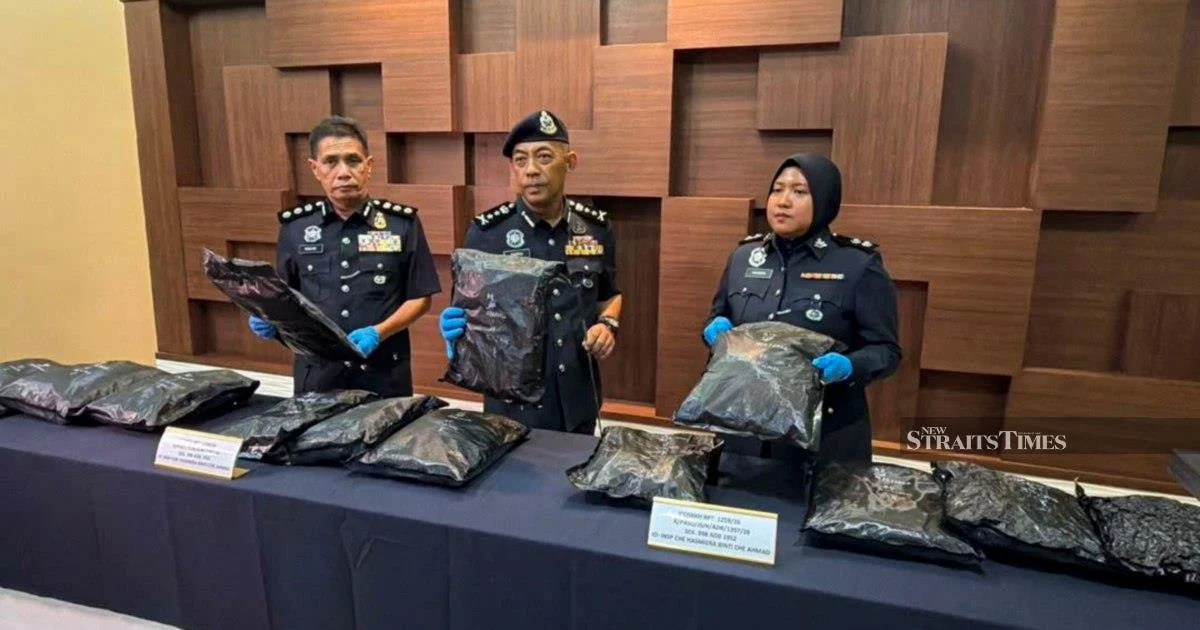
A student attending a private higher education institution has been taken into custody following an attempted smuggling operation at Bukit Kayu Hitam, with narcotics officials seizing a substantial quantity of cannabis buds during the operation. The arrest, which occurred on Monday, marked a significant drug interception along Malaysia's northern border corridor, where enforcement activity has intensified in response to trafficking pressures in recent months.
The 14.63 kilogrammes of cannabis buds recovered during the interception carry an estimated street value of RM1.17 million, according to preliminary assessments by the narcotics division. This substantial haul underscores the commercial scale of the operation, suggesting the suspect was engaged in transportation rather than personal consumption. The method of smuggling and the quantity involved indicate involvement in a wider distribution network that likely extends beyond the student's direct involvement.
Bukit Kayu Hitam, positioned as a critical gateway on Malaysia's northwestern frontier, has emerged as a focal point for drug trafficking interdiction efforts. The location's strategic importance as a border crossing between Malaysia and Thailand makes it particularly vulnerable to transnational smuggling operations. Authorities have progressively upgraded screening mechanisms at this checkpoint, and this seizure reflects the effectiveness of enhanced vigilance protocols implemented across major entry points.
The arrest raises pertinent questions about the recruitment patterns used by organised drug syndicates to leverage university students as couriers. Young academics present an attractive target for trafficking networks due to their mobility, relative freedom of movement, and perceived lower risk profile compared to professional smugglers. The use of students as transporters also reflects broader vulnerabilities within higher education communities across Southeast Asia, where socioeconomic pressures and limited awareness of legal consequences can make enrollees susceptible to criminal exploitation.
Law enforcement agencies in Malaysia have documented an escalating trend of drug smuggling attempts along northern land borders, with cannabis-related seizures constituting a growing proportion of interdictions. The potency and refined nature of contemporary cannabis products, particularly buds and concentrated forms, have shifted criminal focus toward smaller quantities with proportionally higher market values. This shift has enabled smugglers to operate more discreetly while maintaining substantial profit margins, creating detection challenges for customs and narcotics personnel.
The detention of the student represents a critical intervention point within a smuggling pipeline that typically involves multiple nodes across the supply chain. Investigators will likely pursue leads into the broader criminal apparatus responsible for sourcing, consolidating, and dispatching such shipments. The interrogation of the arrested individual may yield intelligence regarding cross-border coordination networks, financial arrangements, and downstream distribution arrangements operating within Malaysian territory.
Private institutions of higher learning have increasingly become focal points for law enforcement attention regarding student involvement in criminal enterprises. While the vast majority of students maintain lawful conduct, the accessibility of campus environments and the relative anonymity afforded by large student bodies create operational advantages for criminal recruiters. Security frameworks at such institutions remain substantially less robust than government-funded alternatives, potentially facilitating illicit activities within residential and academic facilities.
The RM1.17 million valuation assigned to this seizure reflects both the quantity and the premium market pricing for cannabis products in Malaysia, where supply constraints maintain elevated prices relative to source countries. Cannabis trafficking networks operating in Southeast Asia have increasingly professionalised their operations, establishing sophisticated logistics systems that exploit regulatory gaps and border management inefficiencies. The involvement of a student in this particular operation suggests that networks are actively diversifying their courier profiles to evade detection patterns based on demographic and behavioural profiling.
Regional cooperation frameworks between Malaysian and Thai authorities have enhanced border security protocols, yet sophisticated smuggling operations continue to adapt and circumvent enforcement measures. The Bukit Kayu Hitam crossing experiences substantial legitimate traffic flows, which criminal operators exploit by embedding illicit shipments within broader cargo movements. The successful interception of this consignment demonstrates that enhanced screening capabilities are generating meaningful results, though the persistence of such attempts indicates that perceived profit opportunities continue to incentivise smuggling risks despite criminal penalties.
The prosecution pathway for this case will likely proceed under Malaysia's Dangerous Drugs Act, with sentencing provisions carrying substantial custodial terms and monetary penalties. The circumstances surrounding recruitment, awareness of contraband nature, and degree of culpability within the broader trafficking hierarchy will factor into judicial determinations. Student defendants often receive scrutiny regarding rehabilitation potential versus public safety considerations, though trafficking volumes at this level typically preclude lenient sentencing outcomes under Malaysian jurisprudence.
The arrest carries broader implications for campus security and student welfare frameworks at Malaysian private institutions. Educational administrators will face increased pressure to implement preventative initiatives addressing vulnerability to criminal recruitment, including awareness campaigns, counselling services, and enhanced coordination with law enforcement agencies. Universities maintain responsibility for fostering environments where students can pursue education without exposure to criminal exploitation, requiring proactive engagement beyond traditional security infrastructure.