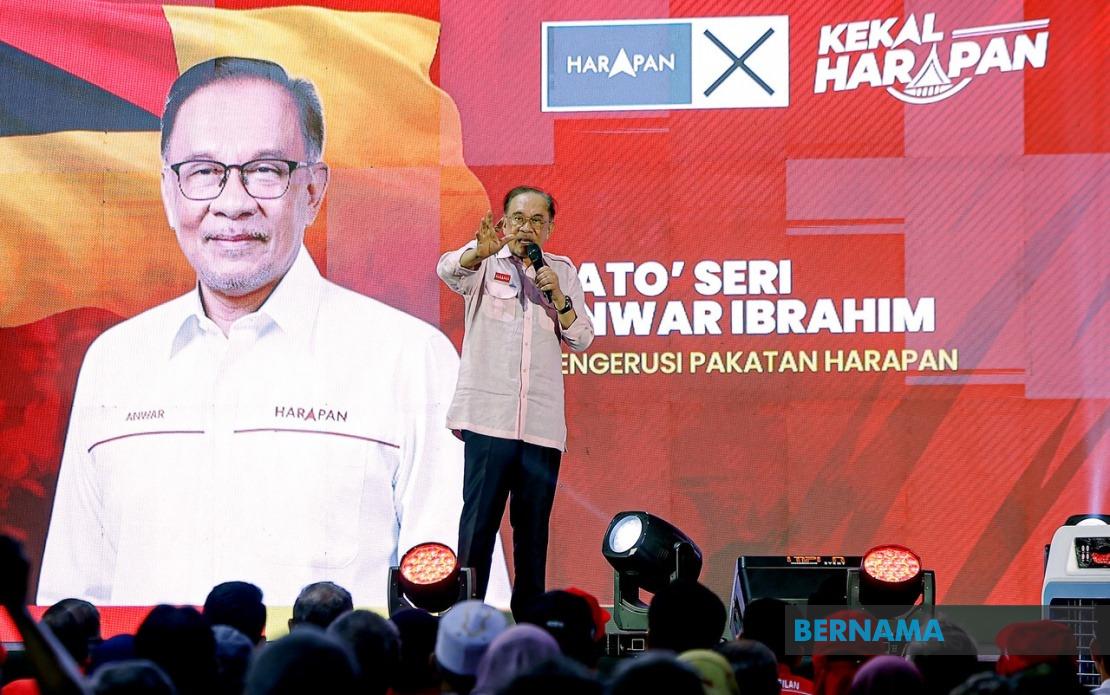
Prime Minister Datuk Seri Anwar Ibrahim moved to reassure stakeholders that the federal coalition supporting his administration continues to function effectively, declaring from Seremban that the Unity Government's strength at the national level has not been compromised. In remarks aimed at addressing concerns about potential fractures within the multiparty alliance, Anwar stressed that maintaining governmental cohesion at the federal tier remains crucial for sustaining Malaysia's economic momentum and preserving the country's appeal to foreign investors.
The prime minister's comments arrived amid a backdrop of simultaneous electoral campaigns at the state level, where component parties of the federal coalition compete against one another in pursuit of regional mandates. This apparent contradiction—coalitional partners functioning as collaborators in Putrajaya while functioning as competitors in state capitals—has long posed a structural tension within Malaysia's federal system. Anwar sought to demonstrate that this duality need not undermine the central government's effectiveness or the unity framework that has underpinned federal governance since the 2022 general election.
Cabinet operations have proceeded without significant disruption, according to Anwar's account, with routine ministerial meetings chaired by the prime minister demonstrating the operational normalcy of federal administration. He specifically referenced recent cabinet sessions involving key figures including Minister of Agriculture and Food Security Datuk Seri Mohamad Sabu, Transport Minister Anthony Loke, and Deputy Prime Minister Datuk Seri Dr Ahmad Zahid Hamidi, framing their continued collaboration as evidence of institutional stability. The regularity and coherence of these proceedings, Anwar suggested, contrasts with potential dysfunction that might arise from deep internal divisions.
The distinction Anwar drew between state-level friction and federal-level equilibrium reflects the pragmatic compartmentalization that has enabled the Unity Government to function across disparate political terrain. While acknowledging that tensions and competing interests inevitably surface at the subnational level, where electoral incentives encourage aggressive intracoalition rivalry, the prime minister sought to establish that such pressures have not permeated the federal decision-making apparatus. This separation of concerns—allowing states to be battlegrounds while maintaining federal collaboration—constitutes the implicit covenant upon which the coalition's continuity depends.
Investor confidence emerges as a critical variable in Anwar's framing of governmental stability. The prime minister's emphasis on reassuring international business interests underscores the economic logic underpinning coalition maintenance: foreign capital flows depend substantially on the perception of political predictability and policy continuity. Disruptions to federal governance, whether through coalition collapse or internecine conflict, could signal to markets that Malaysia faces governance uncertainty, potentially triggering capital flight or dampening new inflows. By stressing that cabinet operations remain unaffected by state-level competitions, Anwar seeks to convey that systemic political instability has not materialized.
The invocation of "Insha'Allah," or God willing, in Anwar's public remarks carries particular significance given Malaysia's multicultural political landscape and the prime minister's own religious credentials. The phrase suggests both humility regarding future contingencies and an appeal to shared values that transcend partisan division. By framing the coalition's hoped-for continuation as subject to divine will, Anwar appeals to religious constituencies within the Unity Government's broader coalition, encompassing Malay Muslim parties alongside non-Muslim and secular-oriented partners.
For Malaysian observers monitoring federal stability, Anwar's comments constitute a categorical reaffirmation that the coalition architecture remains functional despite surface-level turbulence. The Unity Government, assembled following the 2022 election and refined through subsequent political negotiations, has now operated for an extended period without collapsing into the cabinet crises or parliamentary confidence votes that periodically threatened prior administrations. This relative longevity, Anwar's comments suggest, reflects genuine commitment among coalition partners to preserving federal governance frameworks rather than momentary convenience or temporary accommodation.
The timing of these remarks, arriving as state-level electoral activity accelerates, appears strategically calibrated. By preemptively addressing potential concerns about coalition cohesion, Anwar aims to prevent state-level election campaigns from destabilizing federal governance narratives. Opposition parties seeking coalition collapse have long attempted to weaponize state rivalries as evidence of broader disunity; Anwar's proactive statements attempt to neutralize such arguments by establishing that federal institutions function independently of state electoral outcomes. This rhetorical positioning allows the coalition to campaign competitively at subnational level while maintaining unified federal messaging.
The broader implications for Southeast Asia extend beyond Malaysia's borders. Coalition governments and multiparty administrative arrangements proliferate throughout the region, from Thailand to Indonesia to the Philippines. Malaysia's Unity Government experiment thus carries demonstration value for how heterogeneous political alliances can maintain executive functionality despite inherent tensions. Should Anwar's coalition prove durable while managing competing state-level interests, it may offer a model for other Southeast Asian democracies grappling with fragmented political landscapes that resist single-party dominance.
Economic considerations remain paramount in evaluating coalition performance, particularly for a country like Malaysia that depends substantially on international trade, foreign investment, and regional manufacturing integration. Any perception that federal governmental divisions threaten policy consistency or regulatory stability could prove costly in an era of heightened geopolitical competition for investment flows. Anwar's emphasis on cabinet steadiness and uninterrupted ministerial functioning thus reflects an acute awareness that coalition maintenance serves economic imperatives that transcend purely political calculations, binding diverse partners together through shared interest in national prosperity.

