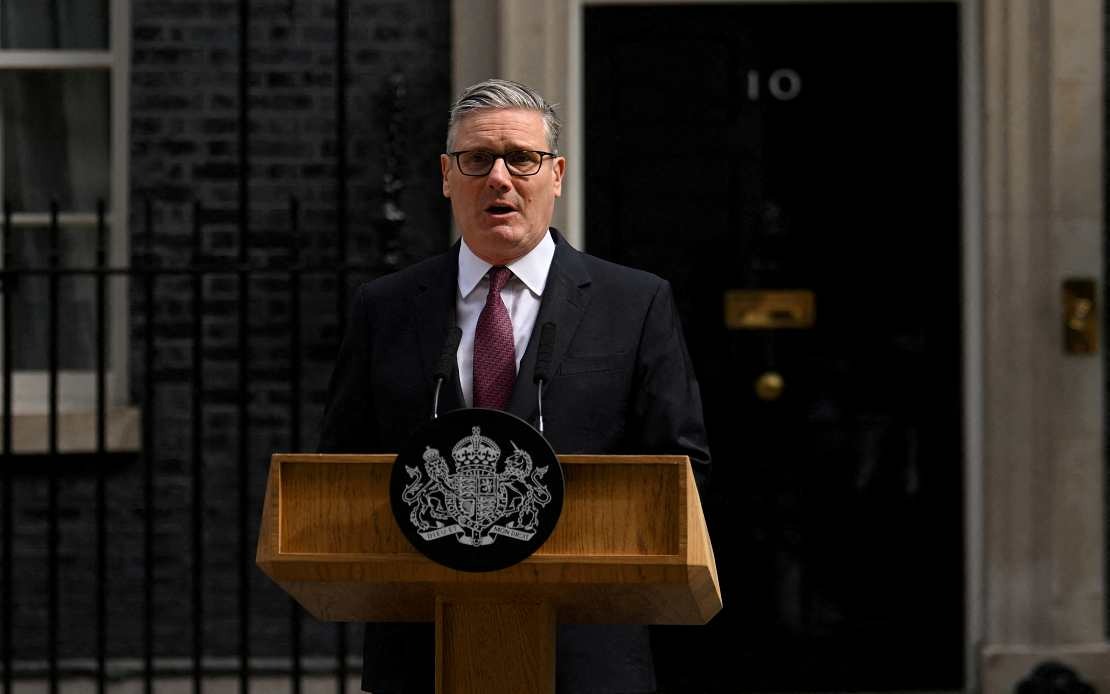
British Prime Minister Keir Starmer has intensified diplomatic pressure on both Tehran and Washington to revive stalled ceasefire negotiations, warning that the escalating confrontation over the Strait of Hormuz threatens global maritime security and energy supplies. Speaking at a multilateral gathering in Paris alongside leaders from France, Germany, and Ukraine, Starmer made clear that the recent tit-for-tat military exchanges between the US and Iran have pushed the critical waterway to the brink of crisis, with potential consequences extending far beyond the Middle East.
The timing of Starmer's intervention reflects growing alarm among Western allies over what appears to be a breakdown in the diplomatic framework that had seemed to stabilise the region just weeks earlier. The British Premier unequivocally condemned Iranian attacks on commercial shipping vessels and infrastructure serving Gulf partner states, framing these actions as unacceptable breaches of international maritime norms. His language was notably firm, suggesting that London views the situation as having crossed a significant threshold that demands immediate corrective action from Tehran.
The backdrop to these diplomatic manoeuvres involves a fragile agreement signed in June aimed at bringing an end to the US-Israeli military campaign that commenced in late February. That memorandum of understanding had raised hopes for a comprehensive regional de-escalation, including restoration of unrestricted navigation through the Strait of Hormuz—one of the world's most strategically vital chokepoints through which roughly one-third of global maritime petroleum traffic flows. However, recent developments suggest that agreement has unravelled more completely than initially apparent.
President Donald Trump's announcement that the United States would reinstate comprehensive sanctions on Iranian oil exports and establish a paid passage system for vessels transiting the strait represents a dramatic hardening of the American position. The US administration's characterisation of this approach as a "blockade" strategy signals intent to squeeze Iran's economy while asserting American naval dominance over international waters. This move fundamentally contradicts the spirit of the June agreement and appears calculated to inflict maximum pressure on the Iranian economy.
Iran's response over the weekend—conducting fresh military strikes against American positions and assets—demonstrates that Tehran refuses to accept what it perceives as renewed economic strangulation. The cycle of action and counter-action suggests both sides have concluded that negotiation has reached an impasse, with military posturing now substituting for diplomatic dialogue. For Southeast Asian nations heavily dependent on Middle Eastern oil and requiring secure passage through the Strait of Hormuz for trade, this deterioration carries profound implications.
Starmer's proposal to deploy additional Western military assets ostensibly to safeguard merchant shipping reflects a broader Western strategy of military presence as a pressure mechanism. By positioning naval vessels in the region and guaranteeing safe passage for commercial traffic, Britain and its allies aim to demonstrate capacity to maintain freedom of navigation regardless of Iranian actions. However, such deployments risk further militarising an already volatile situation, potentially triggering miscalculation or unintended escalation.
For Malaysian observers, the stakes involve both immediate and medium-term concerns. Malaysia's geographic position as a major Southeast Asian trading hub means disruptions to global shipping lanes directly threaten domestic prosperity. Many Malaysian companies depend on predictable maritime routes and stable energy markets to maintain competitiveness. Any sustained disruption to Strait of Hormuz traffic would drive up oil prices, inflate shipping costs, and create uncertainty affecting investment and consumer confidence across the region.
The fundamental challenge underlying Starmer's diplomatic initiative is that both Iran and the United States appear wedded to incompatible strategic objectives. Iran seeks recognition as a legitimate regional power entitled to influence its neighbourhood without external interference. The United States, conversely, remains committed to preventing Iranian regional dominance and constraining its military capabilities. These competing visions cannot be easily reconciled through conventional negotiation unless both sides demonstrate flexibility neither has exhibited thus far.
Starmer's emphasis on "unrestricted freedom of navigation" articulates a principle that benefits all maritime trading nations, including Malaysia and other ASEAN members. Establishing secure, neutral passage through strategic waterways serves universal interests transcending geopolitical rivalries. However, converting this principle into practical reality requires confidence-building measures, verified compliance mechanisms, and third-party guarantees that current antagonisms make difficult to construct.
The involvement of France and Germany in Starmer's diplomatic initiative underscores European anxiety about regional stability and energy security. Both nations retain economic interests in normalized relations with Iran and harbour reservations about Trump administration pressure tactics. Their participation suggests a coordinated Western effort to restore negotiating momentum before the situation deteriorates further into open conflict.
What remains unclear is whether either Tehran or Washington possesses sufficient domestic political space to accept the compromises necessary for genuine ceasefire renewal. Trump's characterisation of sanctions reimposition and toll collection as American policy suggests ideological commitment to maximum pressure strategies. Iranian hardliners, conversely, view any Western pressure as illegitimate interference justifying military defiance. Navigating between these positions requires diplomatic creativity and mutual recognition of shared interests in avoiding full-scale confrontation—qualities currently in short supply.
For Southeast Asian policymakers watching developments unfold, the imperative involves preparing contingency arrangements for prolonged uncertainty in the Strait of Hormuz. Diversifying energy sources, exploring alternative maritime routes, and strengthening regional coordination mechanisms become increasingly prudent. Malaysia and neighbouring nations should also consider active diplomatic involvement in international efforts to restore stability, positioning themselves as honest brokers committed to universal maritime security rather than partisan alignment with either Washington or Tehran.

