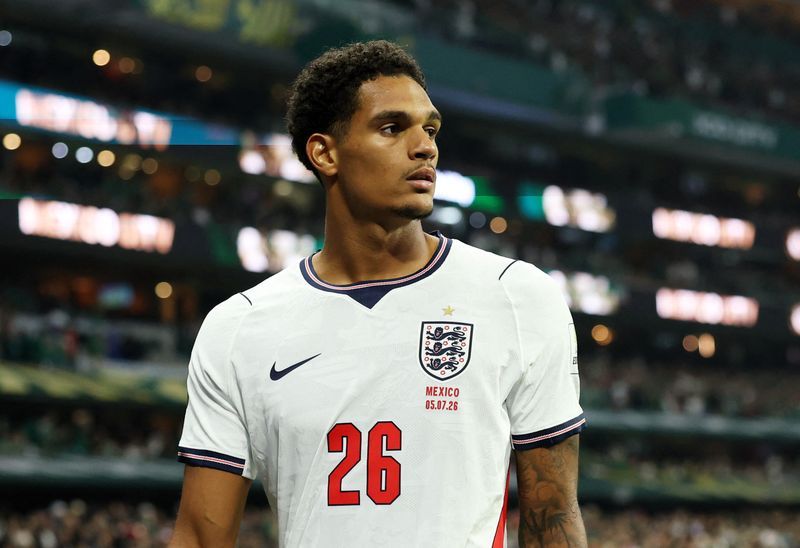
The World Cup's most damaging controversy has now crossed into parliamentary politics, with British lawmakers directly challenging FIFA's handling of player suspensions after the governing body granted U.S. striker Folarin Balogun an unprecedented reprieve. On Monday, just hours after England's dramatic 3-2 victory over Mexico at the Azteca Stadium, where defender Jarell Quansah was sent off, Labour MPs began circulating open letters to FIFA president Gianni Infantino demanding he apply the same generous treatment to the English player. The intervention represents a sharp escalation in a scandal that has already engulfed the tournament's credibility, with allegations swirling that political pressure—including a direct intervention from U.S. President Donald Trump—may have influenced what FIFA insists are independent judicial decisions.
The Balogun case exploded into public view when Trump publicly acknowledged telephoning Infantino to discuss the American striker's automatic one-match suspension stemming from a red card. Though Infantino maintained that FIFA's judicial bodies would rule independently, the subsequent decision to defer Balogun's ban until after the World Cup has triggered a crisis of confidence in the sport's disciplinary apparatus. Now Quansah, who received a similar red card in identical circumstances, faces the same automatic suspension—yet the precedent set by Balogun's reprieve has created an impossible situation. If FIFA denies Quansah the same consideration, the inconsistency will appear nakedly political. If it grants relief to every suspended player, the disciplinary system collapses into meaninglessness.
Labour MP Noah Law articulated the dilemma with surgical precision in his letter to Infantino, acknowledging that Quansah deserved the red card but arguing that consistency demanded a deferred ban matching Balogun's outcome. "Whilst I believe it was right for Jarell Quansah to have received his red card… I believe it would be right to delay his suspension until after the completion of this World Cup," Law wrote, effectively establishing that the precedent had become inescapable. Colleague Melanie Onn reinforced the argument by emphasizing the legal principle of equal treatment, contending that it would be indefensible for FIFA to benefit one player while denying another in materially identical circumstances the same mercy. Both MPs framed their appeal not as special pleading but as a defense of FIFA's institutional integrity, warning that inconsistent rule application would fundamentally undermine global confidence in the sport's governance structures.
The timing of the MPs' intervention—immediately following England's World Cup fixture—highlights how deeply this controversy has penetrated the tournament itself. Rather than remaining confined to disciplinary technicalities, the suspension row has become enmeshed with international diplomacy and parliamentary scrutiny. Caroline Dinenage, chair of the House of Commons Culture, Media and Sport Committee, issued a formal statement calling for urgent clarification from FIFA, explicitly raising the specter of political interference. "For sport to mean anything, its rules and laws must be applied equally to all teams," Dinenage said, articulating the fundamental principle at stake. Her intervention carries particular weight, representing not individual MPs but a parliamentary committee with formal oversight responsibilities, signaling that Britain's political establishment now views FIFA's conduct as a matter of governmental concern.
The English Football Association is reportedly weighing its own appeal options, though internal deliberations remain opaque. A source familiar with the FA's position confirmed to Reuters that officials are actively considering potential courses of action, yet the organization has not publicly declared whether it will formally petition FIFA or what specific grounds it might invoke. This measured silence contrasts sharply with the aggressive public advocacy from MPs, suggesting the FA may be calculating the diplomatic costs of direct confrontation with FIFA while politicians operate under fewer institutional constraints. The divergence between parliamentary pressure and organizational reticence illustrates the complicated politics surrounding the case, with different actors pursuing distinct strategies toward the same objective.
FIFA has maintained steadfast silence throughout the escalating controversy, declining to respond to multiple media inquiries about whether Article 27—the provision cited in the Balogun decision—will apply to Quansah's situation. The governing body's refusal to clarify or elaborate on its reasoning has only deepened suspicions that political rather than sporting considerations drove the original ruling. In normal disciplinary cases, FIFA typically issues detailed explanations of its judicial reasoning, yet the Balogun decision emerged shrouded in vagueness, fueling speculation about behind-the-scenes influence. This opacity stands in sharp contrast to how FIFA usually operates, suggesting awareness that transparent articulation of its rationale might expose the decision to legal or political challenge.
The broader implications for football governance extend far beyond this tournament. If FIFA establishes that automatic suspensions can be deferred based on political intervention or perceived unfairness, the system loses its predictability and force. Every future red card becomes potentially negotiable depending on which nation's political establishment chooses to lobby FIFA. Conversely, if the organization applies suspensions inconsistently across different players and nations, it signals that some teams enjoy protected status within global football politics while others do not—precisely the kind of inequity that corrodes international sporting competition. This binary trap is largely of FIFA's own making, created when officials granted Balogun relief rather than declining Trump's request outright or explaining why disciplinary rules cannot bend for any player regardless of political pressure.
For Malaysia and Southeast Asia more broadly, this crisis carries specific resonance around the principle of equal treatment in international sports governance. Smaller footballing nations often feel that major sporting bodies apply different standards to powerful countries and their athletes compared to emerging football nations. The Balogun-Quansah controversy validates those concerns empirically, demonstrating that political capital and access to FIFA leadership can apparently influence outcomes that are supposedly determined by independent judicial processes. Malaysian football administrators and sports observers have reason to watch this situation closely, as it sets precedents about how FIFA responds when wealthy nations' political leaders directly intervene in sporting decisions. The answer will likely inform how other nations approach future conflicts with FIFA and whether lobbying FIFA leadership is now considered an acceptable tactic for securing favorable rulings.
England faces Norway in the World Cup quarter-final in Miami on Saturday, meaning the timing of any FIFA decision on Quansah's suspension is now critically urgent. Quansah's availability could materially affect England's tournament prospects, creating yet another layer of complexity. If FIFA grants the reprieve, it appears to validate political interference. If it denies relief, it appears to apply discriminatory standards between players. The organization has painted itself into a corner where either decision carries profound reputational consequences. FIFA's silence suggests it is attempting to navigate this minefield by making no public pronouncement, hoping the controversy will gradually fade from international attention. However, the escalating involvement of national parliaments makes that strategy increasingly implausible, as multiple governments have now signaled that they view FIFA's conduct as a matter warranting formal political attention.
The disciplinary row also carries implications for how major sporting bodies interact with national political leaders generally. Trump's admission that he telephoned Infantino has essentially normalized direct presidential intervention in sporting governance, suggesting that future political leaders facing similar situations may feel emboldened to contact sports administrators directly when their nations' athletes face suspension. This potential normalization of political lobbying represents perhaps the most consequential long-term damage from the Balogun case, extending beyond this tournament into the fundamental relationship between politics and sports governance. If FIFA yields to such pressure, it invites a new era where international sports competitions become arenas for demonstrating political influence rather than purely athletic meritocracy. British MPs are essentially trying to prevent that outcome by establishing that rules must apply equally regardless of which nation's leadership exerts pressure, yet their intervention itself demonstrates how thoroughly the political sphere has now penetrated World Cup governance.

