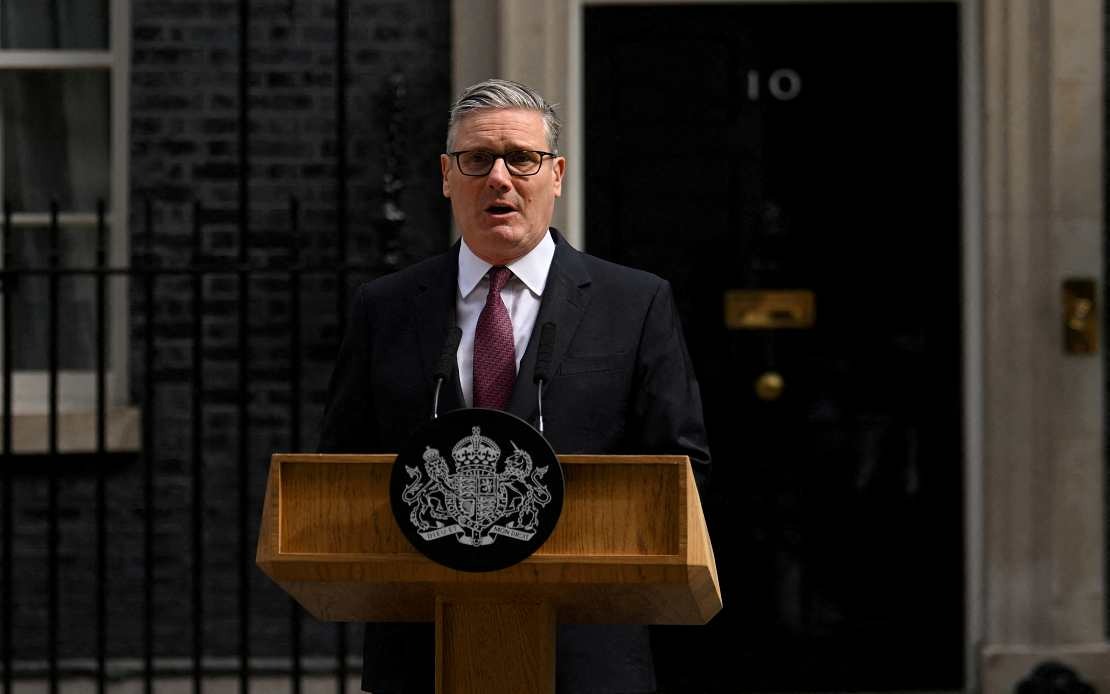
British Prime Minister Keir Starmer has announced he will step down as Labour leader, marking a dramatic reversal of fortune for a government that swept to power less than two years ago with promises to restore stability to British politics. The transition will take place with a new leader installed by the time parliament returns in September, Starmer confirmed on Monday. His decision to remain in the prime ministerial office during the leadership transition signals an attempt to maintain governmental continuity while the party selects his replacement.
Starmer's position had deteriorated markedly over recent months, but the immediate catalyst came on Friday when Andy Burnham, the powerful mayor of Greater Manchester, secured a decisive parliamentary victory in a by-election. Burnham's win resonated powerfully with Labour MPs because it came in a fiercely contested contest against a candidate fielded by Nigel Farage's Reform UK party, which has dominated national opinion polling for over a year. The result suggested that Labour could recover electoral ground under different leadership, a finding that accelerated the party's push for a change at the top.
Burnham, a seasoned political operator with a reputation for strong communication, has emerged as the frontrunner to replace Starmer. His victory in the by-election gave hope to Labour lawmakers that he could reverse the party's declining fortunes under Starmer, whose approval ratings have plummeted to historic lows for any serving British prime minister. The contrast between Burnham's recent electoral success and Starmer's unpopularity created irresistible momentum within the parliamentary Labour Party for a leadership change.
Yet Burnham's path to Number 10 remains uncertain, with significant questions about his policy direction unresolved. Beyond broad statements about the need for fundamental economic restructuring and reducing the cost of living, he has offered little clarity on his stance on foreign policy, economic management and defence matters. These omissions matter considerably because the next British prime minister will inherit an extraordinarily constrained fiscal and political position, with limited room for manoeuvre regardless of who occupies the office.
The incoming prime minister will face what analysts describe as a precarious budgetary landscape. Britain carries the highest borrowing costs within the Group of Seven industrialised nations, a consequence of elevated national debt, substantial interest payment obligations, weak economic expansion over many years, and the resistance of policymakers to meaningful spending cuts. Simultaneously, the country must boost investment in critical areas such as defence and infrastructure, creating a fundamental tension between fiscal discipline and the investment needs of a struggling economy.
Burnham himself has previously suggested that Britain must move beyond subservience to bond market sentiment, comments that have created apprehension among investors about his willingness to maintain fiscal orthodoxy. When asked about these concerns, investors expressed divided views on whether Burnham would ultimately respect market expectations or attempt more expansionist policies. Economists at Citibank issued a stark assessment, arguing that a Burnham government would confront a deeply precarious fiscal position with insufficient policy tools to deliver the transformative change voters are demanding.
Starmer's departure represents merely the latest in an extraordinary sequence of changes at the apex of British politics. The person who succeeds him will become Britain's seventh prime minister since the 2016 Brexit referendum, a turnover rate unprecedented in nearly two centuries of British parliamentary governance. This relentless cycling through leadership reflects a deeper democratic crisis: successive governments have failed to convince voters that the political system can deliver improvements in living standards, strengthen public services, or effectively manage immigration pressures.
The accelerated timeline for Starmer's departure reflects internal Labour calculations about the political value of his orderly transition. By announcing his intention to step down while remaining in office through September, he creates space for formal leadership procedures while preventing a destabilising period of paralysis. The European Union reset summit planned for July, intended to repair damaged bilateral relations following Brexit tensions, provides a symbolic opportunity for Starmer to participate in an important diplomatic moment before departing. This sequencing also gives Burnham or whichever candidate emerges from the leadership contest several weeks to prepare substantive policy platforms and government formation strategies.
For Malaysian observers and Southeast Asian policymakers, the British upheaval carries instructive lessons about the political consequences of failing to deliver tangible improvements in living conditions and public sector competence. The rapidity of institutional breakdown in a mature democracy suggests that voter patience with underperforming governments has contracted substantially across developed nations. The inability of successive British administrations to control costs, reform public services, or manage demographic pressures mirrors challenges facing governments throughout the region. Additionally, Burnham's comments about fiscal constraints and bond market discipline echo tensions that many Southeast Asian economies navigate when attempting to balance development spending against investor demands for prudent fiscal management.