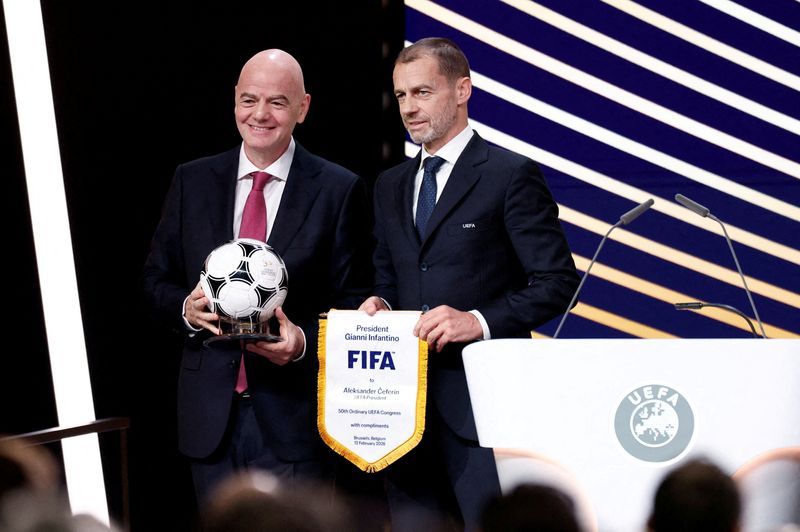
European football's governing body UEFA has escalated its confrontation with FIFA President Gianni Infantino by petitioning a United States federal court for access to documents and witness testimony held by FIFA entities in Florida. The materials are intended to bolster a criminal complaint that UEFA plans to file in Switzerland, marking a significant escalation in the dispute over Infantino's handling of the FIFA Forward Enterprise proposal, an investment scheme that threatened to split world football just weeks ago.
The core of UEFA's complaint centres on what the confederation characterizes as a fundamentally flawed and secretive process surrounding the FFE initiative. Rather than following FIFA's established governance structures, UEFA alleges that Infantino conceived and developed the commercial rights proposal with only a small cadre of hand-picked advisers and investors, deliberately excluding FIFA's Council, the organisation's 211 member associations, and the six continental confederations that form football's global backbone. This alleged circumvention of standard decision-making procedures forms the basis of UEFA's charges under Article 158 of the Swiss Criminal Code, which addresses mismanagement of public institutions.
The specifics of the FFE scheme reveal why its mechanics proved so contentious. Under the proposal, FIFA's most lucrative commercial assets—the rights to broadcast and commercially exploit the men's and women's World Cups alongside the Club World Cup—would have been transferred into a newly created subsidiary. A consortium of investors led by Thrive Eternal, an investment vehicle connected to Joshua Kushner and Thrive Capital, would have injected approximately 4.2 billion dollars for a stake in this enterprise. This valuation placed the overall value of the commercial rights at roughly 20 billion dollars, a figure that UEFA disputes as substantially undervaluing FIFA's assets and one that was never subjected to competitive bidding or independent assessment.
For Southeast Asian football stakeholders and Malaysian readers, the implications of this dispute extend beyond European concerns. FIFA's global governance structure directly affects how football development funds flow to member associations across the region, how broadcasting arrangements are negotiated, and ultimately how the sport's resources are distributed across nations of varying economic means. The concentration of decision-making power that Infantino allegedly exercised threatens the principle of democratic governance that has theoretically underpinned FIFA's operations, setting a precedent that could reshape how football administration operates globally.
UEFA's threat to withdraw European teams from FIFA competitions, including the World Cup itself, represented an unprecedented challenge to Infantino's authority. The confederation's 55 member associations unanimously voted on July 30 to boycott all FIFA competitions unless the FFE proposal was abandoned. This extraordinary show of solidarity across a continent ranging from Portugal to Kazakhstan demonstrated the depth of opposition to what many perceived as a power grab disguised as a commercial innovation. When FIFA capitulated and withdrew the proposal on July 31, it marked a rare instance of FIFA leadership yielding to confederation pressure, though the victory proved hollow given continued questions about governance and accountability.
However, UEFA's temporary suspension of its boycott threat should not be misconstrued as forgiveness or resolution. The confederation secured only written assurances that the FFE proposal had been "irrevocably and permanently withdrawn," language that suggests scepticism about whether commitments from FIFA leadership can be trusted. UEFA explicitly stated that its member associations have mandated the confederation to pursue "every available institutional, political and legal avenue" to secure fundamental reforms to FIFA's governance structure and to restore meaningful limits on presidential authority. The criminal complaint in Switzerland represents precisely such a legal avenue, and obtaining documentary evidence from Florida-based FIFA entities is a critical step in building that case.
The financial justification for seeking outside investors to fund football development remains unexplained and highly suspicious, according to UEFA's analysis. FIFA currently holds billions of dollars in reserves—resources that belong, in principle, to the member associations collectively. Infantino's rationale for requiring external private investment to expand development programmes, when such capital already exists within FIFA's own coffers, has never been satisfactorily answered. This absence of credible explanation fuels suspicion that the true motivation lay elsewhere: perhaps in generating personal wealth for favoured investors, consolidating power by indebting FIFA to private financial interests, or some combination thereof.
Infantino's defence of the proposal, both before and after its withdrawal, has centered on characterizing it as a well-intentioned development initiative that simply created unfortunate divisions within the football family. He has described it as a "golden opportunity" to expand football development funding worldwide. However, internal complaints from FIFA staff members, who reportedly felt "deceived" by the process, combined with reports that FIFA Secretary General Mattias Grafstrom was excluded from drafting discussions, suggest that even within FIFA's own bureaucracy there was awareness that the proposal's origins and processes were problematic. The fact that such concerns were raised internally yet overridden by senior leadership underscores UEFA's argument that proper governance and consultation were systematically bypassed.
Infantino retains significant support within FIFA, particularly from confederations representing Africa and South America, nations whose votes will be decisive in the presidential election scheduled for March 2027. Saudi Arabia's football federation has also publicly backed Infantino's continued leadership and praised his efforts to restore unity. This geographical split in support reflects broader divisions within global football and raises questions about whether reform-minded confederations can effectively challenge incumbent leadership when votes are concentrated among confederations with different governance priorities or institutional incentives. Southeast Asian football, represented through the Asian Football Confederation, will likely face pressure to align with either the reformist European bloc or the Infantino-supporting majority within Asia's football establishments.
UEFA has already signalled its strategy for the 2027 election: the confederation will work with allied confederations to identify and promote a "credible alternative" candidate committed to meaningful reform. This implicit threat suggests that regardless of the outcome of the Swiss criminal proceedings, the debate over FIFA's future direction will intensify considerably as the election approaches. The question of whether FIFA can institute genuine external oversight of its commercial dealings, presidential authority, and governance processes will define Infantino's potential fourth term or determine his successor's mandate.
The broader significance of this episode extends to how international sports organizations balance concentrated executive power with the legitimate interests of member institutions. Infantino's presidency has been marked by centralised decision-making and a tendency to pursue strategic initiatives through executive discretion rather than broad consultation. The FFE affair demonstrated that while such approaches may succeed initially, they generate backlash when they threaten the fundamental interests of powerful member confederations. For Malaysian football administrators and stakeholders, understanding these dynamics is essential, as future governance reforms at FIFA will directly affect how Asian football organisations participate in and influence global football administration.

