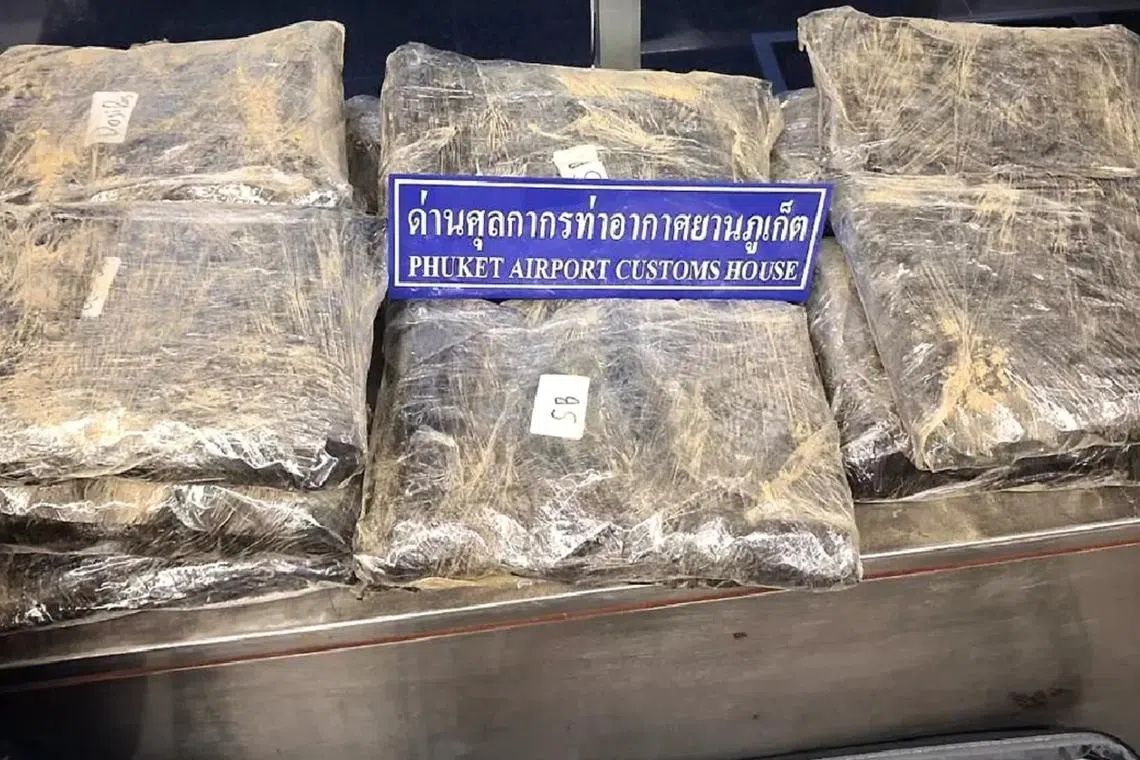
Authorities at Phuket International Airport have apprehended two women for attempting to illegally export cannabis products, with a combined haul exceeding 32 kilograms of cannabis flowers seized during separate enforcement operations on Thursday, July 9. The arrests, conducted jointly by Phuket Airport Customs House and Sakhu Police Station officers in the international departures terminal, underscore the region's intensifying efforts to prevent the illicit export of controlled substances through major travel hubs.
The first incident occurred around 11am when customs officials conducting routine inspections intercepted a black Pierre Cardin wheeled suitcase belonging to Levannah Chelsea Guzman, an 18-year-old Filipino national. Upon examination, officers discovered 14 separately vacuum-sealed packages containing cannabis flowers distributed throughout the luggage. The total weight of the confiscated material, including packaging, reached 14.5 kilograms. During subsequent questioning, Guzman acknowledged ownership of both the suitcase and its contents, providing authorities with a straightforward confession that would streamline subsequent legal proceedings.
Guzman now faces multiple charges spanning several legislative frameworks governing Thailand's approach to cannabis control and customs enforcement. The primary charge relates to violations of the Customs Act BE 2560 (2017), which criminalizes the attempted export of goods without completion of mandatory customs procedures. Beyond customs violations, she has been charged under the Narcotics Code, the Protection and Promotion of Traditional Thai Medicine Wisdom Act BE 2542 (1999), and the Public Health Ministry's 2025 notification designating cannabis as a controlled herb. This layered charging approach reflects Thai authorities' determination to prosecute such offences across multiple regulatory domains.
Less than two hours after the initial arrest, customs officers identified a second suspicious piece of luggage as passengers prepared for departure. The green Swish Navy wheeled suitcase, registered to Penpitcha Phutsiang, a Thai national, contained considerably more contraband than the first seizure. Officers removed 16 vacuum-sealed packages of cannabis flowers with a combined weight of 17.6 kilograms. Like her Filipino counterpart arrested earlier that morning, Phutsiang admitted full ownership and responsibility for both the suitcase and its illicit contents during questioning.
Phutsiang faces an identical suite of charges under Thai law, with authorities pursuing the same comprehensive legal strategy applied to Guzman. Following initial processing at the customs facility, both women were transferred to Sakhu Police Station for more extensive investigation and to facilitate formal legal proceedings. The parallel nature of their charges and similar smuggling methodologies suggest possible coordination, though authorities have not publicly disclosed whether the two suspects were acquainted or acted independently.
The timing of these arrests reflects broader regional concerns about cannabis flower smuggling through Southeast Asian airports. While Thailand has reformed its cannabis regulations in recent years, allowing cultivation for medical and research purposes under strict licensing, the export of cannabis products remains prohibited without explicit government authorisation. The gap between domestic regulatory changes and international drug control treaties creates opportunities for smugglers, particularly those attempting to transport products to jurisdictions with more permissive cannabis laws.
Southeast Asia represents a strategic transshipment point for drug trafficking operations, with major airports serving as critical chokepoints where enforcement agencies intercept significant quantities of illicit substances. Phuket International Airport, as one of Thailand's busiest tourist destinations and a major commercial hub, attracts consistent scrutiny from customs and narcotics enforcement teams. The airport's high volume of international departures and arrivals presents both challenges and opportunities for law enforcement, requiring sustained vigilance and resource allocation to detect concealment methods.
These arrests align with documented intensification of anti-smuggling operations at Thai airports. Customs authorities have progressively enhanced inspection protocols, deploying more sophisticated screening methodologies and increasing the frequency of manual luggage examinations targeting outbound passengers. The vacuum-sealing technique employed by both suspects represents a common attempt to obscure cannabis from detection by drug-sniffing dogs, a strategy that nevertheless proved ineffective against professional customs inspectors during routine baggage screening.
For Malaysian readers and regional observers, these developments carry significance beyond Thailand's borders. The incident demonstrates how regional drug control cooperation requires comprehensive airport security measures and information sharing across national boundaries. As ASEAN nations navigate differing cannabis policy trajectories, with some jurisdictions moving toward decriminalisation or medical legalisation while others maintain strict prohibition, enforcement challenges intensify. Smuggling networks exploit regulatory inconsistencies between countries, making coordinated regional responses essential to prevent organised trafficking operations from exploiting policy gaps.
The case also illustrates enforcement patterns that transcend nationality. The involvement of both a Filipino and a Thai national suggests that smuggling networks recruit operatives across national boundaries, potentially targeting tourists or migrant workers as couriers. Such operations often involve financial incentives that appeal to economically vulnerable individuals, particularly young people like the 18-year-old Guzman, who may underestimate legal consequences or be unaware of severe penalties applicable under Thai law.
Thailand's narcotics legislation carries substantial penalties for drug-related offences, with trafficking convictions potentially resulting in extended imprisonment and substantial fines. The charges filed against both women could result in sentences of several years imprisonment depending on judicial determination and any aggravating circumstances authorities establish during investigation. The strict application of existing laws, combined with enhanced airport enforcement, sends clear deterrent messaging to potential smugglers considering Thailand as a transit point.
Moving forward, these arrests represent incremental progress within broader enforcement campaigns, though they also highlight the persistent appeal of smuggling operations to criminal networks. The continued vigilance demonstrated by Phuket Airport Customs House and coordinating agencies underscores institutional commitment to preventing drug trafficking, yet the regularity of such seizures suggests demand and profit margins remain sufficiently attractive to motivate smuggling attempts despite heightened enforcement risks.

