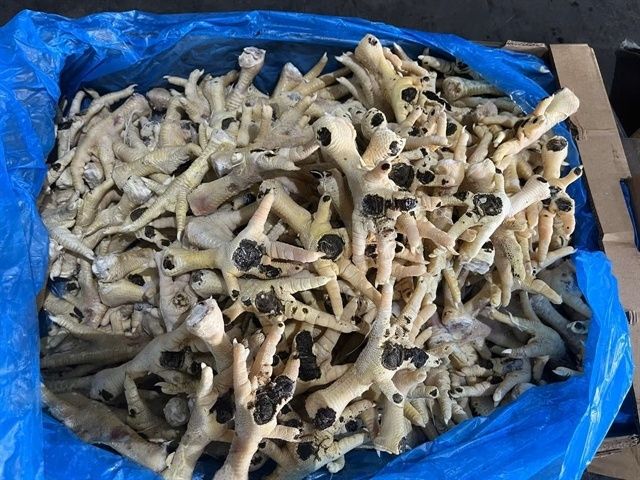
Hanoi police have brought formal charges against two businesswomen accused of orchestrating a sophisticated smuggling operation involving hundreds of containers of frozen chicken feet sourced from countries battling active poultry disease outbreaks. The investigation, completed on Friday, revealed that the suspects circumvented customs regulations and evaded import duties on goods valued at more than VNĐ347 billion—approximately US$13 million—before distributing them through food-service channels across multiple Vietnamese provinces.
The two defendants are Nguyen Thi To Loan, aged 47, who directed operations at ABF Food Import-Export JSC based in Ninh Binh Province, and Trang Tuyet Ngoc, 45, who held a management position within An Binh Group's administrative structure. Police records indicate both individuals have admitted to all charges brought against them. Their operation exemplifies a troubling pattern of regulatory circumvention that poses significant public health risks, particularly given the sourcing of poultry products from jurisdictions where disease control measures remain inadequate.
The scheme unfolded systematically between 2023 and 2026, during which the importers brought in 339 shipping containers of frozen chicken feet. Official customs declarations falsely characterized these shipments as materials intended exclusively for value-added processing and subsequent re-export to third markets. Vietnamese law explicitly restricts the domestic sale of poultry products originating from countries experiencing active disease outbreaks, permitting entry only when goods are destined for industrial reprocessing and export. This regulatory framework exists precisely to protect local consumers and prevent the spread of avian influenza and related pathogens that regularly devastate poultry industries across Asia.
Investigators discovered that Loan directed Ngoc to divert the incoming shipments from their declared export pathway into Vietnam's domestic food distribution networks. Rather than fulfilling their contractual obligations to re-export the frozen chicken feet, the operation systematically supplied the product to restaurants, food-processing facilities, and catering businesses operating throughout Hanoi, Cao Bang, Ninh Binh, Quang Ninh, and numerous surrounding provinces. The scale of this domestic distribution exceeded 10,000 metric tonnes, meaning potentially hundreds of thousands of consumers may have unknowingly purchased poultry products sourced from regions with confirmed disease vulnerabilities.
The financial dimensions of this case underscores the profitability of circumventing customs compliance. By importing under false pretenses and avoiding legitimate duty payments, the smuggling network essentially operated as a tax evasion scheme that also undermined legitimate domestic poultry producers competing on a genuinely level playing field. The estimated value of VNĐ347 billion represents not merely the wholesale cost of the chicken feet themselves, but also the calculated duty avoidance that made this illegal enterprise financially attractive to perpetrators willing to accept criminal liability.
Law enforcement operations uncovered the full scope of the operation when authorities conducted coordinated raids on multiple cold-storage facilities suspected of serving as distribution hubs. At the An Viet 2 freezer installation located within Hanoi's Quang Minh Industrial Zone, investigators recovered more than 1,000 metric tonnes of frozen chicken feet. Particularly alarming was the discovery of approximately 260 metric tonnes of expired product exhibiting visible mold growth and pungent odours characteristic of advanced spoilage, yet positioned and organized in preparation for further market distribution. This detail suggests the operation demonstrated callous disregard for consumer safety and food hygiene standards.
A subsequent search of the THL cold-storage warehouse in Lang Son Province yielded an additional 1,030 metric tonnes of frozen chicken feet, bringing the total recovered inventory to over 2,000 metric tonnes. The geographic distribution of these storage facilities—spanning multiple provinces from Hanoi northward to Lang Son—indicates a deliberately decentralized logistics strategy designed to minimize detection risk and complicate regulatory oversight. This operational sophistication suggests Loan and Ngoc did not act in isolation but rather directed a functioning enterprise with established distribution channels and storage infrastructure.
The formal charges against both defendants invoke Article 188 of Vietnam's 2015 Penal Code, which addresses smuggling offences. The severity with which authorities pursued this case reflects growing recognition throughout Southeast Asia that food-supply criminality demands rigorous prosecution. Beyond the immediate financial losses and customs evasion, this operation potentially exposed millions of Vietnamese consumers to contaminated or disease-compromised poultry products during a period when regional avian influenza surveillance has documented repeated spillover events.
Hanoi police emphasized that their investigation remains ongoing, with authorities actively working to identify additional individuals and corporate entities potentially implicated in the smuggling network. This suggests the operation likely extended beyond the two primary defendants, involving transportation providers, warehouse operators, purchasing agents, and end-market distributors who facilitated the movement of contraband chicken feet through commercial channels. The network's apparent sophistication and multi-province reach suggest involvement from persons occupying various positions within supply-chain ecosystems.
For Malaysian readers and regional observers, this case illustrates the persistent vulnerabilities within Southeast Asian food-import regulatory systems and the criminal incentives that drive food-supply violations. Vietnam's experience with this poultry-smuggling conspiracy mirrors challenges confronting other ASEAN nations where geographic borders, limited inspection capacity, and corruption within customs agencies create opportunities for large-scale food contraband operations. The case also highlights how disease-affected animal products can infiltrate consumer markets despite explicit legal prohibitions, underscoring the importance of robust inspection protocols, whistleblower mechanisms, and coordinated intelligence-sharing between trading partners.
The revelation that over 10,000 metric tonnes of potentially compromised chicken feet successfully entered Vietnam's food-service sector before detection raises uncomfortable questions about how much contaminated product may have escaped discovery entirely. Food-safety compliance in the region remains uneven, with smaller enterprises and informal food vendors often operating outside regulatory visibility. This incident reinforces the necessity for enhanced traceability systems, comprehensive cold-chain monitoring, and serious penalties for food-import crimes—measures increasingly recognized as essential infrastructure for protecting public health across the Association of Southeast Asian Nations.

