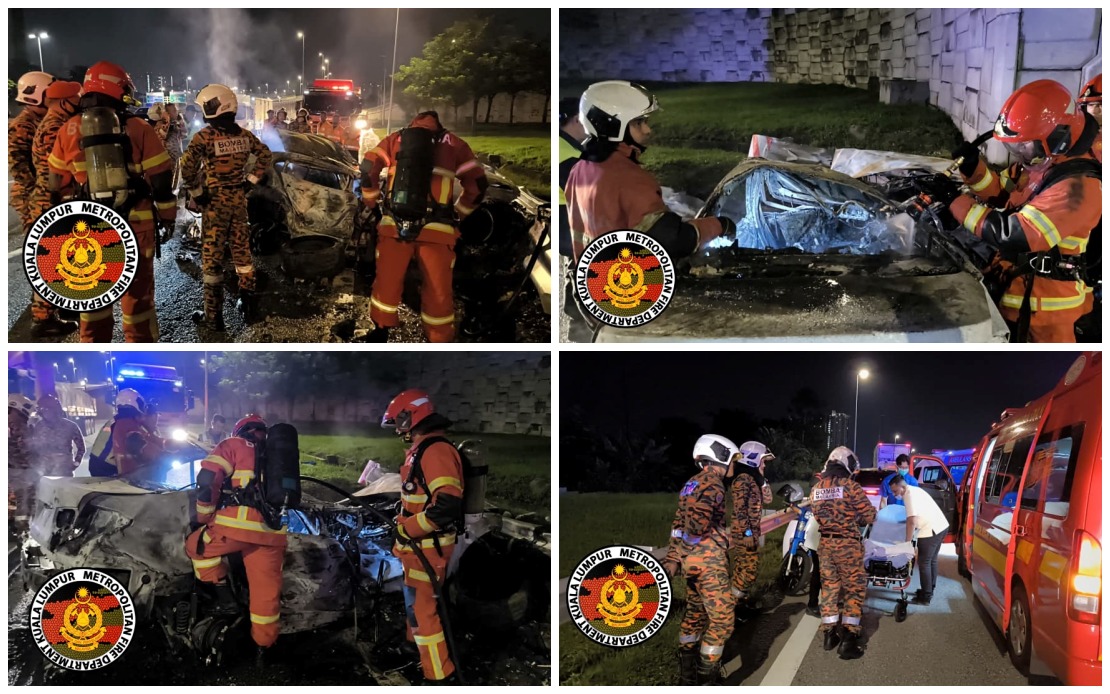
A tragic road accident on the Duta-Ulu Kelang Expressway in Kuala Lumpur has claimed the lives of two young Malaysian university students in the early hours of Wednesday morning. The incident, which occurred at the Jalan Kuching exit ramp, has prompted renewed scrutiny into speeding-related fatalities on the city's major arterial routes. Police have classified the case as an apparent high-speed collision that escalated into a fatal fire after the vehicle struck infrastructure along the roadway.
According to Kuala Lumpur Traffic Investigation and Enforcement Department chief ACP Mohd Zamzuri Mohd Isa, the BMW 328i Sport was moving from Jalan Duta in the direction of Selayang when the driver allegedly lost command of the vehicle. Evidence suggests excessive speed was a contributing factor in the mishap. The car subsequently veered leftward, collided with the road divider, and ignited immediately following impact. The intensity of the fire proved catastrophic, with both occupants in the front seats unable to escape the burning wreckage.
The deceased have been identified as a 22-year-old male driver enrolled as a student at Queensland University of Technology in Australia and a 21-year-old male front-seat passenger studying at Sunway University in the Klang Valley. Both individuals were pronounced dead at the scene, having become trapped within the vehicle as flames consumed the interior. The incident underscores the severe consequences that can result from loss of vehicle control at high velocities on expressway sections where barriers and dividers create additional hazards for motorists who cannot maintain their trajectory.
A third occupant, identified as a 20-year-old Singaporean male student, was more fortunate in his positioning within the vehicle. He sustained only minor injuries and received treatment at Kuala Lumpur Hospital. His survival suggests he may have been seated in the rear of the vehicle or possessed greater opportunity to exit before the fire reached its most intense phase. The disparity in outcomes among the three passengers illustrates how proximity to impact zones and initial fire development can determine survival prospects in vehicular accidents of this nature.
Identification procedures for the two deceased have proven complex due to the severe thermal damage inflicted by the fire. Authorities have determined that DNA analysis will be necessary to confirm the identities of both victims, a standard protocol when traditional visual identification becomes impossible. This process typically requires coordination with pathology specialists and may take several days to complete, adding to the distress experienced by the families awaiting confirmation of their loss.
Investigators are pursuing multiple lines of inquiry to establish the precise sequence of events preceding the collision. Closed-circuit television footage from the expressway and surrounding areas is being reviewed to determine whether the vehicle exhibited signs of instability prior to the impact with the divider. The surviving passenger has provided initial statements to authorities, though ongoing interviews will likely seek to clarify his observations regarding the driver's behavior and any factors that may have contributed to the loss of control.
The investigation is proceeding under Section 41(1) of the Road Transport Act 1987, which addresses motor vehicle-related fatalities and determines whether traffic violations or negligent driving contributed to the tragedy. This statutory framework allows authorities to examine evidence comprehensively and to assess whether charges may be warranted, though given that the driver was among the deceased, any proceedings would necessarily focus on establishing causation for insurance and family notification purposes rather than criminal prosecution.
The incident occurs against a backdrop of persistent concerns regarding speeding on Kuala Lumpur's expressway network. The DUKE corridor, which connects the city centre to outlying areas including Selayang, experiences substantial traffic volumes during peak and off-peak periods. Early morning hours, when the accident occurred, typically feature lighter traffic but may coincide with greater individual vehicle speeds as drivers encounter fewer congestion points. The exit ramp environment presents particular risks, as vehicles transition from high-speed expressway travel to lower-speed local roads, requiring precise deceleration and directional control.
Authorities are appealing to the public for assistance in reconstructing the incident's timeline. Individuals who may have dashcam recordings of the accident or the vehicle's behavior in the minutes preceding impact are encouraged to contact the Traffic Police Station at Jalan Tun H.S. Lee or any nearby police facility. Such footage frequently proves invaluable in accident reconstruction, particularly when examining vehicle positioning, lighting conditions, and any mechanical or driver-related factors that may have initiated the sequence of events.
The tragedy serves as a sobering reminder of the lethal potential inherent in high-speed road travel, particularly for younger drivers who may possess limited experience in managing emergency situations on expressways. Queensland University of Technology and Sunway University may jointly commemorate the students and implement enhanced safety messaging within their international and domestic student communities. The incident will likely inform ongoing discussions within Malaysian traffic safety circles regarding speed limit enforcement, vehicle safety standards, and driver education initiatives aimed at reducing expressway-related fatalities among the university-age demographic.

