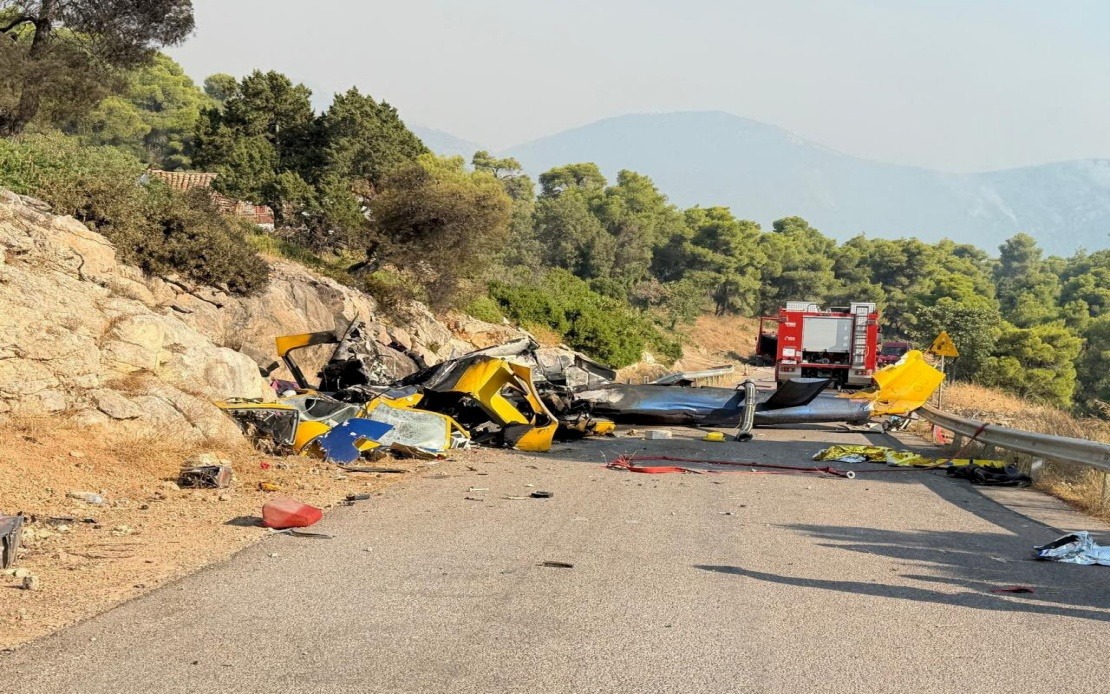
Two helicopter crews engaged in aerial firefighting operations collided in mid-air near the coastal town of Psatha in western Attica on Sunday, resulting in the deaths of a Danish pilot and a Greek firefighting coordinator. Fire Service spokesperson Vassilis Vathrakogiannis confirmed the fatalities at a press briefing, while also announcing that two crew members survived the collision. The survivors included a British pilot and a Greek firefighting coordinator, with one of them sustaining injuries from the accident.
Both aircraft were Bell helicopters contracted to assist in combating a major wildfire spreading across the Attica and Boeotia regions. Each helicopter carried a crew of two personnel responsible for conducting water drops and monitoring the fire's progression. The collision occurred while the aircraft were actively engaged in firefighting manoeuvres, highlighting the inherent dangers that aerial crews face when managing large-scale natural disasters. Authorities immediately launched search and rescue operations following the incident, though both aircraft had crashed, making recovery and investigation efforts the immediate priority.
The precise cause of the mid-air collision remains under investigation by Greek authorities. Determining what led two experienced crews to occupy the same airspace simultaneously involves examining multiple factors, including communication protocols between ground control and airborne units, weather conditions at the time of impact, visibility constraints, and the spatial coordination systems used to manage multiple aircraft operating in close proximity during emergency response. Preliminary findings will be crucial for understanding whether procedural failures, mechanical issues, or environmental factors contributed to the tragedy.
Greece has been grappling with an escalating wildfire crisis throughout the summer season, with multiple blazes consuming vast tracts of land across the country. The collision underscores the mounting pressure on firefighting resources as authorities stretch personnel and equipment across numerous simultaneous incidents. The Attica and Boeotia fires represent particularly significant challenges given their proximity to populated areas and the speed at which flames have advanced through drought-stricken terrain.
Weather conditions across Greece have been exceptionally challenging for firefighting efforts. Intense heat, low humidity, and strong winds create ideal conditions for rapid fire spread and make aerial operations particularly hazardous. Pilots and crews must navigate turbulent air currents, reduced visibility from smoke, and extreme temperatures while attempting precise manoeuvres to deliver fire suppressant materials. The environmental factors that intensify wildfire danger simultaneously amplify the risks faced by those combating these blazes.
The deployment of rented helicopter assets reflects the severity of Greece's wildfire situation and the necessity of mobilising external resources to supplement national capabilities. When domestic firefighting infrastructure becomes insufficient to address multiple concurrent crises, nations turn to private contractors and international assistance. The Bell helicopters involved in Sunday's collision represented vital supplementary capacity in an already stretched emergency response system.
For Malaysian readers and Southeast Asian observers, Greece's wildfire crisis and the tragic incident offer important lessons regarding disaster management infrastructure and interagency coordination. Rapid urbanisation and climate-driven environmental changes have increased wildfire risks globally, including in tropical and subtropical regions. The collision demonstrates how emergency response operations, while essential, carry significant occupational hazards for personnel directly engaged in combating natural disasters.
The incident will inevitably prompt reviews of helicopter coordination protocols and airspace management procedures during large-scale firefighting operations. Authorities across Europe and internationally will examine the circumstances surrounding the collision to identify systemic improvements in communication, tracking technology, and safety procedures. Such reviews often lead to enhanced regulations and operational standards that eventually benefit emergency response capabilities across multiple nations.
The families of the deceased Danish pilot and Greek coordinator, along with the injured survivor and their colleagues, face the emotional aftermath of this tragedy. The sacrifice made by firefighting personnel, whether on the ground or in the air, often goes underappreciated despite the critical role these professionals play in protecting communities and infrastructure. This incident serves as a stark reminder of the human cost associated with wildfire management and disaster response operations.
As Greece continues combating its wildfire emergency, the loss of two experienced crew members reduces available aerial firefighting capacity at a time when such resources are most needed. Replacing contracted helicopter services and redeploying remaining assets will require careful coordination among Greek authorities. The incident also raises questions about optimal staffing levels and equipment reserves necessary to sustain prolonged emergency operations without compromising safety standards or overwhelming available personnel.

