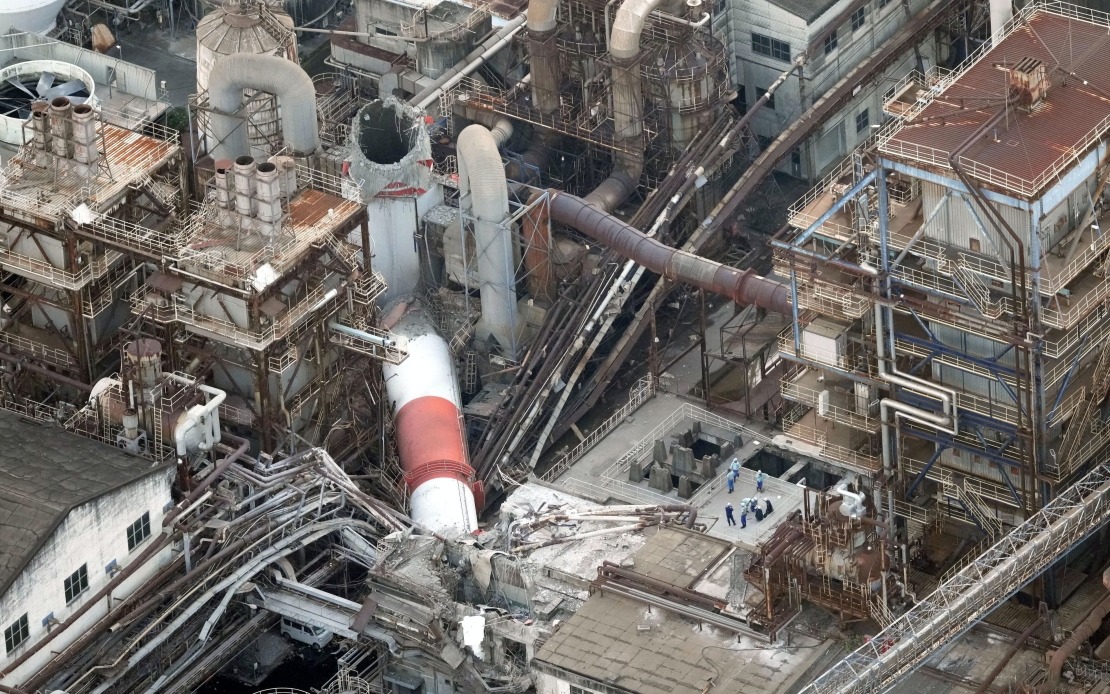
A critical industrial disaster unfolded in southwestern Japan on Tuesday when a towering smokestack at a Nippon Paper manufacturing plant in Yatsushiro City, Kumamoto Prefecture, came crashing down in the aftermath of a major earthquake. The structural failure has left emergency responders facing a grim search operation, with two individuals reported to be in cardiac arrest and nine others unaccounted for among the factory's workforce. The incident underscores the cascading dangers that follow major seismic events in industrialised regions, where aging infrastructure and sudden ground movement can compound already severe disaster conditions.
According to reporting by Japan's public broadcaster NHK, the smokestack's collapse appears directly linked to the earthquake that struck the region earlier in the day, with the violent tremors presumably destabilising the industrial structure. Kumamoto Prefecture, located on the island of Kyushu, sits within one of Japan's more seismically active zones. The prefecture experienced a devastating magnitude 7.0 earthquake in April 2016 that killed dozens and displaced tens of thousands of residents, making communities there acutely aware of seismic risks. Tuesday's tremor has revived concerns about structural vulnerability in older industrial facilities throughout the region.
Local police in Yatsushiro received multiple emergency calls reporting the collapse and the missing workers, prompting an immediate alert to rescue and emergency management authorities. However, the broader scale of the earthquake's impact has severely hampered response efforts. Across the disaster-affected areas of Kumamoto and surrounding prefectures, emergency dispatch centres have been inundated with thousands of distress calls simultaneously, leaving rescue teams stretched impossibly thin. This coordination challenge represents a common vulnerability in Japan's emergency response system during major earthquakes: the sheer volume of simultaneous incidents overwhelms available resources.
Rescue operations at the paper mill site have been delayed as a direct result of this broader emergency saturation. Standard search and rescue protocols typically begin within minutes of structural collapse, as survivor survival rates decline sharply after the first few hours. The inability to immediately deploy heavy rescue equipment and trained teams to the Nippon Paper facility represents a critical bottleneck in what may prove to be a time-sensitive operation. Emergency management officials acknowledged publicly that rescue efforts have yet to commence, a candid admission reflecting the scale of the crisis unfolding across multiple locations.
The Nippon Paper facility represents a significant employer in Yatsushiro, and the incident has sent ripples of concern through Japan's industrial sector. Manufacturing plants, petrochemical refineries, power stations, and other large-scale industrial operations throughout seismic zones face similar structural vulnerabilities. Following the 2011 Tōhoku earthquake and tsunami, Japan undertook extensive reviews of industrial facility safety, yet questions persist about whether all older installations have been adequately retrofitted or reinforced. The Kumamoto incident suggests that some facilities may remain exposed to catastrophic failure during major seismic events.
For Malaysia and other Southeast Asian nations, the Kumamoto smokestack collapse offers sobering lessons about industrial safety in earthquake-prone regions. While Malaysia itself experiences relatively moderate seismic activity, several neighbours including Indonesia and the Philippines face significant earthquake hazards. Manufacturing plants, particularly those housing heavy structures or storing hazardous materials, require periodic seismic safety assessments. The incident demonstrates that structural engineering standards, even in developed economies like Japan, may not universally account for worst-case seismic scenarios.
The human toll of industrial disasters following natural disasters often exceeds initial estimates as rescue efforts progress and full damage assessments emerge. The nine missing workers at the Nippon Paper site may include individuals trapped beneath collapsed debris, buried in rubble, or unable to reach safe zones during the initial tremor and structural failure. Their families face an agonising waiting period as rescue teams attempt to prioritise this incident amid competing emergencies across the earthquake zone.
Japan's earthquake preparedness systems, among the world's most advanced, are being tested once again by the events in Kumamoto. The nation has invested heavily in early warning systems, seismic building codes, and emergency response training. Yet Tuesday's incident illustrates that human and material resources remain finite constraints. Even well-prepared emergency management systems struggle when multiple catastrophic failures occur simultaneously across a wide geographic area. This reality applies equally to other earthquake-prone regions globally.
The Nippon Paper incident will likely trigger immediate structural safety reviews at similar industrial facilities throughout Japan, with particular focus on aging smokestacks and other tall structures that may be vulnerable to lateral earthquake forces. Regulatory authorities may accelerate compliance deadlines for retrofitting programmes already underway. International industrial safety standards bodies may also examine the incident as a case study for evaluating current design guidelines for industrial structures in seismic zones, potentially leading to enhanced specifications.
As rescue operations ultimately commence at the paper mill site, the focus will be on locating survivors among the nine missing workers and understanding precisely how the smokestack failed structurally. Engineering investigations will examine whether the facility met current seismic building codes and whether maintenance records indicate any previous structural concerns. These technical findings will inform not only reconstruction efforts at this specific facility but also broader policy conversations about industrial safety resilience in earthquake-prone nations throughout the Asia-Pacific region.

