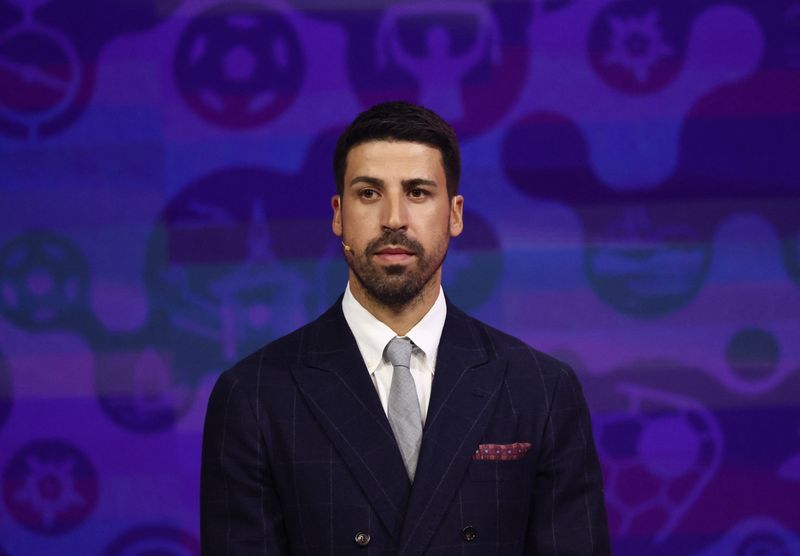
Sami Khedira, who lifted the World Cup trophy with Germany in 2014, has emerged as an unlikely voice of perspective on one of international football's most poignant modern phenomena: siblings donning different national jerseys. Speaking at the Home of Football museum in New York, the veteran midfielder dismissed concerns about brothers competing against each other at the 2026 World Cup, instead framing the trend as a reflection of our interconnected, mobile world where loyalty to place and heritage cannot be confined to a single nation.
Khedira's own experience provides the emotional foundation for his worldview. His brother Rani currently represents Tunisia at the World Cup, the nation of their father's birth, while Sami chose to play for Germany, the country where he was raised by a German mother. Rather than viewing this split as a source of tension or confusion, Khedira sees it as a natural expression of modern family life. For him, carrying two cultures is not a liability but a strength, a reflection of how millions of people worldwide navigate identity in an age of migration, intermarriage, and global mobility.
The current World Cup cycle has thrown this reality into sharp relief. Eight sets of brothers are competing across the tournament, with four pairs playing together for the same nation and four split across different teams. The Inaki and Nico Williams brothers exemplify this divide—they share club colours at Athletic Bilbao but international allegiances split between Ghana and Spain respectively. Similarly, Guela and Desire Doue represent the Ivory Coast and France, while other sibling pairs like Derrick Luckassen and Brian Brobbey, who share a mother but use different surnames reflecting their fathers' heritages, play for Ghana and the Netherlands. The Souttar brothers are divided between Australia and Scotland, while three other pairs represent Europe's smaller footballing nations and the Caribbean.
What strikes Khedira most profoundly is not the logistical or sporting complications of such arrangements, but their symbolic power. He witnessed the Doue brothers singing both the French and Ivorian national anthems before their countries met in a friendly earlier this month—a moment he describes as genuinely beautiful. For him, this image captured something essential about football's capacity to transcend mere sport and communicate deeper truths about human experience. The ability of these young men to honour two nations simultaneously, rather than choose one over the other, sends a powerful multicultural message to a world that still struggles with questions of belonging and identity.
Khedira's own journey informs his empathetic stance toward young players facing such decisions. Growing up German yet bearing a distinctly Tunisian name and appearance, he experienced firsthand the questions and assumptions that accompany dual heritage. Some questioned his Germanness based on his surname and features; in Tunisia, he could be perceived as German. Rather than viewing these contradictions as irreconcilable, he embraced them as the simple truth of his existence. Both nations, both mentalities, both cultural frameworks are genuinely part of who he is, and his refusal to choose one over the other has not diminished his achievement or his sense of belonging.
The expansion of the World Cup to 48 teams from 2026 onwards has broader implications for how nations approach player recruitment and identity. Khedira argues that the larger tournament has opened doors for football-developing nations like Cape Verde, Curacao, and Haiti to compete at the highest level, fundamentally changing the competitive landscape. He notes that African and Asian football has been steadily closing the gap with traditional powerhouses in Europe and South America, driven by improvements in coaching education, infrastructure investment, and systematic player development. These changes mean that opportunities for international representation are no longer concentrated in wealthy European and South American federations.
Yet Khedira raises an important counterpoint to this optimistic narrative. While Europe benefits from players with dual heritage choosing to represent European nations, he argues that European football federations and clubs have a moral obligation to invest in development at source—in Africa, Asia, and the Caribbean—rather than simply harvesting talent from these regions through dual-nationality loopholes. The talent pipeline works both ways, and sustainable growth in global football requires wealthy nations to nurture development abroad rather than merely exploit it.
The most delicate aspect of this whole phenomenon, in Khedira's view, is the pressure placed on young players who must choose between nations before they have fully matured emotionally or intellectually. At 18 years old, he recalls making his own decision with a sense of gravity that most adolescents never experience. The weight of representing a nation, of choosing between heritage and upbringing, of potentially disappointing family members across continents—these represent an immense psychological burden for teenagers still finding themselves. Yet Khedira believes the solution is not to deny young people the right to choose, but rather to ensure that decisions come from genuine conviction rather than political pressure, administrative coercion, or family obligation.
For Khedira, the answer to such monumental personal decisions cannot be legislated or forced. It must emerge from what he calls a gut feeling—an internal compass that points toward the community with which a young player most genuinely identifies. This is not something that can be manufactured through incentives, patriotic rhetoric, or heritage claims. It requires young athletes to listen to their own hearts and make choices that feel authentically theirs. The Tunisian Football Association approached him with respect, he notes, understanding that such decisions must ultimately rest with the individual rather than institutional pressure.
Khedira's perspective offers important wisdom for football administrators, parents, and young players themselves navigating an increasingly complex landscape of identity and belonging. Rather than treating dual loyalty as a problem to be solved, he advocates for celebrating it as evidence of football's universality and humanity. The game's greatest strength may lie not in erasing difference or demanding singular loyalty, but in creating spaces where people can honour multiple identities simultaneously. In an era of rising nationalism and identity politics, the sight of brothers singing different anthems before competing fiercely on the pitch sends exactly the kind of positive, cosmopolitan message that global sport is uniquely positioned to deliver.

