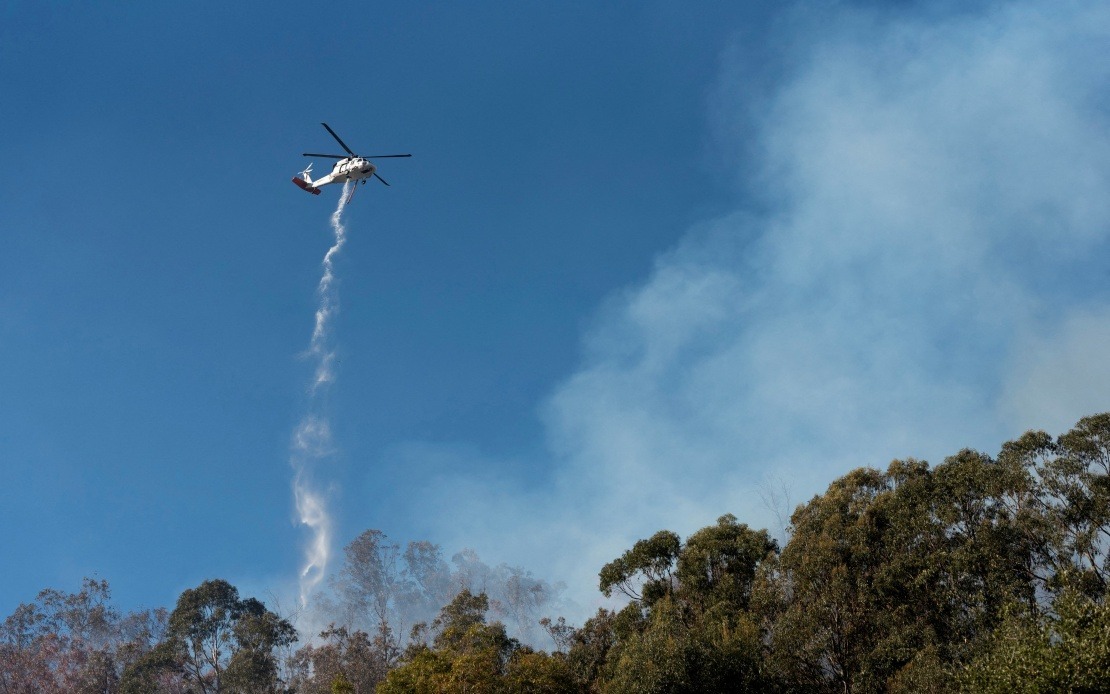
A Sikorsky S-64 helicopter contracted to the US Forest Service went down near Richfield, Utah on Friday morning, claiming the lives of its pilot and one crew member in what authorities describe as a tragic reminder of the perils inherent in wildland firefighting. The aircraft crashed at approximately 10 am local time while conducting support operations for the sprawling Widemouth 2 Fire, one of the region's most significant wildfire incidents this year. Though initial investigations could not immediately determine what caused the accident, the National Transportation Safety Board has assumed lead investigative responsibilities to examine the circumstances surrounding the loss.
The remote location where the helicopter came down presented immediate challenges for emergency responders attempting to reach the crash site and recover the victims. Fire activity in the immediate vicinity, combined with the rugged terrain characteristic of central Utah's landscape, prevented crews from accessing the wreckage during the initial hours following the accident. Compounding these difficulties, the crash itself ignited additional fires, creating a secondary hazard that further complicated rescue and recovery operations while raising serious safety concerns for responders working in an already dangerous environment.
Utah Governor Spencer Cox issued a statement acknowledging the gravity of the situation, emphasising the extraordinary risks that wildland firefighters routinely assume in their work. Cox characterised the incident as "a painful reminder" of the dangers inherent in one of America's most hazardous professions, calling for residents to grant investigators and emergency personnel the necessary time and space to conduct their operations unimpeded. The governor's comments underscore a broader recognition within government circles that wildfire suppression demands a workforce willing to operate in extreme conditions where the margin for error remains dangerously narrow.
The Widemouth 2 Fire originated on July 27 when lightning struck dry vegetation across the Fishlake National Forest near the small community of Kanosh. Since ignition, the fire has expanded with alarming speed, capitalising on extended periods of drought, elevated temperatures, and unpredictable wind patterns that swept across the region throughout late summer. The combination of these meteorological factors created ideal conditions for rapid fire propagation, triggering mandatory evacuations from surrounding communities and resulting in considerable property damage across the affected area.
As of the latest official reporting, the Widemouth 2 Fire encompasses approximately 114,000 acres—an expanse equivalent to roughly 461 square kilometres—making it a substantial wildfire by most standards. Despite sustained firefighting efforts involving multiple agencies and resources, containment efforts had achieved only 24 per cent containment at the time the helicopter crashed. Officials confirmed that at least six structures had fallen victim to the advancing flames, though damage assessments in remote areas continue as the fire remains active and crews maintain intensive suppression operations.
The incident raises significant questions about the adequacy of resources and protocols governing aerial firefighting operations in the western United States. Helicopter crews performing this work operate under conditions of considerable stress, often working in deteriorating visibility, extreme heat, and over challenging topography where mechanical failure or disorientation can prove catastrophic. The loss of the Sikorsky S-64—a heavy-lift helicopter specifically designed for such assignments—demonstrates that even purpose-built aircraft and experienced operators cannot guarantee safety when deployed in such demanding operational environments.
For Southeast Asian nations like Malaysia, which increasingly faces its own wildfire challenges particularly during dry seasons, the Utah incident offers sobering lessons about the human costs of firefighting operations. As climate patterns shift and drought conditions become more frequent in tropical regions, aerial firefighting capabilities are likely to expand across the region, bringing with them similar occupational hazards for crews and support personnel. The accident underscores the necessity for rigorous training protocols, regular equipment maintenance, and robust safety procedures to protect those tasked with combating increasingly destructive wildfires.
The broader context of wildfire management in the American West reveals an escalating challenge, with fires burning with greater intensity and frequency as global temperatures rise and forest conditions deteriorate. The US Forest Service and its contractor partners operate dozens of aircraft across multiple states, transporting firefighters, dropping retardant, and supporting ground operations on an industrial scale. Each flight carries inherent risks amplified by the unpredictability of weather, terrain, and fire behaviour, making the profession among the most dangerous in the world despite technological advancement and years of accumulated operational experience.
The identities of the two deceased remained unreleased as of Saturday, pending notification of family members and completion of preliminary investigations. This deliberate pause in public disclosure reflects standard procedures designed to ensure dignity for the deceased and their families during an exceptionally difficult time. The incident will inevitably prompt reviews of operational procedures, equipment specifications, and safety protocols governing aerial firefighting missions, potentially leading to revised guidelines that could influence how such operations are conducted across the western United States and beyond.

