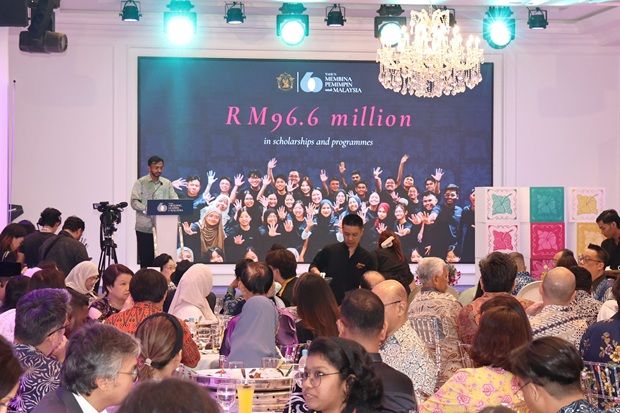
The Tunku Abdul Rahman Foundation (YTAR) reached a significant milestone on August 13 when it commemorated six decades of nation-building through education at a ceremony held at Bangunan Sultan Abdul Samad. What began as a grassroots movement to honour Malaysia's founding Prime Minister has evolved into one of the country's most enduring institutions dedicated to identifying talent and creating pathways for Malaysian youth to access higher learning and develop their potential for national contribution.
The foundation's origins reflect a remarkable chapter in Malaysia's early years of independence. In 1964, Utusan Melayu spearheaded a nationwide crowdfunding campaign on Tunku Abdul Rahman Putra al-Haj's birthday to establish an education fund in his name, garnering more than M$60,170.20 from ordinary Malaysians—a sum equivalent to approximately RM380,000 in current economic terms. This groundswell of public support demonstrated the nation's collective belief in education as a cornerstone for development. The Education Minister at that time, Tan Sri Mohamed Khir Johari, recognized the significance of this community initiative and brought the proposal to the Federal Government, which formally established Yayasan Tunku Abdul Rahman through the Tunku Abdul Rahman Foundation Fund Act 1966 (Act 43), transforming a citizen-led effort into a national institution.
Over the past six decades, YTAR has disbursed RM96.6 million to support the educational aspirations of more than 12,000 Malaysian youths regardless of background, race, colour or creed. National Unity Minister Datuk Aaron Ago Dagang, speaking at the anniversary ceremony, highlighted how the foundation's mission has expanded significantly beyond its original remit as a scholarship provider. The organization now functions as a comprehensive talent identification and youth development ecosystem, providing not only financial assistance for higher education but also access to opportunities, employability programmes, and skills development initiatives designed to equip Malaysian youth with the capital, capabilities and values needed to navigate an increasingly complex world.
The foundation's impact extends across all sectors of nation-building. Alumni of the Tunku Abdul Rahman Scholarship—known colloquially as Tunku Scholars—have gone on to serve as educators, civil servants, lawyers, doctors, healthcare professionals and community leaders, each contributing their expertise and commitment to Malaysia's progress. This dispersal of beneficiaries across diverse fields underscores the foundation's belief that investing in human potential yields returns that ripple through every layer of society and economy. The institution's enduring success reflects not the work of any single individual but rather the collective stewardship of generations of Malaysians who have guided its evolution and supported its mission.
Two distinguished alumni honoured at the anniversary celebration embodied the transformative power of YTAR's interventions. Dr Zakaria Ali, recognized as one of Malaysia's forerunners in fine arts and now an accomplished painter, writer, educator and academic figure, received his scholarship after a serendipitous chain of events. An American instructor from Texas, impressed by young Zakaria's potential while he worked as a processing assistant, took the initiative to apply on his behalf to Southwestern University in Austin. When financial barriers threatened his dream, the instructor's personal advocacy—writing directly to the King, education minister and prime minister—catalyzed the scholarship opportunity that launched Zakaria's illustrious career.
Similarly, Ch'ng Kim See, now recognized as one of the country's most prominent librarians with significant regional influence in Southeast Asian history and library science, received her YTAR scholarship in 1967 at a critical moment of financial distress during her university years. Having exhausted other scholarship channels, the unexpected award proved transformative for her family's circumstances. Ch'ng's subsequent career trajectory, marked by institutional leadership and intellectual contribution to the field, exemplifies how targeted educational support can catalyze not merely individual advancement but broader disciplinary and regional development.
Datin Sri Sharifah Menyalara Syed Hussein, chairperson of YTAR and granddaughter of the late Prime Minister, articulated the philosophical foundation underpinning the institution's work during the anniversary ceremony. She recalled her grandfather's insistence that before undertaking grand ambitions, one must establish a robust foundation—and for him, that foundation was education. Critically, Tunku Abdul Rahman conceived of education not as mere academic credential acquisition but as the cultivation of character, purpose and the values necessary for individuals to discover their place within society and contribute meaningfully to national development. This conception distinguishes YTAR's mission from narrowly vocational scholarship provision and positions education as integral to nation-building itself.
The foundation's evolution over 60 years reflects shifting national priorities and demographic realities. In its early years, YTAR primarily facilitated Malaysian youth accessing higher education internationally, a critical function when domestic tertiary institutions were limited. As Malaysia's own higher education ecosystem expanded, YTAR adapted its programmes to encompass scholarships within the country, financial assistance for economically disadvantaged students, and increasingly sophisticated talent identification and mentoring initiatives. This flexibility demonstrates institutional resilience and relevance across changing circumstances.
Minister Datuk Aaron Ago Dagang used the anniversary celebration to encourage Malaysia's corporate sector to embed education and talent development more substantively within their corporate social responsibility frameworks. He specifically called for greater partnership between private enterprises and foundations such as YTAR, recognizing that the nation's human capital challenges require collaborative approaches extending beyond government and philanthropic institutions. This appeal acknowledges both the resource constraints limiting YTAR's expansion and the potential for private sector engagement to amplify educational access and youth development across the country.
CEO Kularetnam Vijayakumar contextualized the foundation's significance within Malaysia's broader development narrative. He noted that the original 1964 crowdfunding campaign reflected a national consensus regarding education's transformative potential—a belief that has remained remarkably consistent across six decades of social and economic change. This ideological continuity, despite Malaysia's profound development over the period, suggests that education's role in enabling individual potential and facilitating social mobility remains a foundational aspiration within Malaysian society. The foundation's mission to invest in youth as Malaysia's greatest resource resonates as powerfully today as it did in the early independence period.
Tunku Abdul Rahman himself articulated this philosophy in 1964, observing that the nation's present and future depend substantially upon its youth. This sentiment animated the original scholarship initiative and continues to guide YTAR's strategic direction six decades later. As the foundation moves into its next phase, its challenge lies in scaling these interventions to reach greater numbers of deserving Malaysian youth while maintaining the personalized, mentorship-oriented approach that characterized early programmes. The balance between expansion and intimacy will likely define YTAR's contribution to Malaysian development in coming decades.
Looking forward, the foundation has announced opening of nominations for the 2026 Pingat Tunku Award, with a notable innovation: for the first time, self-nomination has been made available to graduates of both public and private higher education institutions throughout Malaysia. This democratization of the nomination process, beginning August 31 and closing September 30, signals a deliberate effort to surface talent and contribution that might otherwise remain unrecognized through traditional institutional pathways. The move reflects an institutional commitment to identifying excellence and leadership potential across the widest possible segment of Malaysian society, reinforcing YTAR's role not merely as a historical institution but as an active architect of national talent identification and development in the contemporary context.

