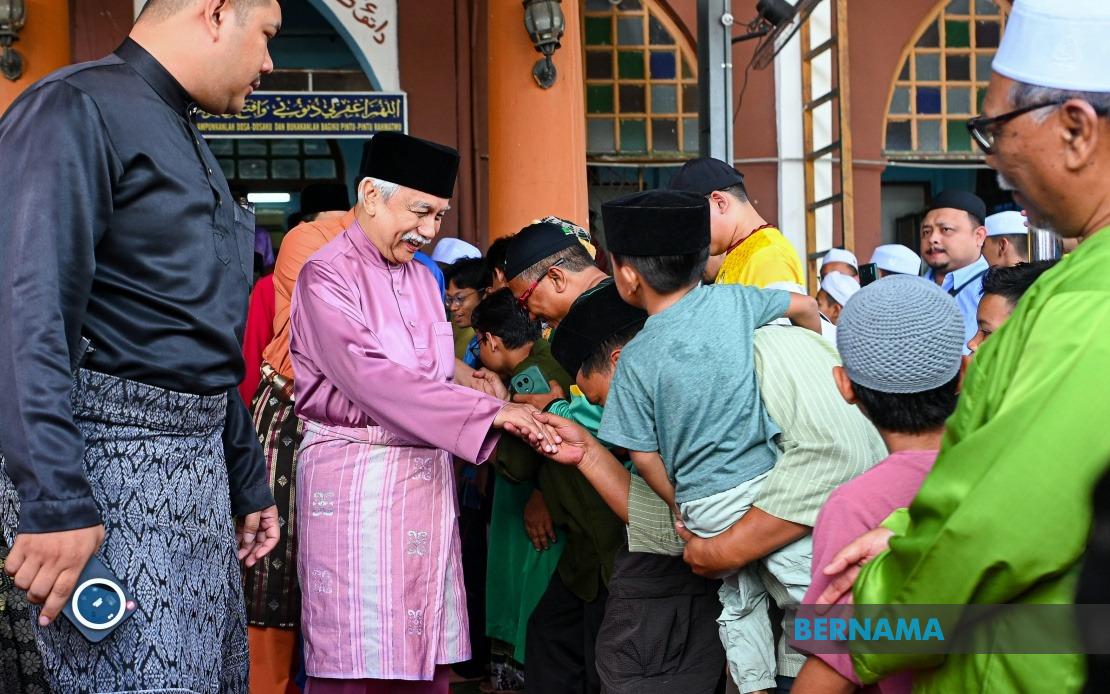
Negeri Sembilan's paramount ruler, Tuanku Muhriz Tuanku Munawir, fulfilled his religious obligations by attending congregational prayers on Friday, July 17, at Masjid Kariah Pantai in Seremban, where he worshipped alongside a gathering of more than 500 devotees. The attendance underscored the royal household's commitment to participating in community religious observances and reinforced the long-standing tradition of Malaysia's hereditary rulers actively engaging with their subjects through spiritual occasions.
The Yang Dipertuan Besar's presence was notably distinguished by the participation of his immediate family. His two sons, Tunku Besar Seri Menanti Tunku Ali Redhauddin and Tunku Zain Al-'Abidin, joined their father in the congregational worship, signifying the intergenerational transmission of religious values within the Negeri Sembilan royal family. This family-oriented approach to religious observance carries symbolic weight in demonstrating that even members of the highest echelon of Malaysia's constitutional monarchy regard mosque attendance and Islamic practice as integral to their public and private lives.
The occasion drew not only the royal household but also prominent figures from Negeri Sembilan's administrative and traditional leadership structures. Undang of Luak Sungei Ujong Datuk Klana Petra Muhammad Faris Johari, representing the territorial chief's authority rooted in the state's unique dual-system governance, attended alongside Menteri Besar Datuk Seri Aminuddin Harun. Their collective participation illustrated how religious gatherings serve as forums where different tiers of hierarchical authority—monarchical, bureaucratic, and customary—converge in the practice of Islam, reinforcing social cohesion across institutional lines.
The religious dimension of the gathering centred on the sermon delivered by Imam Amru Zubair Abu Hanifah preceding the actual prayers. Rather than limiting remarks to routine procedural announcements, the imam crafted a thematic discourse examining contemporary challenges confronting Islamic faith. This homiletical choice suggests deliberate attention to the spiritual anxieties and doctrinal questions facing modern Malaysian Muslims, extending the mosque's role beyond a place of ritual observance to encompass intellectual and moral engagement with pressing religious matters.
Following the completion of the Friday prayers, Tuanku Muhriz and his sons did not depart immediately but instead engaged in direct interaction with members of the congregation. This post-prayer engagement carried significance beyond mere courtesy; it represented an accessible moment when the royal family could meet ordinary citizens in a religiously sanctioned setting, fostering a sense of accessibility and shared spiritual identity that transcends the formal distance typically separating royalty from commoners. The informality of mingling after prayers is a distinctly Islamic practice that emphasizes the equality of all believers before God.
A particularly notable dimension of the royal family's engagement involved the distribution of financial contributions to children who had attended the prayers. This gesture served multiple purposes within the Islamic and Malaysian social context. The monetary support acknowledged the younger generation's participation in religious life and provided tangible encouragement for their continued involvement in mosque activities, addressing a frequent concern among Muslim communities about declining youth attendance at congregational prayers. Simultaneously, the contribution reinforced the traditional royal prerogative of charitable dispensation and benevolence toward subjects.
For Malaysian observers and the broader Southeast Asian region, this religious observance by Negeri Sembilan's paramount ruler carries implications for understanding how constitutional monarchies navigate religious authority and cultural responsibility. Malaysia's system of hereditary rulers has long existed in tension with secular constitutional governance, yet occasions like this Friday prayer service demonstrate how royalty maintains religious credibility and cultural legitimacy through visible piety and community participation. In Negeri Sembilan specifically, where the Yang Dipertuan Besar holds both ceremonial and, by historical convention, certain religious administrative roles, such public worship reinforces the connection between temporal authority and spiritual obligation.
The location of the prayers at Masjid Kariah Pantai, a neighbourhood mosque rather than a grander state or palace mosque, also merits consideration. This choice suggests intentionality in demonstrating support for community-level religious infrastructure and the spiritual lives of ordinary citizens in residential areas. For Negeri Sembilan, a state that often receives less international media attention than Kuala Lumpur or other peninsular powerhouses, such visible royal engagement in grassroots community affairs contributes to maintaining the state's institutional cohesion and social fabric during periods when many state functions have been increasingly centralized at the national level.
The convergence of such diverse participants—royal family members, territorial chiefs, elected state leadership, and hundreds of ordinary worshippers—illustrates how Friday prayers remain among the most significant social and political occasions in Malaysian Islamic life. Unlike ceremonies confined to official state functions, mosques remain genuinely public spaces where the full spectrum of Malaysian society can gather, creating opportunities for organic interaction across hierarchical divides. For Seremban's Muslim community, the presence of Tuanku Muhriz and state officials amplified the cultural significance of that particular Friday, transforming a routine religious obligation into an occasion of heightened communal and national awareness.

