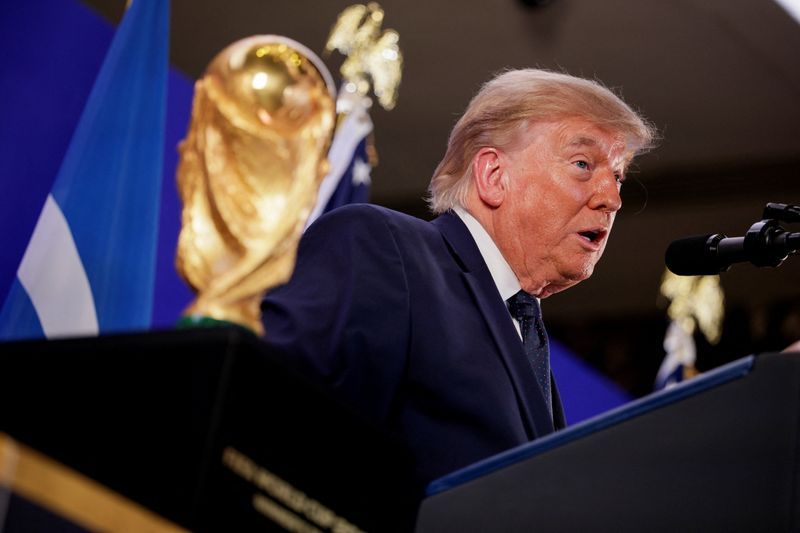
Donald Trump will occupy a prominent position at Sunday's World Cup final between Argentina and Spain at New York/New Jersey Stadium, sitting alongside FIFA President Gianni Infantino and presenting the winning trophy—a role that underscores his deepening entanglement with international football at the highest level. Yet his presence comes fraught with controversy, having just confirmed his direct intervention in a key match decision that has cast a shadow over the tournament's integrity and raised uncomfortable questions about the boundary between political power and sporting governance.
The focal point of the drama centres on a red card issued to U.S. striker Folarin Balogun, which Trump asked Infantino to review. That request, now publicly acknowledged, has ignited fierce debate about whether elected officials should wield influence over match officials' decisions. FIFA has maintained that Trump played no role in the subsequent suspension of the ban, yet the very act of a sitting president appealing a referee's decision has fundamentally altered perceptions of the tournament's independence from political pressure.
Trump and Infantino's relationship has visibly strengthened in recent months, evident in their public displays of mutual admiration at a Manhattan reception on Friday held at Trump Tower, where FIFA opened an office last year. Before approximately 300 dignitaries, including Brazilian football legend Ronaldo and various FIFA officials, Infantino lauded Trump's contribution to what has become a record-breaking tournament. The partnership reflects a broader alignment between the Trump administration and FIFA leadership, one that began when the tournament was officially awarded to the United States, Canada, and Mexico during Trump's first term in 2018—an achievement he has repeatedly cited as a personal triumph.
Yet the path to this final has been far from smooth. A year before the tournament began, American host cities grappled with serious diplomatic concerns about how they could reassure international visitors and teams troubled by Trump's immigration policies and travel restrictions affecting multiple countries. The political landscape surrounding the tournament threatened to undermine its global appeal at a moment when FIFA sought to project unity and inclusivity.
Those tensions escalated when Trump subsequently threatened to relocate matches away from Democratic-controlled cities, a move FIFA firmly rejected by clarifying that such decisions lay entirely outside presidential discretion. The clash exposed the fundamental tension between national political interests and international sporting governance—a tension that remains unresolved. On Friday, Trump compounded the controversy by suggesting that the United States host the World Cup again in 2038, but pointedly excluding Mexico and Canada from his vision, a comment that carries obvious protectionist and nationalist undertones.
For American television audiences, Trump's prominent placement at the final creates unusual editorial challenges. Fox Sports, which broadcasts the match using FIFA's world feed rather than its own camera angles, will have no control over whether—or when—the broadcast cuts to Trump seated beside Infantino and other dignitaries. Play-by-play announcer John Strong acknowledged the awkwardness: commentators have no advance notice of such cutaways and cannot predict their timing, meaning viewers will encounter Trump's image unexpectedly during crucial moments of play. Strong also recognised the polarised nature of Trump's presence, noting that significant portions of the audience will celebrate his appearance while others find it objectionable.
Trump's pursuit of high-profile sporting moments has intensified over the past 18 months, particularly as his approval ratings during his second term have declined. He successfully tapped into enthusiastic American crowds at last year's Ryder Cup on Long Island, where he received sustained cheers from partisan spectators. However, his reception elsewhere has proved decidedly mixed. He was loudly booed at Game 3 of the NBA Finals last month, and his attendance at the U.S. Open men's tennis final at Flushing Meadows triggered such extensive security protocols that fans waiting outside experienced significant delays, fuelling resentment among those unable to witness the match's opening moments.
The broader context reveals how Trump has sought to leverage sports as a platform for political visibility and brand enhancement at a time when his traditional approval metrics have softened. World Cup hosting, in particular, carries symbolic weight—it represents global recognition and validates his claim that the United States remains a destination capable of managing events of unprecedented scale. His repeated assertions that he personally delivered the tournament to America form part of a larger narrative about national achievement and international standing.
For Malaysian and Southeast Asian observers, Trump's behaviour at this World Cup illuminates the persistent vulnerability of international sports governance to political interference. The incident raises uncomfortable questions about whether FIFA's institutional independence can withstand pressure from powerful political figures, particularly heads of state in wealthy, influential nations. Should other countries hosting future tournaments expect similar interventions from their own presidents and prime ministers? The precedent established here may fundamentally alter how international football bodies manage relationships with host nation governments.
Moreover, the tournament's record-breaking success—achieved despite these controversies—suggests that financial and logistical accomplishments can coexist with ethical compromises around governance and political influence. This duality will likely define discussions about whether the World Cup, as a sporting institution, has become too enmeshed with nationalist politics and individual political leaders seeking personal elevation through association with global events.
As Sunday's final approaches, Trump's presence will simultaneously celebrate American sporting achievement and embody the unresolved tensions that have marked this tournament. His role presenting the trophy carries symbolic significance that transcends football: it represents the visible fusion of national political power with international sporting authority, a fusion that has become increasingly difficult to conceal or justify.

