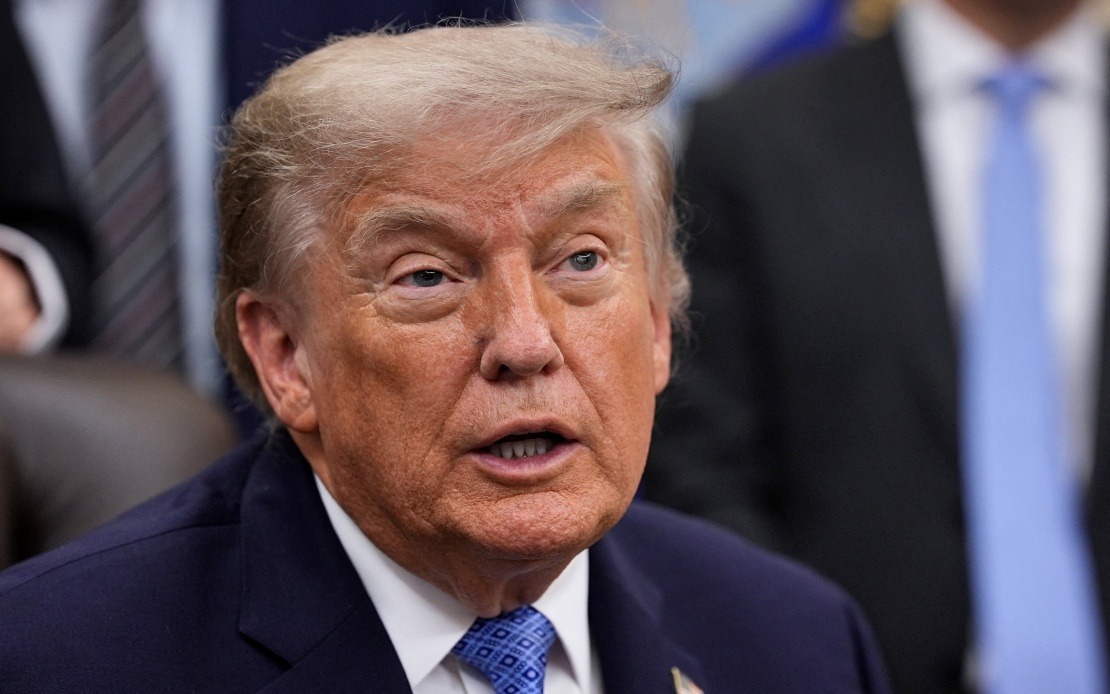
US President Donald Trump has escalated his criticism of Canada over wildfire smoke that has blanketed parts of the northeastern United States, threatening to impose additional tariffs on Canadian goods unless Ottawa addresses what he characterizes as forest mismanagement. The remarks, posted on his Truth Social platform on Friday, mark a striking instance of the American leader weaponizing trade policy in response to what scientists attribute primarily to climate change rather than negligent land stewardship.
Trump's core argument centres on his assertion that Canada has failed to maintain its forests properly and remove accumulated brush and debris, creating conditions that allow fires to spread with particular severity. In his statement, he declared that the United States was being "unnecessarily invaded by filthy, polluted, and unhealthy air, the quality of which is dangerous, and totally unacceptable." He indicated his intention to speak with Prime Minister Mark Carney to determine what measures Canada intended to implement to resolve the situation.
The tariff threat represents Trump's preferred instrument for addressing international grievances, reflecting his administration's willingness to use trade restrictions as leverage in disputes spanning environmental management to geopolitical concerns. He suggested that the cost of the resulting pollution should necessarily be incorporated into tariffs that Canada currently pays to the United States, effectively proposing that environmental damage be monetised through trade penalties.
The smoke problem stems from dozens of active wildfires in Ontario and Minnesota, creating hazardous air quality conditions across a vast geographic region encompassing major metropolitan centres. Toronto, Chicago, Detroit, Washington and New York have all experienced significant impacts, with visibility substantially diminished in New York City where smoke odour has persisted throughout the affected areas. The cross-border nature of the crisis underscores how environmental challenges transcend political boundaries and require coordinated rather than adversarial responses.
However, the scientific consensus directly contradicts Trump's framing. Research from environmental and climate scientists consistently links North American wildfire frequency and intensity to climate change rather than to forest management practices alone. Rising temperatures extend fire seasons, dry out vegetation more rapidly, and create atmospheric conditions conducive to larger and more severe burns. While forest management certainly influences localized fire risk, attributing the current crisis primarily to Canadian negligence oversimplifies complex environmental dynamics shaped substantially by global warming trends.
Ontario Premier Doug Ford responded to Trump's criticism by rejecting the blame-focused approach in favour of practical cooperation. Ford noted that rather than engaging in recriminations, political leaders should prioritise sending assistance to affected regions, pointing out that Canada has previously provided similar support to American communities facing natural disasters. His response highlights a fundamental divergence in approach, with the Ontario government viewing cross-border environmental crises as opportunities for mutual aid rather than occasions for scoring political points.
The incident reflects broader tensions in Canada-United States relations during Trump's presidency, where trade disputes, tariff threats, and disputes over various bilateral issues have created a fraught diplomatic atmosphere. Canada's vulnerability as a trade-dependent economy makes it susceptible to American tariff threats, a dynamic that Trump has repeatedly exploited across multiple policy domains. However, the application of this strategy to environmental phenomena raises questions about whether trade mechanisms constitute appropriate or effective tools for addressing climate-related challenges.
For Malaysia and Southeast Asian nations, the dispute offers instructive lessons about emerging climate-related conflicts and their potential to intersect with trade tensions. As climate change intensifies environmental pressures across the region—from transboundary haze to water resource disputes—similar scenarios may arise wherein neighbouring countries face pressure to adopt each other's environmental remediation costs or face economic penalties. The Canada-US exchange demonstrates how environmental crises can rapidly become politicised and weaponised through trade policy, potentially complicating the cooperative frameworks necessary for regional climate adaptation.
The wildfire situation also underscores the limitations of national-level environmental policy when addressing phenomena that respect no borders. Smoke transported across hundreds of kilometres affects air quality and public health in jurisdictions that lack direct control over fire sources. This reality demands multilateral approaches emphasising information sharing, coordinated resource deployment, and joint investment in fire prevention and management. Trump's unilateral tariff approach, by contrast, threatens to create adversarial dynamics that may undermine the collaborative spirit essential for addressing transnational environmental challenges effectively.

