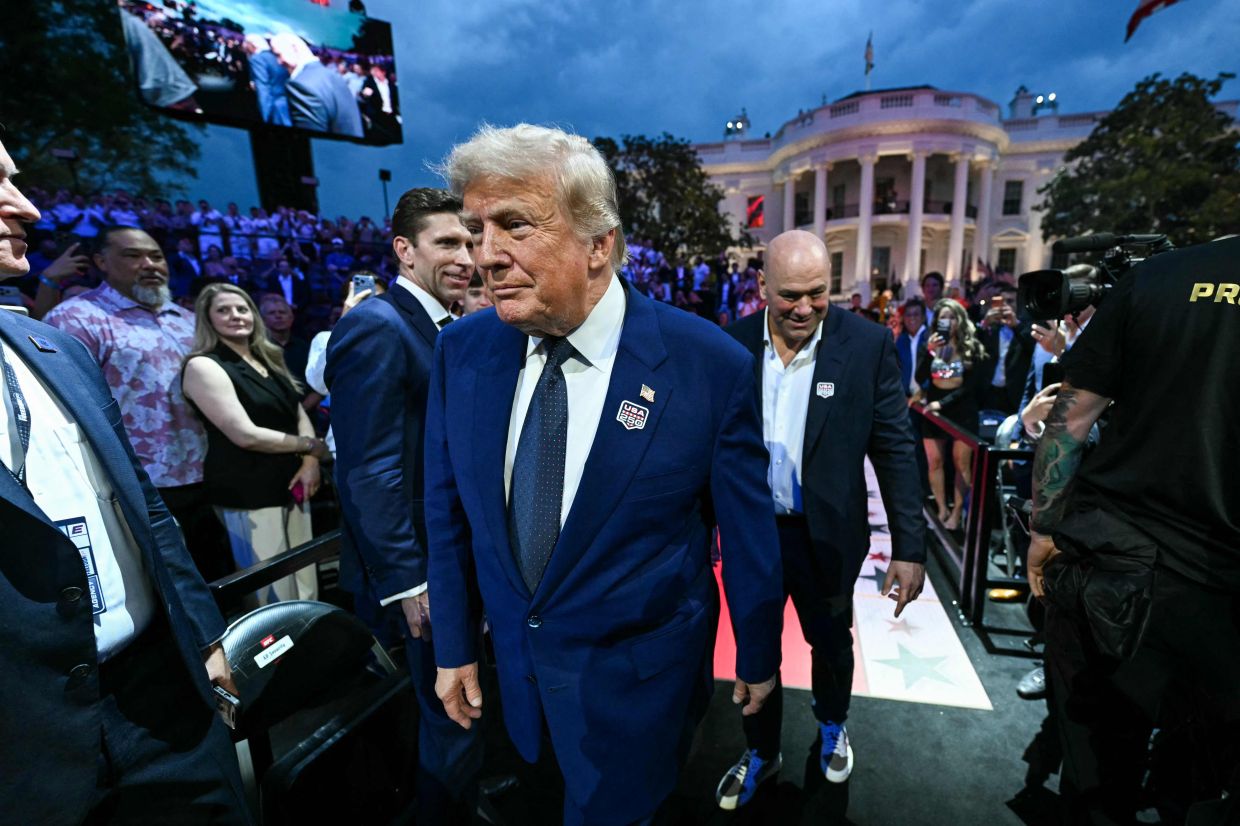
Before departing for France to engage in what promises to be challenging diplomatic exchanges with international leaders, Donald Trump opted to mark his 80th birthday with an evening of visceral combat sport on the grounds of the nation's highest office. The Ultimate Fighting Championship event, presented by TKO Group Holdings Inc., transformed the South Lawn of the White House into an arena over the weekend, introducing a form of entertainment rarely, if ever, associated with presidential celebrations in American history.
The fights commenced just before 8:30pm on Sunday, with Trump and UFC President Dana White making their entrance through the White House corridors into a custom-built 100-foot-tall "Claw" structure designed to house seven cage matches. Weather threatened to derail proceedings entirely, with lightning and thunder creating an unpredictable backdrop to the evening's spectacle, though organisers managed to proceed despite the delay. The event served as the inaugural celebration for what the administration is framing as a broader commemoration of America's 250th anniversary, which will encompass everything from a commemorative gold coin bearing Trump's likeness to an IndyCar race through Washington DC streets in August.
The guest list reflected Trump's political and business ecosystems. Meta Platforms Inc. CEO Mark Zuckerberg, Paramount Skydance Corp. CEO David Ellison, and Treasury Secretary Scott Bessent occupied premium positions, alongside members of Trump's immediate family. Joe Rogan, whose podcast reaches millions of younger voters who constituted a crucial demographic in Trump's 2024 election victory, provided live commentary throughout the matches. Military servicemembers filled sections of the audience, with the broadcast even cutting away to watch parties at bases worldwide, including Okinawa, Japan—a curious reminder of how thoroughly the event saturated the American security apparatus.
The staging underscored the UFC's strategic importance to Trump's political machinery. The league's predominantly young and male fanbase played an instrumental role in his recent electoral success, a demographic Trump's administration has actively cultivated. This alignment has already translated into tangible government support: the State Department and Federal Bureau of Investigation have both established formal partnership agreements with the organisation. The event itself reflected this alignment, with World Liberty Financial—a Trump family venture—announcing an additional US$250,000 in bonuses for the event's top two competitors.
Yet the spectacle generated substantial controversy and public resistance. A lawsuit filed by the Public Integrity Project characterised the event as a "volcano of corruption," raising questions about the propriety of using presidential grounds for commercial entertainment, regardless of sponsorship arrangements. More broadly, public sentiment ran decidedly against the occasion: a YouGov poll released on June 5 revealed that 51 per cent of Americans surveyed disapproved of the White House fight, with only 27 per cent expressing approval—a stark disconnect between Trump's enthusiasm and broader American opinion.
The financial dimensions of the undertaking were substantial. The UFC reportedly spent more than US$60 million to stage the event, with over seven federal agencies "allocating significant resources and manpower" to its execution, according to court filings that had sought unsuccessfully to prevent the gathering. While Dana White suggested the promotion would operate at a loss, unnamed company executives painted a different financial picture. The physical footprint proved equally ambitious: the custom "Claw" arena accommodates 4,300 seated spectators, with an additional estimated 120,000 spectators expected to occupy the nearby Ellipse, where free tickets were distributed through a lottery system.
The commercialisation extended to prominent sponsorship arrangements. Crypto.com and Dodge's Ram truck brand secured prominent placement through the UFC Freedom 250 website, representing the convergence of emerging financial technologies and traditional American consumer goods with presidential pageantry. The integration of cryptocurrency sponsorship proved particularly notable given ongoing regulatory scrutiny of digital assets under various government agencies.
The ceremonial buildup sprawled across Washington's most historically significant landmarks. Dana White conducted a Friday news conference at the Lincoln Memorial, where competing fighters engaged in the traditional pre-fight antagonism and boasting expected of the sport. Michael Chandler, one of the participating fighters, reframed the occasion in patriotic terms, stating that spectators would witness "the best version of" him "on the White House lawn for America's 250th birthday." This rhetorical approach attempted to elevate the commercial sporting event into a statement of national significance.
The logistical arrangements further demonstrated the event's unprecedented scale. Locker rooms were established directly on White House grounds, including within the Indian Treaty Room—a space traditionally reserved for official state functions and ceremonial occasions. The South Lawn itself, which has historically hosted decidedly more sedate presidential events such as the Easter Egg Roll and Congressional Picnic, suddenly hosted a structure Trump himself compared to the Eiffel Tower in terms of architectural prominence. Trump even mused in a June 2 TikTok video that the structure might become permanent, remarking that "we're building something in front of the White House that's quite attractive to a lot of people," before later claiming he had been joking. Court filings from the administration indicated that disassembly would commence at 10am Monday.
The timing of this celebration carries its own geopolitical dimension. Trump departs for France to participate in Group of Seven meetings even as the UFC championship belt prepared to accompany him to these high-level diplomatic engagements. The juxtaposition of brutal combat sport celebration and international diplomatic negotiation illuminates the unconventional nature of Trump's approach to presidential ceremonial functions and international relations more broadly. For Malaysian and Southeast Asian observers, the event underscores how deeply commercialised entertainment and political messaging have become intertwined in American governance, and how leaders increasingly deploy popular culture as a vehicle for political alignment with key voter demographics.
%22%2F%3E%3C%2Fpattern%3E%3C%2Fdefs%3E%3Crect%20width%3D%22100%25%22%20height%3D%22100%25%22%20fill%3D%22url(%23ph1354vg)%22%2F%3E%3Crect%20width%3D%22100%25%22%20height%3D%22100%25%22%20fill%3D%22url(%23ph1354vp)%22%2F%3E%3Ctext%20x%3D%2250%25%22%20y%3D%2250%25%22%20text-anchor%3D%22middle%22%20dominant-baseline%3D%22central%22%20fill%3D%22rgba(255%2C255%2C255%2C0.95)%22%20font-family%3D%22Georgia%2C%20'Times%20New%20Roman'%2C%20serif%22%20font-weight%3D%22700%22%20font-size%3D%22320%22%20letter-spacing%3D%22-0.02em%22%3EGRS%3C%2Ftext%3E%3C%2Fsvg%3E)