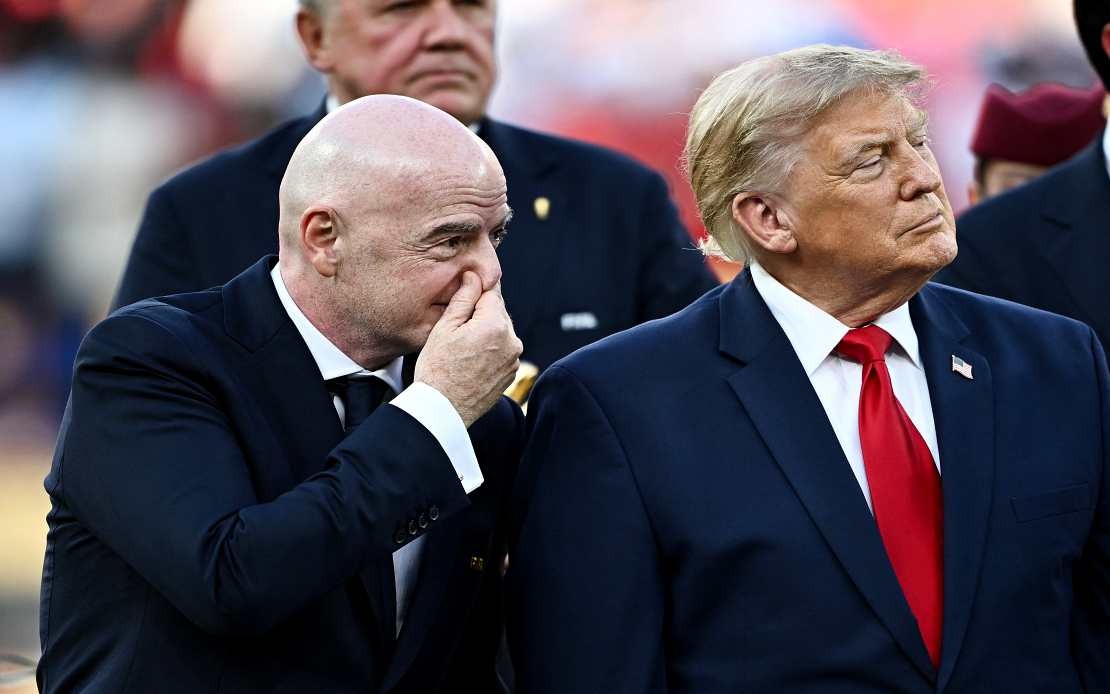
Donald Trump has moved to shield FIFA President Gianni Infantino from mounting international pressure, declaring the football chief an outstanding and irreplaceable figure in global sport. The intervention underscores the polarised responses to Infantino's leadership as the FIFA boss navigates a deepening crisis over a failed bid to monetise the organisation's commercial assets. Trump's support, expressed through his Truth Social platform, marks a rare moment of prominent American political backing for a figure facing sustained criticism from major continental football bodies across Europe, Asia and the Americas.
The FIFA president has been under siege since European, Asian and American football confederations jointly issued a scathing open letter calling for an independent investigation into the circumstances surrounding his attempted sale of FIFA's commercial rights. The Union of European Football Associations, the Asian Football Confederation and the Confederation of North, Central American and Caribbean Football signalled their deep reservations about both the transaction itself and the governance processes that underpinned it. Their coordinated action represented an unusually unified front among bodies that typically operate with significant autonomy, suggesting the gravity of concerns about Infantino's stewardship.
At the heart of the controversy lies an ambitious but ultimately contentious scheme to raise US$4.2 billion through the sale of approximately 20 per cent equity in a newly created entity that would have consolidated FIFA's media and commercial rights. The structure was designed to hand over control of lucrative broadcasting contracts and sponsorships for World Cup tournaments and other major competitions to private investors. The scale of the transaction underscored the commercial value embedded in football's premier governing body, yet it also triggered alarm bells about privatisation, governance dilution and the appropriate stewardship of global football's commercial interests.
Reports circulating in international media suggested that the investment opportunity might be acquired by a foundation connected to Joshua Kushner, brother of Trump's son-in-law Jared Kushner. This potential American connection likely informed Trump's vocal backing for Infantino, as the arrangement could have positioned US-based interests at the centre of global football's commercial architecture. The involvement of figures within Trump's orbit would naturally incline the former and current president toward supporting a deal that benefited his family's business network, even as it faced international opposition from the world's major football confederations.
Emergency deliberations at FIFA's top echelon in early August revealed the depth of the institutional crisis engulfing Infantino's presidency. Convening his inner circle of leadership, the FIFA chief sought to stabilise his position amid mounting criticism and an observable erosion of his influence across the organisation's sprawling bureaucracy. During these fraught meetings, Infantino offered an apology for mistakes associated with the FIFA Forward Enterprise commercial initiative, a move that suggested awareness of the governance shortcomings that had triggered such fierce opposition. However, the apology proved insufficient to contain the broader firestorm surrounding the commercial rights sale proposal.
Trump's intervention centred on Infantino's stewardship of the 2022 World Cup in Qatar, which the American president characterised as extraordinarily successful by historical measures. Trump claimed that the recent tournament exceeded previous editions in scope and profitability by a factor of four, a metric that served as his primary justification for retaining Infantino in office. By anchoring his defence in concrete sporting achievement rather than addressing the governance concerns raised by UEFA, AFC and CONCACAF, Trump effectively sidestepped the substance of the criticism while elevating the narrative of Infantino's indispensability to FIFA's future.
For Malaysian readers and broader Southeast Asian observers, the dispute carries significant implications. The AFC represents Asian football interests in global governance structures, and its decision to join European and American confederations in demanding an independent investigation signalled that Asian concerns about FIFA's direction are being taken seriously at the highest levels. Malaysia, as an AFC member, has a stake in ensuring that FIFA operates with transparency and that commercial decisions affecting the continental confederation are made through legitimate consultative processes that respect the voices of smaller and emerging football nations.
UEFA's decision to orchestrate a comprehensive boycott of FIFA competitions by all its member nations represented the starkest rebuke of Infantino's leadership. The threat to withdraw from FIFA-sanctioned events constituted an existential challenge to his authority, as European football's commercial and competitive significance makes such a boycott genuinely consequential. This escalation forced Infantino's hand and ultimately compelled him to announce the abandonment of the commercial rights sale. The reversal demonstrated that, regardless of American political support, Infantino remained vulnerable to coordinated action by major continental bodies controlling the world's most commercially valuable football markets.
Infantino's decision to scrap the proposal, while salvaging his immediate position, left unresolved the underlying questions about FIFA's governance model and the appropriate balance between commercial innovation and democratic accountability. The swift capitulation also raised questions about why the FIFA president had pursued such a controversial scheme without achieving prior consensus among continental confederations whose cooperation would be essential for implementation. The episode exposed a fundamental tension within FIFA between Infantino's technocratic ambitions and the confederated structure of global football governance that ultimately constrains any individual leader's autonomy.
The Trump intervention illustrates how international sports governance remains intertwined with broader political and commercial interests. The defence of Infantino, ostensibly based on sporting merit, appeared equally motivated by the potential commercial benefits to Trump's family network through the Kushner connection. This conflation of political backing with personal financial interest underscores a persistent vulnerability in international sports administration, where the boundaries between legitimate governance oversight and factional political rivalry often blur.
Looking forward, Infantino's position remains precarious despite Trump's public support and the emergency backing from FIFA's leadership. His authority has been demonstrably diminished by the coordinated pressure from UEFA, AFC and CONCACAF, and the retreat on the commercial rights sale represents a tactical defeat for his strategic vision. Whether he can rebuild credibility and operational effectiveness remains uncertain, particularly given the legitimacy questions that the episode has raised about FIFA's decision-making processes and the fitness of current governance structures for managing the organisation's vast commercial interests in an increasingly complex and contested global environment.

