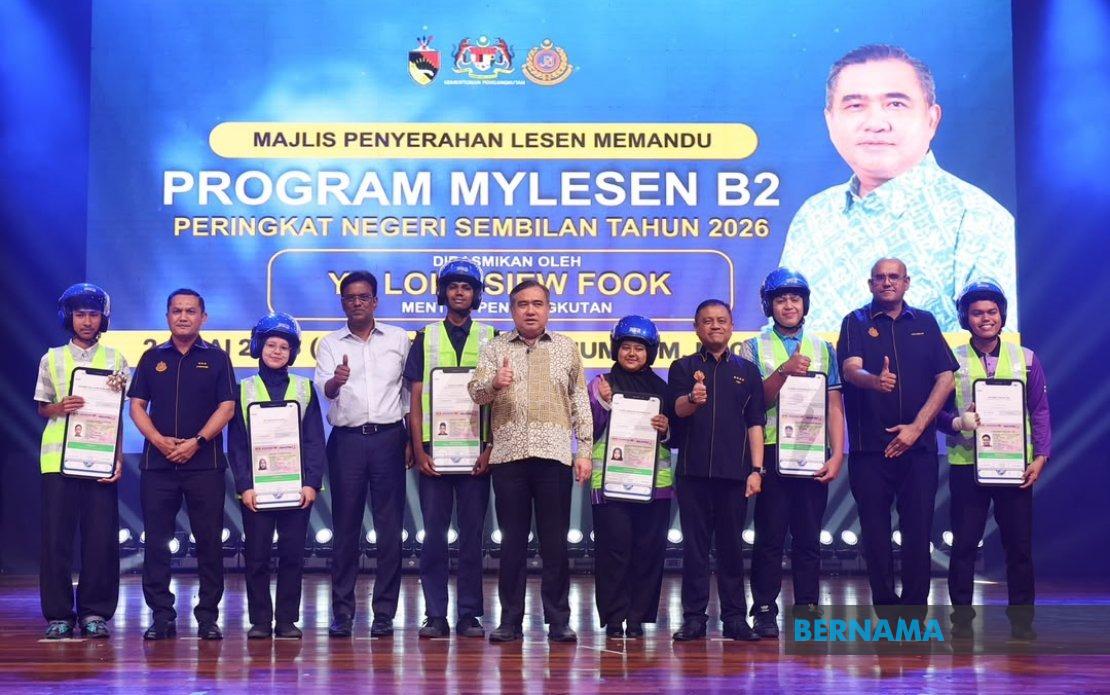
Transport Minister Anthony Loke has delivered a firm message to young motorcyclists receiving free two-wheeler licences through the government's MyLesen B2 Programme: their new licence comes with the obligation to ride safely and obey traffic laws, not with a green light for reckless behaviour. Speaking at a ceremony in Seremban on July 2 where licences were distributed to Negeri Sembilan participants, Loke underscored the distinction between legal riding privileges and irresponsible conduct, particularly warning against the allure of illegal racing on public roads.
The minister's intervention reflects deepening concern about motorcycle safety across Malaysia. Official data reveals that roughly 60 per cent of annual road fatalities involve two-wheeler riders and passengers, with the vast majority of victims under age 30. This demographic concentration underscores why the government has targeted young people through the MyLesen B2 scheme, seeking to instil safe riding habits from the moment they obtain their first licence. Loke's message directly addresses weekend riders who view their new legal status as licence to engage in street racing, a practice that has claimed numerous young lives and traumatised families nationwide.
The MyLesen B2 Programme represents a significant investment in youth mobility and accessibility. Since its launch in 2023, the initiative has benefited over 100,000 recipients across Malaysia, providing free motorcycle licences to eligible young people who might otherwise struggle to afford the licensing process. For many, the licence opens doors to employment, educational opportunities, and improved socio-economic mobility. Negeri Sembilan's allocation this year reached 2,300 participants, doubling from 1,000 in the previous year, reflecting the programme's expanding reach. To date, nearly 1,980 trainees in the state have obtained their Learner's Driving Licence, with approximately 1,880 completing training and passing competency assessments to secure their Probationary Driving Licence.
Beyond the Seremban event, the government has fortified its enforcement arsenal against dangerous riding practices. Parliament has now passed the Road Transport (Amendment) Bill 2026, introducing stringent penalties for illegal racing and speed testing involving all vehicle types. Those caught engaging in street racing now face not merely financial fines but potential imprisonment, marking a significant escalation in consequences. This legislative approach signals the government's seriousness about curbing a practice that has become embedded in youth culture across urban Malaysian centres.
Loke's emphasis on helmet compliance adds another dimension to the safety agenda. All new licence holders have been urged to wear SIRIM-certified helmets every time they ride, whether as drivers or passengers. This technical requirement represents a crucial intervention, as helmets reduce head injury risk substantially in accidents. The government's insistence on certified products ensures riders receive protection meeting established safety standards rather than relying on substandard alternatives available through informal channels.
The programme's expansion reflects deliberate policy to democratise motorcycling access while maintaining safety standards. By removing financial barriers to licensing, the government aims to shift young riders into the formal, regulated system where training, testing, and enforcement mechanisms can operate effectively. This contrasts with unregulated riders who operate without proper instruction or accountability. The structured curriculum underlying the MyLesen B2 scheme emphasises not just technical riding competence but traffic law comprehension and defensive riding philosophy.
For Malaysian families, particularly in lower-income communities, the MyLesen B2 initiative addresses practical mobility challenges. Many young people rely on motorcycles for transport to employment and educational institutions. The free licensing removes a significant financial obstacle for households where motorcycle ownership provides essential access to opportunity. However, this accessibility gains meaning only when paired with responsible riding behaviour and genuine commitment to road safety principles.
The minister's public reminder appears timed strategically as schools break for holidays and weekend recreational riding typically intensifies. Young riders, newly licensed and eager to demonstrate their newfound independence, sometimes surrender to peer pressure and the adrenaline appeal of illegal racing. Loke's intervention attempts to reframe social expectations, positioning safe riding as the norm rather than as constraint limiting freedom. He articulated that weekends should remain occasions for careful, responsible travel rather than platforms for dangerous stunts.
Implementation success for both the MyLesen B2 Programme and the new enforcement regime depends on sustained coordination between the Ministry of Transport, the Road Transport Department (JPJ), and state-level enforcement agencies. The presence of Transport Secretary-General Datuk Seri Jana Santhiran Muniyan, JPJ Director-General Datuk Aedy Fadly Ramli, and regional JPJ officials at the Seremban ceremony reflected this institutional commitment. However, enforcement effectiveness ultimately hinges on ground-level police and JPJ operations consistently apprehending offenders and pursuing prosecutions rather than allowing practices to continue without consequence.
Looking forward, the MyLesen B2 Programme's trajectory will likely influence road safety outcomes for Malaysian youth across the next decade. The initiative, combined with legislative amendments and enforcement enhancement, creates an ecosystem where young riders face both opportunity and accountability. Whether this framework succeeds in changing behaviours will become apparent through accident statistics and JPJ enforcement records. For now, Loke's message to the Negeri Sembilan cohort encapsulates the government's hopeful but cautious approach: trusting young people with the responsibility of legal motorcycling while making clear that abuse of that privilege carries serious consequences.

