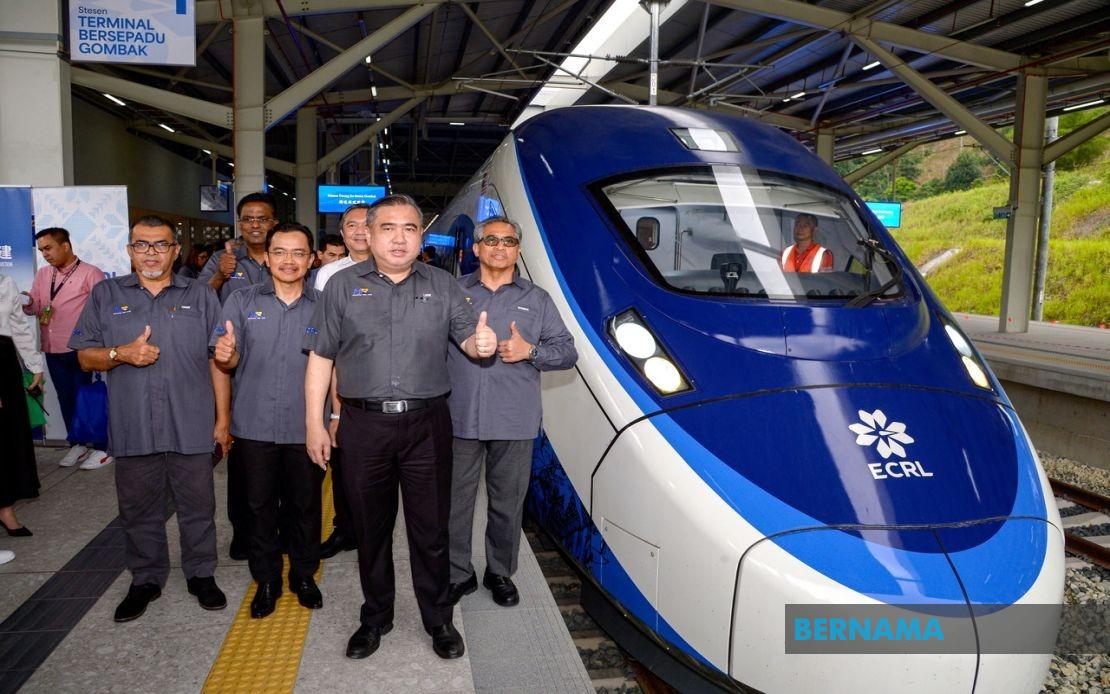
Transport Minister Anthony Loke Siew Fook has signalled an accelerated timeline for the East Coast Rail Link (ECRL) Phase 1, targeting December operations for the crucial Kota Bharu to Gombak corridor instead of the previously scheduled January 2027 commencement. The announcement, made during the launch of testing infrastructure at Gombak Integrated Terminal Station, represents a significant compression of the project's final phases and reflects government determination to deliver the major transport initiative years ahead of original expectations.
The feasibility of achieving this December deadline hinges on the successful completion and smooth progression of rigorous testing protocols currently underway. These include System Integration Testing (SIT) and the Fault-Free Run (FFR), both critical verification processes that cannot be rushed without jeopardising operational integrity. Loke emphasised that while the acceleration effort is genuine, safety considerations remain non-negotiable parameters that will shape the realistic timeline rather than timelines determining safety standards.
Malaysia Rail Link Sdn Bhd and the project's main contractor China Communications Construction Company Ltd face responsibility for coordinating the expedited testing schedule. The minister stressed that both organisations must intensify their collaboration to meet the December target, with particular focus on streamlining administrative procedures surrounding certification and approval stages. Typically these processes consume two to three months; the government is exploring mechanisms through the Land Public Transport Agency (APAD) to compress this duration without bypassing mandatory verification steps.
The rationale for acceleration rests partly on extensive pre-shipment testing already conducted in China, where the rolling stock underwent comprehensive factory evaluations before transport to Malaysia. This prior validation work provides confidence that the Malaysian testing phase might progress more efficiently than would otherwise be necessary. However, Loke cautioned that this foundation does not eliminate the necessity for full local testing under Malaysian conditions and regulatory frameworks.
The System Integration Testing now underway focuses on verifying the seamless functionality of interconnected systems, particularly the sophisticated electrical and signalling infrastructure that underpins safe rail operations. This testing phase is scheduled to conclude before the Fault-Free Run commences in September, a sequence that cannot be compressed without risking system integrity. The FFR represents the penultimate verification stage, requiring the first train set and electric locomotive to traverse 8,000 kilometres under actual operational conditions while unoccupied, monitored by APAD officials to confirm that safety and reliability standards meet legal requirements.
Loke's repeated emphasis on safety reflects awareness that any operational failure on a high-speed rail service would carry catastrophic consequences and reputational damage extending far beyond the project itself. His assertion that the government is "more afraid than you" suggests recognition that political pressure to meet ambitious deadlines must never override engineering prudence. This stance distinguishes the current approach from accusations that infrastructure megaprojects sometimes sacrifice safety for schedule compliance.
As of July, Phase 1 had achieved 95.08 per cent overall progress, indicating that the project stands in advanced stages. This substantial completion rate provides some legitimacy to acceleration ambitions, as major structural and installation work is substantially finished. The remaining work centres primarily on integration, testing, and certification rather than fundamental construction, a distinction that makes compression more feasible than it would be in earlier project phases.
Phase 2, extending the ECRL from Gombak to Port Klang, operates under a separate timeline with December 2027 completion targeted and January 2028 for operational commencement. This sequencing allows the government to demonstrate Phase 1 success before expanding the network, a prudent approach that contains risk and permits operational lessons learned to inform Phase 2 execution. The two-phase structure, while extending the overall project timeline, reflects realistic recognition of the complexity involved in delivering Southeast Asia's most ambitious rail infrastructure initiative.
The project carries profound implications for Malaysian transport connectivity and regional logistics networks. The ECRL represents not merely a domestic convenience but a strategic asset that integrates Kelantan's productive capacity with Selangor's economic heartland, reducing transport times and logistics costs for goods movement. For Malaysia's position within Southeast Asian supply chains, reliable high-capacity rail infrastructure increasingly matters as competing regional economies upgrade their own networks and governments prioritise multimodal connectivity solutions over road-dependent transport systems.
The international dimensions of this project merit consideration alongside domestic objectives. Chinese involvement through CCCC, reflected in the presence of Ambassador Ouyang Yujing at the launch event, underscores the project's significance within bilateral infrastructure cooperation. Malaysia's ability to deliver this project on an accelerated basis while maintaining international standards builds confidence in Malaysian governance capacity and strengthens the foundation for future collaborative megaprojects across the region.
For Malaysian commuters and businesses, the December target, if achieved, would represent transformative access to efficient rail transport years ahead of previous expectations. The Kota Bharu to Gombak link fundamentally alters travel economics for residents across Kelantan and northern Selangor, potentially reducing commute times by hours compared to road journeys. This human impact dimension—improved accessibility, reduced travel time, and enhanced economic opportunity for peripheral regions—represents the ultimate validation of accelerated delivery efforts.

