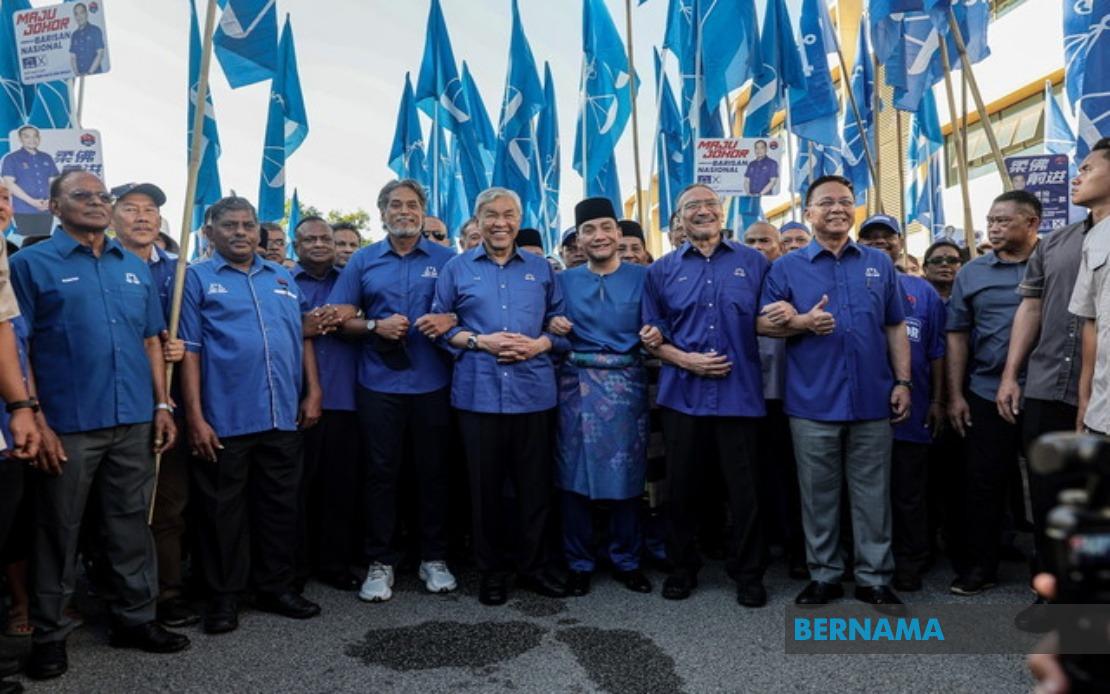
Johor Barisan Nasional chairman Datuk Onn Hafiz Ghazi formally entered the race for the state election on June 27, submitting his nomination documents at precisely 9.10 am at the Muafakat Hall hosted by Simpang Renggam District Council. The filing underscored the significance of the incumbent Machap assemblyman's candidacy, as reflected in the calibre of political heavyweights who turned out to support his bid, signalling UMNO's commitment to consolidating its hold over the strategic Johor state assembly.
The nomination ceremony drew a constellation of senior UMNO figures whose presence carried layers of political meaning. UMNO president Datuk Seri Dr Ahmad Zahid Hamidi, the party's apex leader, personally accompanied Onn Hafiz to the nomination centre, a gesture that demonstrated unambiguous backing from the national party hierarchy. Alongside him were Sembrong MP Datuk Seri Hishammuddin Tun Hussein, whose portfolio includes defence and security matters at the federal level, and Khairy Jamaluddin, a former health minister whose prominence in party circles remains influential despite stepping back from ministerial office. The attendance of these titans indicated that the Johor state election has assumed considerable importance within UMNO's broader political calculations, particularly given the party's need to maintain its dominance in one of Malaysia's economically vital states.
Former Johor Menteri Besar Datuk Seri Hasni Mohammad also graced the occasion with his presence, providing continuity with the state's BN political legacy. His involvement underscored the institutional memory and accumulated experience that Barisan Nasional hopes to leverage in the contest. These senior figures collectively represent decades of political experience and command substantial grassroots networks across Johor, resources that could prove decisive in mobilising voter support.
The Simpang Renggam nomination centre became a hive of activity as party supporters descended on the venue, transforming the landscape into a sea of partisan colours. Demonstrating the organised nature of campaign operations, attendees wore apparel identifying their respective parties and carried banners and flags, creating visual spectacle that conveyed the intensity of electoral competition. This display of grassroots enthusiasm, orchestrated through party machinery, reflects the high stakes involved in Johor state politics, where BN's comfortable historical dominance has been tested by shifting electoral dynamics across Malaysia in recent years.
Onn Hafiz's candidacy carries particular resonance as the incumbent Machap representative, holding a seat that BN has traditionally controlled. His nomination filing represents a continuity bid, seeking to retain one of the coalition's strongholds whilst reinforcing BN's legislative majority in the state assembly. The strong show of leadership support suggests confidence within the party hierarchy regarding his electoral prospects, though it also indicates that UMNO views consolidating Johor as essential to its wider strategic positioning ahead of potential federal-level electoral contests.
The concentration of national-level figures at a state-level nomination ceremony illuminates the interconnected nature of Malaysian politics, where state elections frequently serve as referendums on national party performance and presidential approval. UMNO's decision to deploy its top echelon to Simpang Renggam signals the premium the party places on demonstrating unity and organisational prowess in Johor, a state that has historically functioned as UMNO's power base and financial sinew.
For Malaysian political observers and Johor voters, the assembly of leadership conveyed a message of institutional confidence in BN's election machinery and candidate viability. The presence of such seasoned political operators—several of whom have held ministerial positions and navigated complex governance challenges—suggests that the coalition is approaching the Johor contest with comprehensive preparation and leverage of all available political capital. In the context of Malaysia's fractious politics and the volatility that has characterised state elections over the past decade, UMNO's mobilisation of its senior hierarchy reflects both the importance of retaining Johor and the anxiety about potential slippage.
The nomination filing process itself, though procedurally routine, acquired symbolic weight through this high-profile attendance. Nomination exercises in Malaysian elections function not merely as administrative checkpoints but as theatrical moments where parties broadcast their cohesion, resources, and confidence to supporters, opponents, and media simultaneously. The carefully choreographed appearance of multiple senior UMNO figures transformed what might otherwise have been a bureaucratic exercise into a demonstration of party discipline and gravitational pull.
For stakeholders across Southeast Asia monitoring Malaysian political developments, the Johor election assumes particular significance. As Malaysia's second-most populous state and a crucial economic hub, Johor's political complexion influences not only the federation's internal power dynamics but also regional stability and business confidence. Barisan Nasional's performance in the state will offer indicators of the coalition's capacity to retain voter support amid economic pressures, demographic changes, and the persistent challenge posed by opposition coalitions that have consolidated significantly since the 2018 federal election shock.
The strong turnout of UMNO leadership at Onn Hafiz's nomination filing reflects calculations about the likely trajectory of the Johor election and the party's broader electoral strategy. By visibly aligning behind the Machap incumbent, UMNO sought to project coherence and momentum, qualities that can prove influential in swaying uncommitted voters and reinforcing enthusiasm among the party base. This approach appears designed to preempt any narrative of vulnerability or internal dissent that opposition parties might seek to exploit during the campaign period.

