Malaysia's Deputy Prime Minister Datuk Seri Dr Ahmad Zahid Hamidi has called on the nation's Muslim population to draw inspiration from the accomplishments of this year's Tokoh Maal Hijrah award recipients, whose achievements underscore the importance of continuous learning and community service. Speaking on the occasion of the awards ceremony, Ahmad Zahid emphasised that the honours bestowed upon the winners should serve as a catalyst for broader engagement with Islamic scholarship and social responsibility across the country.
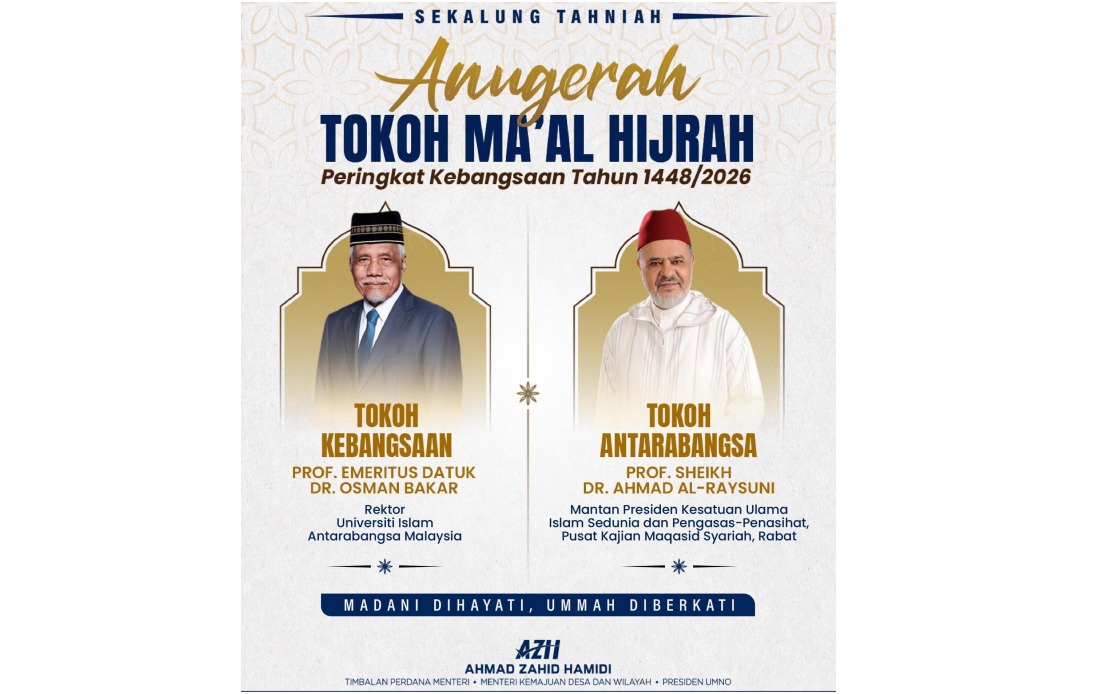
The two recipients of the 1448H/2026M iteration of the awards represent distinct but complementary spheres of Islamic intellectual and scholarly contribution. Prof Emeritus Datuk Dr Osman Bakar was recognised with the National Tokoh Maal Hijrah Award, while Prof Sheikh Dr Ahmad Al-Raysuni, an accomplished Islamic jurisprudence specialist based in Morocco, received the International variant of the honour. Their selection reflects an institutional commitment to acknowledging individuals who have meaningfully advanced Islamic knowledge systems and their practical application to contemporary societal challenges.
Ahmad Zahid's statement underscored the transformative potential embedded in both recipients' life trajectories and intellectual legacies. He highlighted how their recognition encapsulates a broader narrative about empowering Muslim communities through the elevation of scholarly standards and the dissemination of Islamic principles that carry practical benefit beyond purely theological domains. According to the Deputy Prime Minister, the awards represent tangible acknowledgement of efforts directed toward fostering wisdom, mercy and societal welfare through Islamic frameworks—qualities he deemed essential for ummah development.
The ceremony itself took place at the national-level Maal Hijrah celebration held at Masjid Putra in Putrajaya, lending official and ceremonial weight to the proceedings. Sultan Nazrin Shah, the Sultan of Perak, presided over the presentation of awards, distributing cash prizes alongside trophies and certificates to both recipients. This formal institutional endorsement signals the high regard in which Malaysia's leadership holds scholarly contributions to Islamic civilisation and their perceived relevance to national interests.
Deputy Prime Minister Datuk Seri Fadillah Yusof echoed similar sentiments, framing the awards within a broader philosophical context rooted in Islamic historical tradition. Fadillah articulated a nuanced interpretation of the hijrah—the migration of Prophet Muhammad—beyond its historical significance as a foundational event in Islamic chronology. Rather, he positioned the concept as embodying enduring values including sacrifice, communal cohesion, perseverance and the determination necessary to catalyse positive transformation within societies.
This reframing carries particular resonance in Malaysia's contemporary context, where questions of social cohesion, interfaith relations and the role of Islamic institutions in nation-building remain subjects of active public discourse. By invoking hijrah as a principle applicable to modern nation-building efforts, Fadillah effectively broadened the intellectual scope beyond historical commemoration, suggesting that the spiritual and ethical dimensions of the Islamic calendar offer guidance for constructing progressive yet values-anchored societies.
Fadillah further articulated an explicit connection between the awards' recognition of scholarly achievement and Malaysia's aspirations toward becoming a prosperous, unified nation grounded in moral and spiritual principles. His remarks called for collective action to strengthen communal bonds, deepen faith commitments and expand charitable and righteous conduct. This formulation attempts to reconcile aspirations for modernity and material development with religious and cultural preservation—a tension that frequently surfaces in Malaysian public policy debates.
The Tokoh Maal Hijrah awards programme itself represents an institutional mechanism through which Malaysia's federal government and Islamic authorities acknowledge and incentivise contributions to Islamic scholarship, community leadership and civilisational advancement. The distinction between national and international categories reflects recognition that Islamic intellectual traditions and leadership extend beyond domestic boundaries, incorporating transnational networks of scholarship while maintaining particular emphasis on contributions demonstrably affecting Malaysian Muslim communities.
Prof Osman Bakar's recognition carries particular significance given his substantial body of work spanning Islamic philosophy, science and education within Malaysian academic institutions. His elevation through the national award signals institutional validation of approaches to Islamic knowledge that engage contemporary intellectual challenges and institutional contexts. Similarly, Prof Ahmad Al-Raysuni's international recognition acknowledges Morocco's established role as a centre for Islamic juridical scholarship and suggests Malaysia's openness to integrating international Islamic intellectual traditions into its own institutional frameworks.
The emphasis by both Deputy Prime Ministers on drawing broader inspiration from these individual achievements reflects broader governmental strategies toward promoting Islamic scholarship as integral to national development objectives. Rather than positioning Islamic intellectual life as peripheral to economic or technological advancement, the framing offered by Ahmad Zahid and Fadillah positions religious knowledge and ethical leadership as foundational to sustainable societal progress. This perspective potentially influences how Malaysian policymakers approach education policy, civil service recruitment and institutional development priorities.
The awards also occur within broader regional contexts where Southeast Asian nations increasingly emphasise Islamic scholarship and religious leadership as components of national soft power and cultural diplomacy. Malaysia's investment in recognising and honouring Islamic scholars potentially reflects calculated efforts to position itself as a centre for Islamic learning and thought within the region, competing with established intellectual hubs in the Middle East and South Asia for influence within Muslim communities.
For Malaysian society more broadly, the awards programme serves multiple symbolic functions: legitimising particular forms of Islamic intellectual engagement; creating aspirational models for younger scholars and religious professionals; and affirming official commitment to balancing secular and religious dimensions of national identity. The ceremonial apparatus surrounding the awards—formal venues, high-level government participation, cash prizes—materialises abstract governmental commitments to Islamic civilisation into concrete institutional practices and resource allocation.