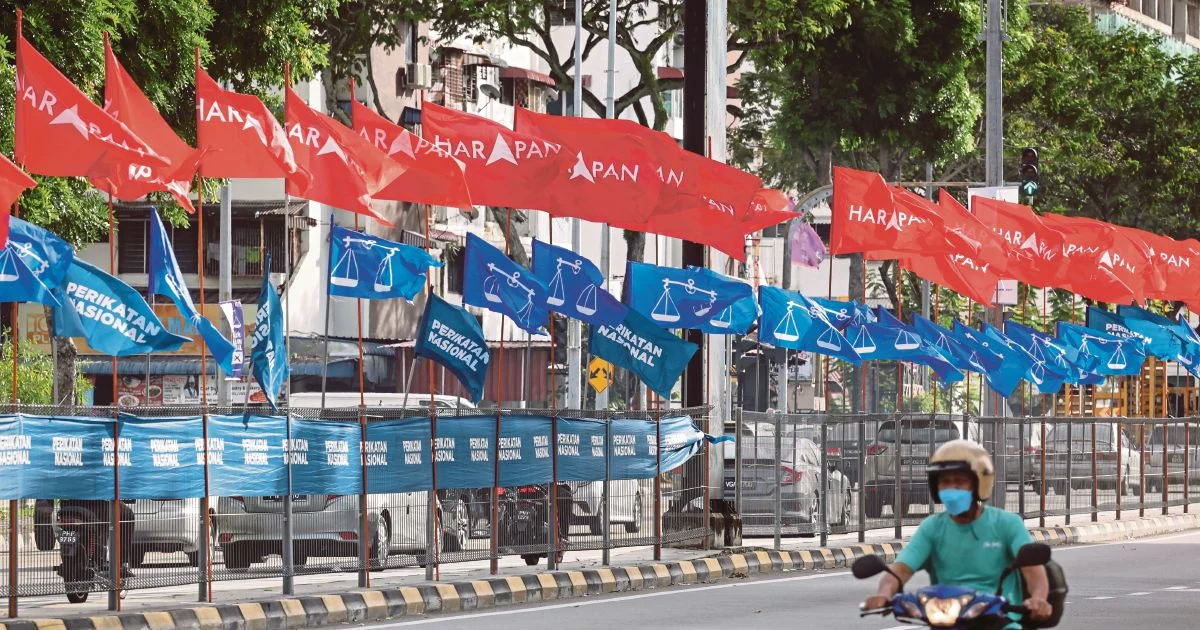
Three major political blocs are poised for fierce competition across Johor's legislative landscape, with simultaneous campaigns converging in 33 of the state's 56 assembly constituencies at the upcoming state election. The convergence of Barisan Nasional, Pakatan Harapan and Perikatan Nasional into head-to-head contests across nearly 60 percent of seats reflects the increasingly fractured nature of Malaysian electoral politics, where traditional two-way contests have given way to triangular battles that reshape local dynamics and voter choice.
The distribution of candidates across these three blocs marks a significant departure from Johor's recent electoral history, where dominant players typically faced limited opposition. The presence of competing slates in the majority of constituencies suggests that all three coalitions view the state as competitively contested terrain, with genuine prospects for advancement rather than defensive positioning. This strategic calculation underscores how the current national political climate has emboldened multiple actors to contest aggressively rather than cede ground to established powerhouses.
Barisan Nasional enters the contest with the institutional weight of long-term electoral dominance in Johor, having maintained substantial legislative majorities and executive control across multiple election cycles. The coalition's presence across nearly all constituencies reflects both the breadth of its organisational presence and its determination to protect traditional strongholds against encroaching challengers. However, the frequency of three-way contests introduces unpredictability that favours neither the frontrunner nor the challengers, as vote splits can produce counterintuitive outcomes where plurality victories replace majority mandates.
Pakatan Harapan's competitive positioning in so many seats demonstrates the coalition's recovery from earlier setbacks and its renewed credibility following its 2022 entry into federal government. The diverse coalition's appeal to urban professionals, younger voters and those seeking change from long-term incumbent governance provides a distinct alternative pitch to Johor's electorate. The breadth of their candidacies suggests confidence in mobilising support across the state's varied constituencies, from established urban centres to rapidly developing suburban zones.
Perikatan Nasional's aggressive expansion into 33 simultaneous contests reveals the coalition's ambition to translate its federal prominence into state-level gains, particularly capitalising on Islamist party appeal and the consolidated support of Pas within coalition frameworks. The bloc's presence in such a large proportion of seats indicates calculation that the current political moment offers windows of opportunity in constituencies previously dominated by larger players. This strategic surge reflects PN's broader effort to establish itself as a consistent alternative force across multiple political levels.
The concentration of three-way contests in 33 seats creates fundamentally different campaign dynamics from the remaining 23 constituencies, where voting patterns and candidate selection suggest more traditional two-cornered formats. Candidates in triangular contests must navigate more complex messaging strategies, balancing efforts to consolidate core supporters while attempting to attract undecided voters who face more numerous alternatives. The resulting fragmentation of campaign attention and voter focus introduces greater uncertainty into outcome prediction compared to clearer binary choices.
Johor's electoral significance extends well beyond state-level governance, carrying implications for national coalition building and parliamentary mathematics. The state's 56 seats represent meaningful legislative weight, and outcomes will signal regional receptivity to different political messages and governance models. Strong performances by any coalition would provide validation for different strategic approaches and potentially shift dynamics within their respective national alliances, influencing resource allocation and priority-setting across other state contests scheduled for coming months.
The timing of the Johor election within Malaysia's broader political calendar places it among the most consequential recent state contests. Following earlier electoral cycles in other states and preceding anticipated contests elsewhere, this election offers crucial data points regarding voter sentiment on key issues including cost of living, governance delivery, and the appeal of competing coalitional visions. Performance metrics from this large state will inform campaign strategies and confidence levels across all three blocs heading into potential future contests.
Voter behaviour in three-way contests often deviates from historical patterns, introducing elements of uncertainty that challenge even experienced political analysts. Split opposition votes can inadvertently deliver victories to candidates who fail to achieve absolute majorities but place ahead of divided challengers, raising questions about mandate clarity and representative legitimacy. Alternatively, successful vote consolidation in particular constituencies can produce surprising victories for challengers previously considered marginal, reshaping local political calculations.
The involvement of three substantial coalitions across the majority of Johor seats reflects transformation in Malaysian political competition, where single dominant players increasingly face multipolar challenges. This structural shift complicates voter choice while potentially improving responsiveness to diverse preferences, though it simultaneously risks producing fragmented results where coalition narratives struggle against localised considerations. For Malaysians and regional observers, the contest offers instructive lessons regarding how democratic systems manage competition among multiple organised groups competing simultaneously for voter support.

