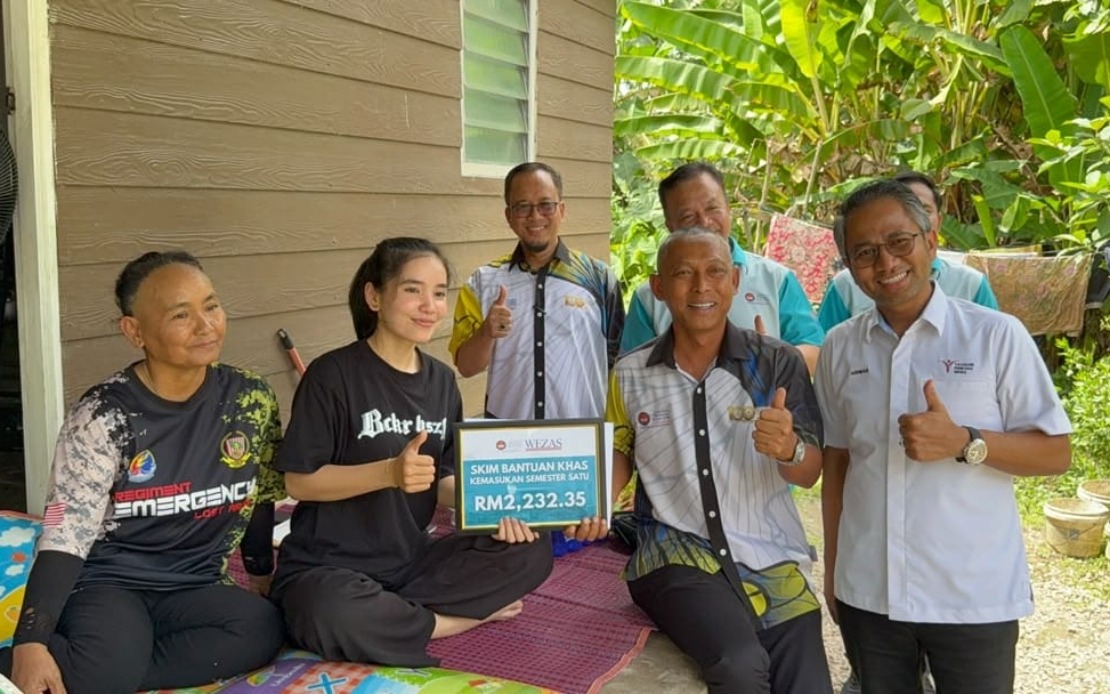
Three promising Malaysian students have secured their entry into higher education after receiving critical financial support from Universiti Pendidikan Sultan Idris (UPSI) and collaborating organizations, addressing a persistent barrier that prevents many capable individuals from pursuing tertiary qualifications. Lovely Sabana Augustine, Siti Nurdianis Nordin, and Muhamad Ilias Danish will each benefit from RM1,500 in assistance to cover registration fees and essential study materials before commencing their courses at the Ipoh-based teacher training university during the 2026/2027 academic session.
Sabana's situation exemplifies the financial constraints faced by talented students from disadvantaged backgrounds across Malaysia. The STPM high achiever, who will enrol in the Faculty of Human Sciences, comes from a household in Tumpat, Kelantan, where her mother Mek Kenui earns approximately RM800 monthly as a school cleaner while also serving as a member of the Malaysian Volunteer Corps Department. Her father, a former military serviceman, passed away in 2017, leaving the family dependent on a single income to support four children. When the time came to prepare for university registration scheduled for September 13, the family lacked sufficient resources to pay upfront fees and purchase necessary study equipment, a gap that became public knowledge through social media appeals.
The intervention reflects a coordinated approach by Malaysia's higher education sector to identify and support deserving students early in their academic pipeline. UPSI's outreach mechanism identified Sabana alongside two other prospective students facing comparable economic hardship and mobilized resources to prevent these individuals from abandoning their educational aspirations. The financial package was assembled through institutional collaboration: UPSI's Centre for Waqf, Endowment, Zakat, Khairat, and Sadaqah (WEZAS) contributed RM500 per student, while Yayasan Perkasa Siswa (YPS), a foundation focused on student welfare, provided the remaining RM1,000 from each recipient's allocation.
Siti Nurdianis, destined for the Faculty of Management and Economics, originates from a household where her mother generates irregular daily wages with no stable employment contract, placing the family in precarious economic circumstances common among Malaysia's working poor. Muhamad Ilias Danish, who will study in the Faculty of Languages and Communication, lost his father and now bears responsibility for supporting his mother alongside his own educational development, a dual burden that testing systems alone cannot adequately measure. These circumstances illustrate how academic excellence among lower-income cohorts often coexists with structural poverty that threatens to derail promising trajectories unless institutional support systems intervene strategically.
The assistance programme operates within Malaysia's evolving policy framework regarding equitable access to higher education. Hirman Awang, director of the Department of Higher Education's Student Affairs Division, emphasized that the Ministry of Higher Education (MOHE) views financial barriers as a correctable policy problem rather than an inevitable filter separating capable students from university opportunities. He characterized Yayasan Perkasa Siswa as acting in a "frontline force" capacity, positioned to protect student welfare and ensure that economic circumstances do not become the determining factor in educational outcomes. This framing suggests movement toward proactive identification of at-risk students rather than relying primarily on their own advocacy or family initiative to locate assistance.
UPSI's institutional commitment to supporting disadvantaged prospective students extends beyond one-off interventions toward systematic recognition mechanisms embedded within administrative structures. Professor Norkhalid Salimin, the university's deputy vice-chancellor for Student Affairs and Alumni, indicated that UPSI intentionally develops early-warning systems to identify students requiring assistance before they encounter crisis points that could force withdrawal. The Student Affairs and Alumni Department (JHEPA) and WEZAS actively monitor applicant profiles for indicators of financial vulnerability, then initiate contact to explain available support mechanisms. This preventive approach acknowledges that many capable students never formally apply for assistance programs, either due to incomplete information, perceived stigma, or lack of knowledge regarding eligibility criteria.
The collaboration between UPSI, YPS, and the Department of Higher Education represents a tripartite model gaining prominence across Malaysian higher education institutions seeking to maintain access standards amid growing enrolment pressures and constrained public funding. By positioning financial assistance as a joint responsibility spanning university institutional resources, dedicated welfare foundations, and government higher education apparatus, the arrangement distributes fiscal burden and establishes multiple engagement points for identifying deserving cases. YPS, which maintains specific mandates regarding student welfare promotion, can leverage institutional knowledge and financial reserves to complement university budgets that typically face competing demands from academic operations and infrastructure requirements.
For students like Sabana, Siti Nurdianis, and Muhamad Ilias, the RM1,500 payment represents more than a monetary amount—it functions as institutional validation that their aspirations warrant structured support despite family economic limitations. The psychological dimension of receiving assistance extends beyond material provision; it signals that universities recognize their circumstances, have allocated internal capacity to address hardship, and consider their success integral to institutional mission. This messaging becomes particularly significant for first-generation university students from working-class backgrounds, who may harbor internalized doubts regarding belonging in higher education environments traditionally associated with middle-class trajectories.
The case study also illuminates persistent regional disparities within Malaysia's socioeconomic landscape, with Kelantan appearing as a source region for academically talented but financially constrained students. That STPM achievers emerge from households earning RM800 monthly underscores the gap between academic talent distribution—which demographic research indicates aligns broadly with population distribution—and educational opportunity concentration, which clusters disproportionately around urban centres and middle-income households. This geographic dimension matters for policy planning, as targeted interventions in designated regions could reach larger cohorts of qualified students before talent migration or educational abandonment occurs.
Moving forward, UPSI's strategic collaboration model with YPS and JPT may establish templates replicable across Malaysia's other public universities and teacher training institutions, potentially scaling support mechanisms beyond current individual-case interventions toward more systematic programmes. The visibility generated through Sabana's social media appeal and subsequent institutional response may also encourage other students facing similar circumstances to access available support rather than assuming their situations are unique or insoluble. As Malaysia continues developing its higher education ecosystem under Vision 2050 and matching national aspirations for increased tertiary attainment, mechanisms ensuring that financial barriers do not filter out talented students from lower-income backgrounds become increasingly central to policy effectiveness and social mobility outcomes.

