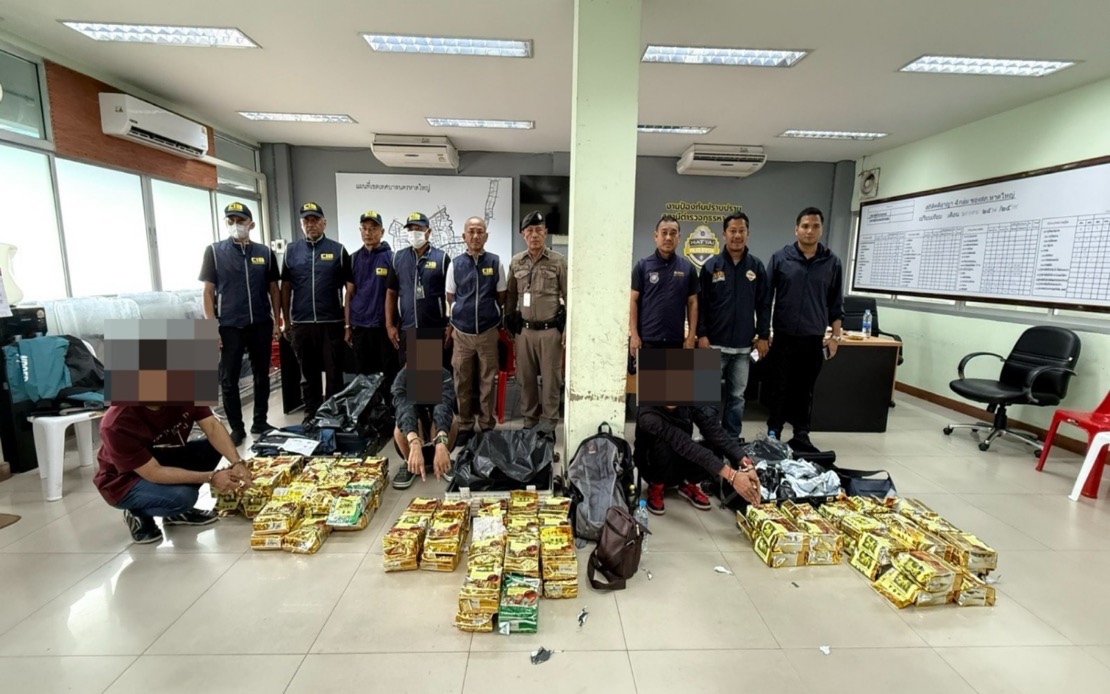
Three Malaysian nationals have been apprehended at Hat Yai Railway Station in Thailand's Songkhla province following what authorities describe as a sophisticated attempt to smuggle a substantial quantity of crystal methamphetamine into Malaysia. The arrests, made on July 31 by specialized Thai anti-narcotics units, represent a significant interdiction in the ongoing battle against transnational drug trafficking networks operating across the Malaysia-Thailand border region.
The suspects, traveling aboard a train from Bangkok, were intercepted upon arrival at the Hat Yai terminus with 87 kilograms of syabu concealed across multiple pieces of luggage. Thai authorities recovered the narcotic substances hidden within three wheeled suitcases and three backpacks, according to Ratchapon Palakul, director of the Narcotics Control Board's Region 9 Office. The seizure underscores the evolving sophistication of smuggling operations, which increasingly utilize public transportation networks to move bulk quantities across borders while attempting to evade detection.
The operation that led to the arrests involved unprecedented coordination between multiple Thai law enforcement agencies. The "Tawan Hat Yai" task force spearheaded the initiative in collaboration with railway police, the Crime Suppression Division, the Anti-Trafficking in Persons Division, tourist police, the Narcotics Suppression Bureau, and regional ONCB personnel. This multi-agency approach reflects Thailand's strategic recognition that combating high-volume drug trafficking requires integrated intelligence-sharing and synchronized enforcement activities rather than siloed departmental operations.
During preliminary questioning, one suspect revealed the financial incentive structure underlying the operation, disclosing that each member of the smuggling team had been offered 8,000 ringgit by their handlers to successfully transport the consignment across the border into Malaysian territory. This comparatively modest per-person compensation relative to the street value of 87 kilograms of methamphetamine illustrates how trafficking syndicates insulate their upper echelons from direct exposure by employing expendable couriers compensated at only a fraction of the cargo's eventual value. For context, crystal methamphetamine typically commands prices ranging from 800 to 1,200 ringgit per gram at retail level in Malaysia and Thailand, suggesting the intercepted shipment possessed a wholesale value substantially exceeding 69 million ringgit.
The three detainees now face formal charges under Thai narcotics legislation for joint possession and trafficking of Category 1 controlled substances intended for distribution purposes. Conviction on these charges carries a maximum prison sentence of 15 years imprisonment coupled with financial penalties reaching 1.5 million baht, equivalent to approximately 183,000 ringgit. The severity of these penalties underscores both the seriousness with which Thai authorities treat large-scale narcotics trafficking and the elevated culpability assigned to individuals involved in cross-border distribution operations as opposed to simple possession offenses.
For Malaysian law enforcement and policymakers, this incident illuminates the persistent vulnerabilities within regional border security frameworks, particularly regarding the use of rail networks for contraband movement. Hat Yai Railway Station serves as a major international transit hub, facilitating millions of passenger journeys annually between Thailand and Malaysia. The relative ease with which smuggling syndicates have attempted to move bulk quantities through this facility raises questions about the adequacy of current screening protocols, the deployment of detection technologies, and the coordination mechanisms between Malaysian and Thai customs and narcotics authorities operating at frontier crossings.
The investigation into the broader criminal network has entered an intensified phase as Thai authorities seek to identify the syndicate's leadership and additional accomplices potentially involved in procurement, logistics, and distribution functions. Understanding the full scope of the organization is essential not merely for criminal prosecution but for disrupting the supply chains through which such large quantities of methamphetamine reach the Southeast Asian market. Malaysian authorities, given the intended destination of the seized cargo, have presumably been engaged in information-sharing regarding potential domestic recipients and distribution networks that would have received this shipment.
This seizure arrives amid mounting regional concern over the proliferation of synthetic drugs, particularly methamphetamine in various forms including pills, powder, and crystal variants collectively known as "ice." The accessibility and affordability of these substances relative to traditional opiates have contributed to rapid escalation in consumption across Malaysia, Thailand, and neighboring countries over the past decade. Public health systems throughout the region now contend with a parallel epidemic of methamphetamine-related dependencies requiring treatment interventions, rehabilitation services, and social support mechanisms that lag substantially behind demand.
The sophisticated organizational capacity demonstrated by this trafficking operation—including the ability to procure large quantities, arrange transportation logistics, coordinate multiple participants, and establish financial compensation systems—suggests the involvement of established criminal enterprises rather than ad-hoc amateur operators. Such networks typically maintain diversified revenue streams spanning multiple drug categories and operate across multiple border routes, adapting their methodologies in response to enforcement actions. The Hat Yai Railway Station interdiction, while significant, likely represents only one tactical victory within a much broader operational landscape characterized by continuing attempts at trafficking via alternative routes and methodologies.
Malaysian officials must consider the implications for cross-border governance frameworks, particularly regarding enhanced information exchange with Thai counterparts, improved coordination at frontier points, and targeted investigation of the downstream recipients who would have distributed this shipment within Malaysian territory. The recovery of 87 kilograms represents not merely the prevention of a single commercial transaction but the disruption of supply to thousands of potential end consumers whose addictions would have generated substantial downstream social costs through crime, health system utilization, lost productivity, and family disruption throughout Malaysian communities.

