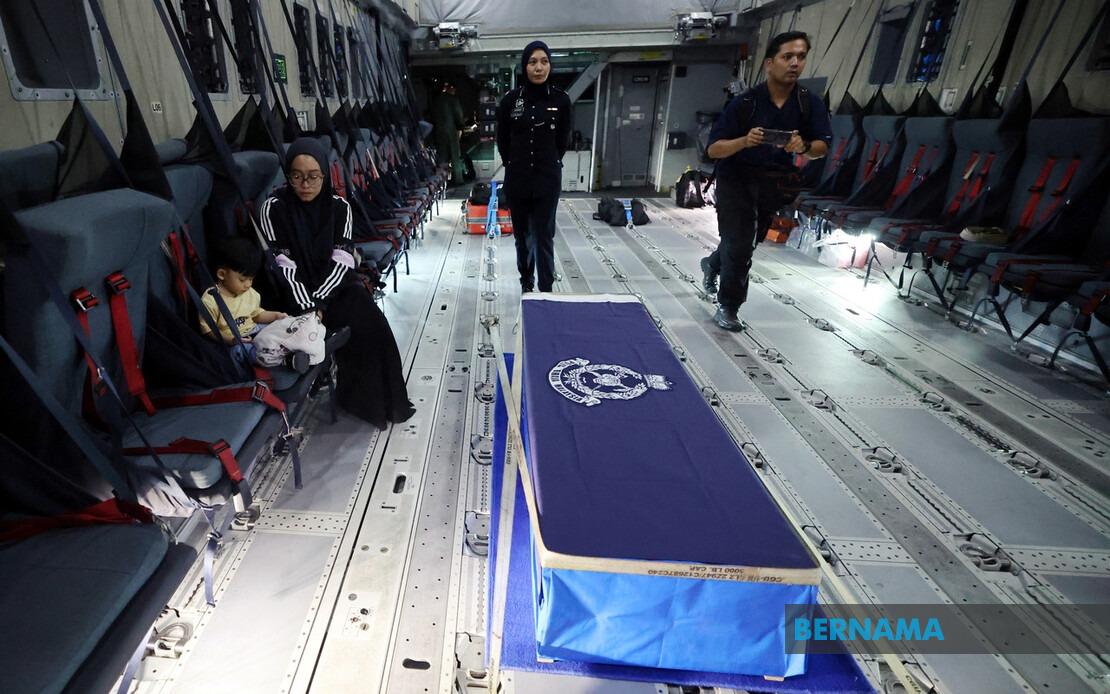
Three Royal Malaysia Police personnel lost their lives in a fatal electrocution incident outside Weston Police Station in Beaufort, Sabah, with their remains now repatriated to their home states. The tragic event, which occurred at 5.50 pm on August 6, claimed the lives of Corporal Chiu Teck Siong, Corporal Mohamad Nur Hafiz Ibrahim, and Constable Muhammad Raimi Ismarubee. Following standard protocol, all three bodies underwent post-mortem examinations at noon on August 7 at the Forensics Department of Queen Elizabeth Hospital in Kota Kinabalu, with release for repatriation completed by mid-afternoon.
The logistics of returning the deceased officers to their families involved coordinated efforts between the Royal Malaysian Air Force and the Royal Malaysia Police Air Operations Force. Two RMAF aircraft were mobilized for the operation, with one departing Kota Kinabalu International Airport at 7.10 pm carrying Corporal Mohamad Nur Hafiz Ibrahim and Constable Muhammad Raimi Ismarubee. The aircraft was scheduled to proceed to the RMAF Air Base in Kuantan before making a final stop at the RMAF Air Base in Gong Kedak, Terengganu, bringing the officers closer to their respective families.
Corporal Chiu Teck Siong's body was transferred to the Royal Malaysia Police Air Operations Force base in Kota Kinabalu before being transported aboard a police aircraft destined for Sarawak. This coordination between military and police aviation assets underscores the operational complexity involved in managing fatalities across Malaysia's dispersed geography and the importance of established inter-agency protocols for such sensitive matters.
The three officers represented diverse backgrounds within the police force. Corporal Chiu Teck Siong, aged 40, hailed from Sarawak and had built a career in the force over decades. Corporal Mohamad Nur Hafiz Ibrahim, 29, came from Kelantan and represented the next generation of law enforcement personnel. Constable Muhammad Raimi Ismarubee, the youngest at 26, was from Terengganu and had been serving as a junior officer. The loss represents a significant blow to their respective communities and to the police force more broadly.
Electrocution incidents, while relatively uncommon in developed policing environments, underscore ongoing workplace safety challenges. The circumstances of this particular incident—occurring outside a police station, a facility where one would reasonably expect proper electrical safety protocols—raises questions about infrastructure maintenance and hazard management. Police stations throughout Malaysia, particularly in Sabah and other East Malaysian states, often operate in challenging environments where regular maintenance and safety inspections are critical but sometimes constrained by resource limitations.
The incident's location outside Weston Police Station in Beaufort, a town in the Kunak District of Sabah, suggests this was likely an occupational exposure during routine duties rather than a training exercise or exceptional circumstance. The simultaneous electrocution of three officers indicates a systemic hazard rather than individual error—possibly involving damaged electrical infrastructure, improperly grounded equipment, or wet conditions that created a conductive environment. Such scenarios demand thorough investigation to prevent recurrence.
For the families of the deceased, particularly those in Terengganu, Kelantan, and Sarawak, the immediate priority is receiving their loved ones' remains and beginning grieving processes. These officers were breadwinners and community members, and their sudden deaths create not only emotional devastation but potential financial hardship. The police force typically provides welfare support to families of deceased personnel, though the adequacy of such measures is an ongoing concern within law enforcement circles across Southeast Asia.
The incident also highlights broader questions about workplace safety within Malaysia's security forces. The Royal Malaysia Police, operating across vastly different terrains and climates from urban centers to remote rural areas, faces unique challenges in maintaining consistent safety standards. East Malaysian facilities like those in Sabah and Sarawak, where infrastructure aging and maintenance backlogs can be pronounced, require particular attention to electrical safety and hazard assessment programs.
This tragedy arrives amid ongoing discussions about police welfare and operational safety within Malaysia's law enforcement community. Officer fatalities, whether in the line of duty through violence or through workplace accidents, represent profound costs that extend beyond individual families to affect morale and recruitment within the force. The manner of these deaths—preventable workplace hazards rather than deliberate violence—emphasizes that systematic attention to occupational health and safety standards remains essential to protecting those who serve the public.
The coordination displayed in the repatriation process, while necessary and respectful, also reflects the unfortunate routinization of officer fatalities within policing globally. Malaysia's police force, despite its crucial role in national security and public order, has not always prioritized preventive safety measures to the degree found in comparable developed nations. This incident, though tragic, provides an opportunity for institutional reflection on whether current safety protocols are sufficiently robust across all police facilities, particularly those in geographically remote or infrastructurally challenged locations where equipment may deteriorate without adequate oversight.

