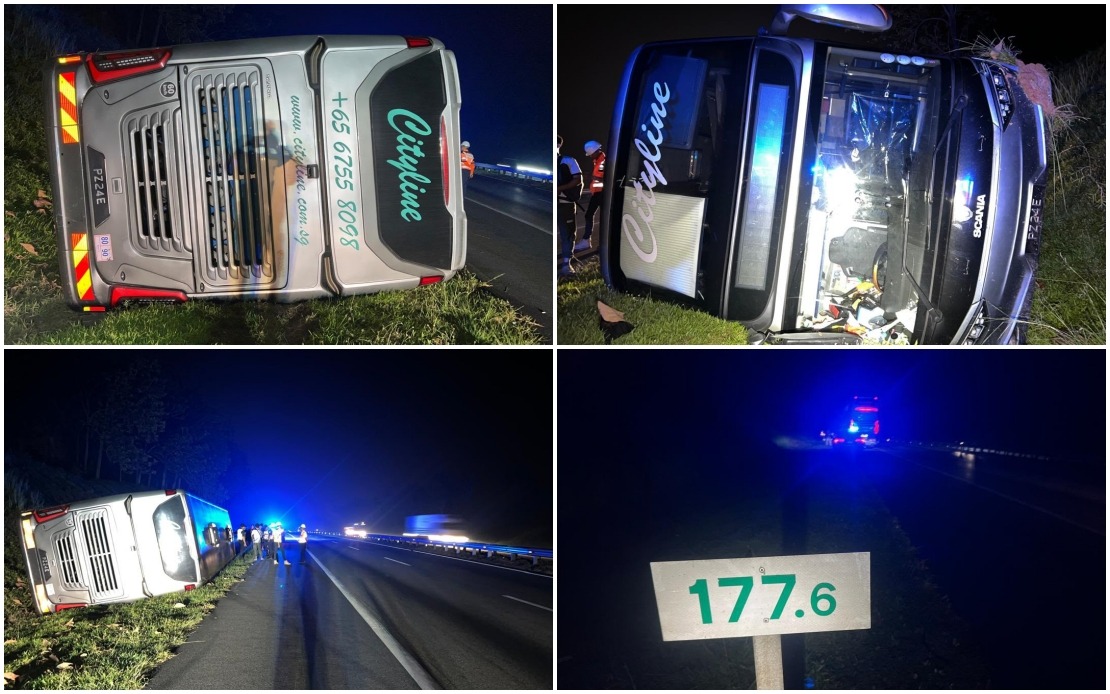
A tour bus carrying twelve passengers overturned on the North-South Expressway in Jasin early Wednesday morning, leaving three people injured and raising fresh concerns about road safety on Malaysia's busiest highway corridor. The accident took place at Kilometre 177.6 on the northbound section of the expressway at approximately 5 am, according to Jasin district police chief Supt Lee Robert. Among those hurt were a 59-year-old Malaysian tour guide, a 62-year-old Singaporean passenger, and a 42-year-old British national, all of whom sustained injuries to their heads and legs before being transported to Jasin Hospital for medical attention.
The tour bus was in transit from Singapore to Kuala Lumpur when the incident occurred, transporting a mixed group of international tourists and Malaysian staff through one of Southeast Asia's most critical transport arteries. Initial police investigations have established that the driver made a sudden manoeuvre to avoid a lorry that had significantly reduced speed ahead on the expressway. In attempting to swerve around the slower vehicle, the bus veered sharply to the left side of the roadway, lost control, and subsequently overturned, according to the police account. The incident highlights the hazardous conditions that can emerge unexpectedly on high-speed expressways when vehicles ahead brake suddenly without adequate warning or visibility.
The bus itself had been operating with a full complement of passengers and staff, including the driver and the injured tour guide who was accompanying the group through Malaysia. The composition of the passenger list—drawn from Singapore, Britain, and Malaysia—underscores the significant role that international tourism and cross-border travel play in the region's economy and transport networks. Such accidents involving tour operators can have cascading effects on tourism confidence, particularly among regional visitors who rely on coach services for overland journeys through Malaysia.
The North-South Expressway represents a critical economic corridor linking major population centres and serving as a primary route for both commercial freight and passenger traffic between Malaysia and Singapore. The highway annually handles hundreds of thousands of journeys, from routine commuter traffic to scheduled tour operations. Accidents on this stretch, particularly those involving commercial vehicles with multiple passengers, draw attention to the ongoing challenges faced by Malaysia's expressway system in managing traffic flow, vehicle spacing, and emergency responses during peak and off-peak hours.
Conditions on the expressway at dawn hours can present particular risks, as visibility may be reduced and drivers of various vehicle types may be operating under fatigue after long overnight journeys. The involvement of a heavy vehicle (the lorry) in the chain of events leading to the accident suggests that interactions between different classes of vehicles—light coaches, lorries, and cars—remain a persistent safety consideration. Sudden braking by slower or heavier vehicles can create cascading hazard situations, especially when drivers of passenger vehicles make reactive manoeuvres without adequate space or time to execute them safely.
The injuries sustained by the three victims, centred on head and leg trauma, are consistent with the violent forces generated during a vehicle rollover incident. Such accidents typically involve multiple impacts as the bus strikes the roadway and potentially other objects during its overturning sequence. The rapid response of emergency services and the availability of medical facilities at Jasin Hospital were crucial in ensuring that the injured received prompt treatment, though the long-term outcomes for these patients remain unclear at present.
From a regulatory perspective, this incident invites scrutiny of several operational and infrastructural factors. Tour bus operators in Malaysia are subject to licensing and safety standards, yet questions persist about driver fatigue management, vehicle maintenance standards, and the adequacy of driver training for emergency manoeuvres on expressways. Additionally, the expressway infrastructure itself—including road markings, barrier systems, and emergency response capabilities—continues to be evaluated for its effectiveness in preventing accidents and minimising injuries when incidents occur.
The accident also carries implications for cross-border tourism operations centred on the Singapore-Malaysia route. Tour operators utilising this corridor will likely review their safety protocols, driver briefings, and passenger communication procedures in the wake of this incident. The involvement of foreign nationals means that diplomatic and consular considerations may accompany the investigation and medical care processes, particularly if the injuries prove more severe than initially reported.
The police investigation into the precise cause of the lorry's deceleration, the exact sequence of events, and whether any traffic violations occurred will provide valuable data for understanding expressway accident dynamics. Such investigations feed into broader road safety analyses that inform policy decisions regarding speed limits, vehicle spacing requirements, lane discipline enforcement, and public awareness campaigns. For Malaysian travellers and international visitors alike, incidents of this nature underscore the importance of adopting cautious driving practices, maintaining safe distances between vehicles, and remaining alert to changing traffic conditions on high-speed routes.

